Congo Musical Instruments Market: Top 5 Importing Countries and Market Competition (HHI) Analysis
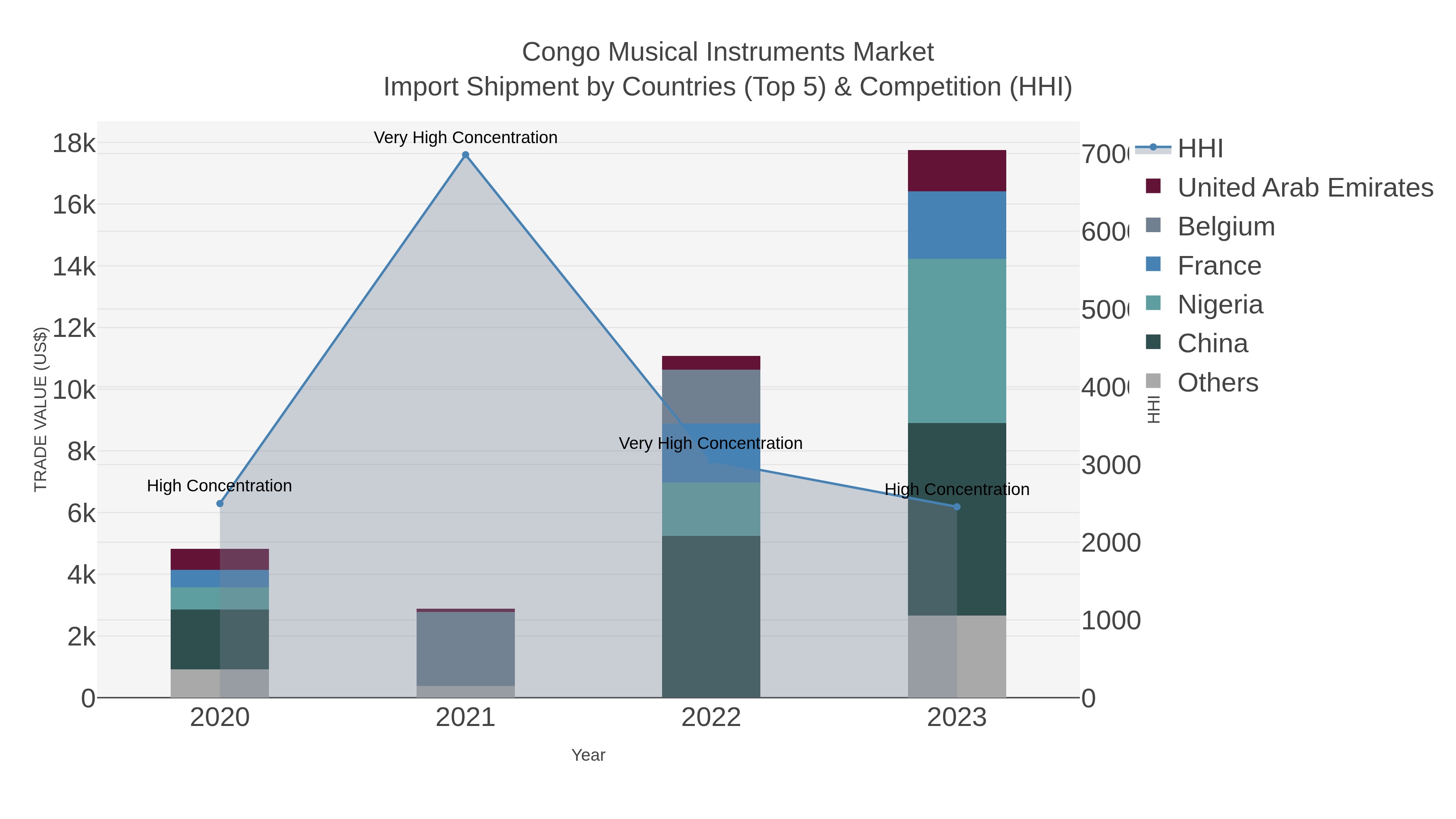
The Congo musical instruments import market saw a significant shift in 2023, with top exporters including China, Nigeria, France, Turkey, and the United Arab Emirates. The market concentration, as measured by the Herfindahl-Hirschman Index (HHI), decreased from very high to high, indicating a more diversified import landscape. The impressive compound annual growth rate (CAGR) of 54.35% and a growth rate of 60.28% highlight the robust expansion of the market, presenting lucrative opportunities for both exporters and importers in the musical instruments industry.
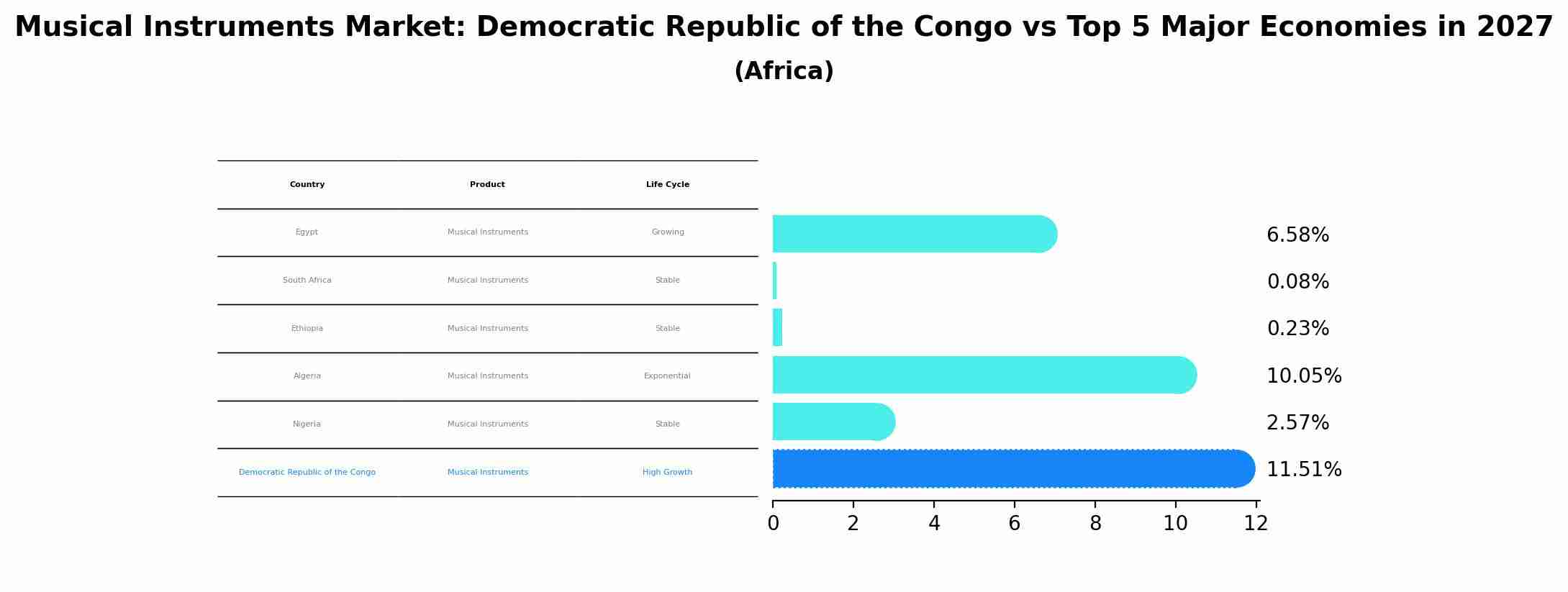
Musical Instruments Market: Democratic Republic of the Congo vs Top 5 Major Economies in 2027 (Africa)
In the Africa region, the Musical Instruments market in Democratic Republic of the Congo is projected to expand at a high growth rate of 11.51% by 2027. The largest economy is Egypt, followed by South Africa, Ethiopia, Algeria and Nigeria.
Congo Musical Instruments Market Overview
The musical instruments market in Congo is seeing steady growth as more people engage in music education and recreational activities. Traditional Congolese instruments, along with modern ones like guitars, keyboards, and drums, are in demand. The market is supported by a growing interest in music as a form of cultural expression and the rising popularity of live music performances.
Drivers of the market
The Congo musical instruments market is driven by the rising interest in music education and the growing popularity of live music performances. Increased disposable incomes and the cultural significance of music in Congo contribute to the demand for musical instruments. Additionally, the growth of online retail channels has made musical instruments more accessible to consumers.
Challenges of the market
In the Congo musical instruments market, challenges stem from the high cost of imported instruments and limited local manufacturing capabilities. The market also suffers from low consumer purchasing power and a lack of music education programs that could drive demand for musical instruments.
Government Policy of the market
The governments cultural policies that promote traditional and modern music are supporting the growth of the musical instruments market in Congo. Initiatives to boost local production and reduce import duties on musical instruments are aiding in market expansion.
Key Highlights of the Report:
- Congo Musical Instruments Market Outlook
- Market Size of Congo Musical Instruments Market, 2024
- Forecast of Congo Musical Instruments Market, 2031
- Historical Data and Forecast of Congo Musical Instruments Revenues & Volume for the Period 2021-2031
- Congo Musical Instruments Market Trend Evolution
- Congo Musical Instruments Market Drivers and Challenges
- Congo Musical Instruments Price Trends
- Congo Musical Instruments Porter`s Five Forces
- Congo Musical Instruments Industry Life Cycle
- Historical Data and Forecast of Congo Musical Instruments Market Revenues & Volume By Type for the Period 2021-2031
- Historical Data and Forecast of Congo Musical Instruments Market Revenues & Volume By Percussion Instruments for the Period 2021-2031
- Historical Data and Forecast of Congo Musical Instruments Market Revenues & Volume By String Instruments for the Period 2021-2031
- Historical Data and Forecast of Congo Musical Instruments Market Revenues & Volume By Piano & Key Instruments for the Period 2021-2031
- Historical Data and Forecast of Congo Musical Instruments Market Revenues & Volume By Organs & Air Blown Instruments for the Period 2021-2031
- Historical Data and Forecast of Congo Musical Instruments Market Revenues & Volume By Others for the Period 2021-2031
- Historical Data and Forecast of Congo Musical Instruments Market Revenues & Volume By End-users for the Period 2021-2031
- Historical Data and Forecast of Congo Musical Instruments Market Revenues & Volume By Commercial Events for the Period 2021-2031
- Historical Data and Forecast of Congo Musical Instruments Market Revenues & Volume By Personal Use for the Period 2021-2031
- Historical Data and Forecast of Congo Musical Instruments Market Revenues & Volume By Music Production/ Direction for the Period 2021-2031
- Historical Data and Forecast of Congo Musical Instruments Market Revenues & Volume By Others for the Period 2021-2031
- Congo Musical Instruments Import Export Trade Statistics
- Market Opportunity Assessment By Type
- Market Opportunity Assessment By End-users
- Congo Musical Instruments Top Companies Market Share
- Congo Musical Instruments Competitive Benchmarking By Technical and Operational Parameters
- Congo Musical Instruments Company Profiles
- Congo Musical Instruments Key Strategic Recommendations






































