Congo Organic Personal Care and Cosmetic Products Market: Top 5 Importing Countries and Market Competition (HHI) Analysis
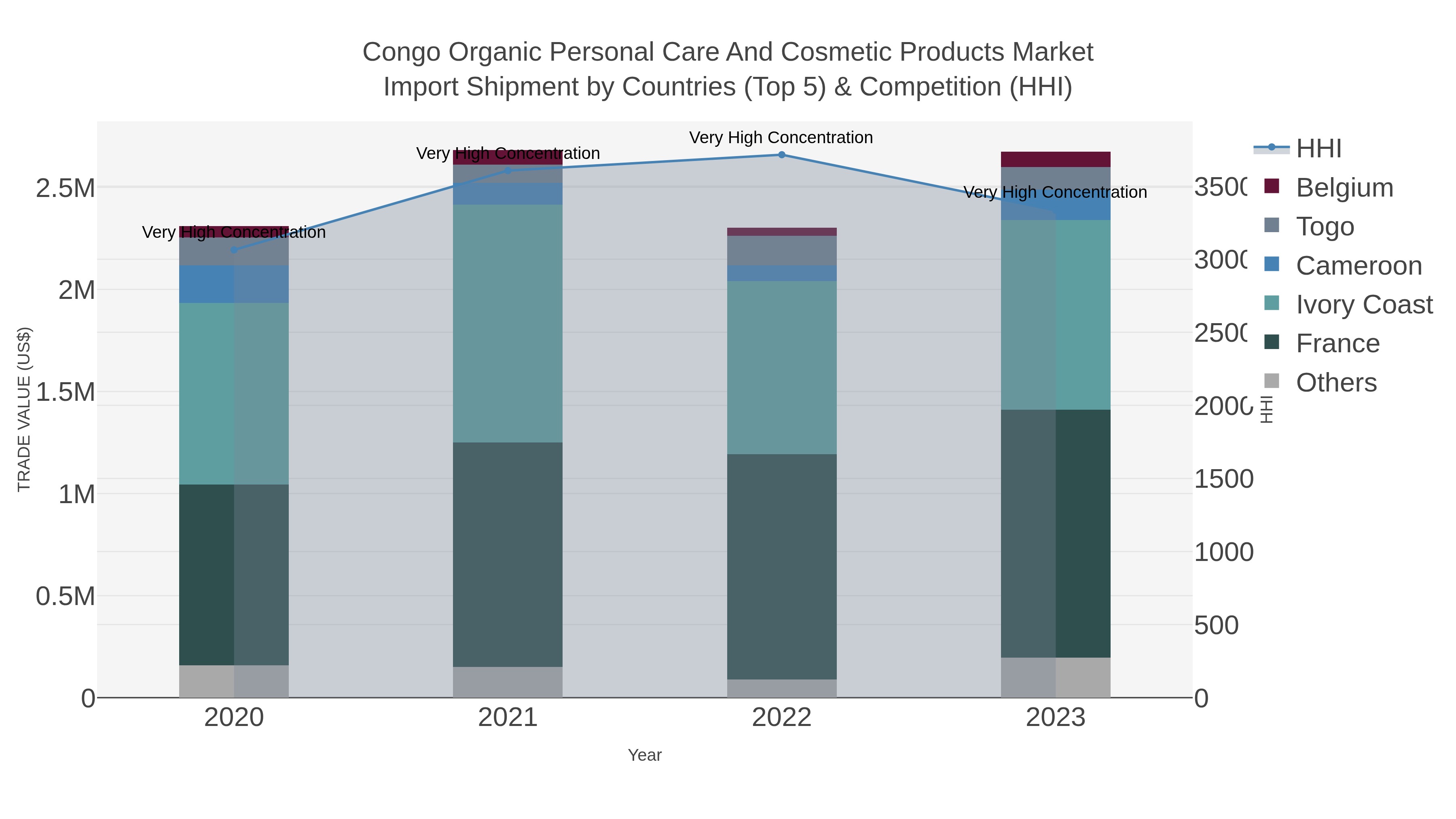
The import shipments of organic personal care and cosmetic products to Congo saw significant growth in 2023, with top exporters including France, Ivory Coast, Cameroon, Togo, and Belgium. The high Herfindahl-Hirschman Index (HHI) indicates a concentrated market, while the compound annual growth rate (CAGR) of 5.0% and growth rate of 16.19% reflect a strong and expanding demand for organic products in the region. Congo market for organic personal care and cosmetic products continues to show promising growth potential for exporters and businesses looking to capitalize on the trend towards natural and sustainable products.
Congo Organic Personal Care And Cosmetic Products Market Overview
The organic personal care and cosmetic products market in Congo is expanding as consumers increasingly seek natural and environmentally friendly alternatives to conventional beauty products. This market includes organic skincare, haircare, and cosmetics that are free from synthetic chemicals and additives. The rise in awareness about the benefits of organic products and the growing trend towards sustainable and ethical consumerism are key drivers of market growth.
Drivers of the market
The Congo organic personal care and cosmetic products market is driven by the rising consumer preference for natural and eco-friendly beauty and skincare products. Increasing awareness of the benefits of organic ingredients and the desire to avoid synthetic chemicals fuel the demand for organic personal care products. The growth of the organic beauty industry is supported by trends towards sustainability and ethical consumerism. Additionally, the expanding retail distribution channels and the introduction of innovative organic formulations contribute to market growth.
Challenges of the market
Challenges in the Congo organic personal care and cosmetic products market include limited access to high-quality organic raw materials and the lack of established supply chains. Regulatory hurdles and varying standards for organic certifications can create additional difficulties. Moreover, consumer awareness and education about organic products are relatively low, affecting market growth.
Government Policy of the market
Government policies in the Congo organic personal care and cosmetic products market are focused on promoting health and safety standards for consumer products. The government regulates the labeling and certification of organic products to ensure they meet established standards. Policies also support the development of the organic sector through incentives for local producers and importers. Additionally, there are initiatives to raise consumer awareness about the benefits of organic personal care products and encourage their use.
Key Highlights of the Report:
- Congo Organic Personal Care And Cosmetic Products Market Outlook
- Market Size of Congo Organic Personal Care And Cosmetic Products Market, 2024
- Forecast of Congo Organic Personal Care And Cosmetic Products Market, 2031
- Historical Data and Forecast of Congo Organic Personal Care And Cosmetic Products Revenues & Volume for the Period 2021-2031
- Congo Organic Personal Care And Cosmetic Products Market Trend Evolution
- Congo Organic Personal Care And Cosmetic Products Market Drivers and Challenges
- Congo Organic Personal Care And Cosmetic Products Price Trends
- Congo Organic Personal Care And Cosmetic Products Porter`s Five Forces
- Congo Organic Personal Care And Cosmetic Products Industry Life Cycle
- Historical Data and Forecast of Congo Organic Personal Care And Cosmetic Products Market Revenues & Volume By Product Type for the Period 2021-2031
- Historical Data and Forecast of Congo Organic Personal Care And Cosmetic Products Market Revenues & Volume By Skin Care for the Period 2021-2031
- Historical Data and Forecast of Congo Organic Personal Care And Cosmetic Products Market Revenues & Volume By Hair Care for the Period 2021-2031
- Historical Data and Forecast of Congo Organic Personal Care And Cosmetic Products Market Revenues & Volume By Oral Care for the Period 2021-2031
- Historical Data and Forecast of Congo Organic Personal Care And Cosmetic Products Market Revenues & Volume By Makeup and Color Cosmetics for the Period 2021-2031
- Historical Data and Forecast of Congo Organic Personal Care And Cosmetic Products Market Revenues & Volume By Others for the Period 2021-2031
- Historical Data and Forecast of Congo Organic Personal Care And Cosmetic Products Market Revenues & Volume By Consumer for the Period 2021-2031
- Historical Data and Forecast of Congo Organic Personal Care And Cosmetic Products Market Revenues & Volume By Men for the Period 2021-2031
- Historical Data and Forecast of Congo Organic Personal Care And Cosmetic Products Market Revenues & Volume By Women for the Period 2021-2031
- Historical Data and Forecast of Congo Organic Personal Care And Cosmetic Products Market Revenues & Volume By Distribution channel for the Period 2021-2031
- Historical Data and Forecast of Congo Organic Personal Care And Cosmetic Products Market Revenues & Volume By Supermarkets and Hypermarkets for the Period 2021-2031
- Historical Data and Forecast of Congo Organic Personal Care And Cosmetic Products Market Revenues & Volume By Departmental stores for the Period 2021-2031
- Historical Data and Forecast of Congo Organic Personal Care And Cosmetic Products Market Revenues & Volume By Drug Stores for the Period 2021-2031
- Historical Data and Forecast of Congo Organic Personal Care And Cosmetic Products Market Revenues & Volume By Brand Outlets for the Period 2021-2031
- Historical Data and Forecast of Congo Organic Personal Care And Cosmetic Products Market Revenues & Volume By Online Sales for the Period 2021-2031
- Historical Data and Forecast of Congo Organic Personal Care And Cosmetic Products Market Revenues & Volume By Others for the Period 2021-2031
- Congo Organic Personal Care And Cosmetic Products Import Export Trade Statistics
- Market Opportunity Assessment By Product Type
- Market Opportunity Assessment By Consumer
- Market Opportunity Assessment By Distribution channel
- Congo Organic Personal Care And Cosmetic Products Top Companies Market Share
- Congo Organic Personal Care And Cosmetic Products Competitive Benchmarking By Technical and Operational Parameters
- Congo Organic Personal Care And Cosmetic Products Company Profiles
- Congo Organic Personal Care And Cosmetic Products Key Strategic Recommendations






































