Congo Polypropylene Market: Top 5 Importing Countries and Market Competition (HHI) Analysis
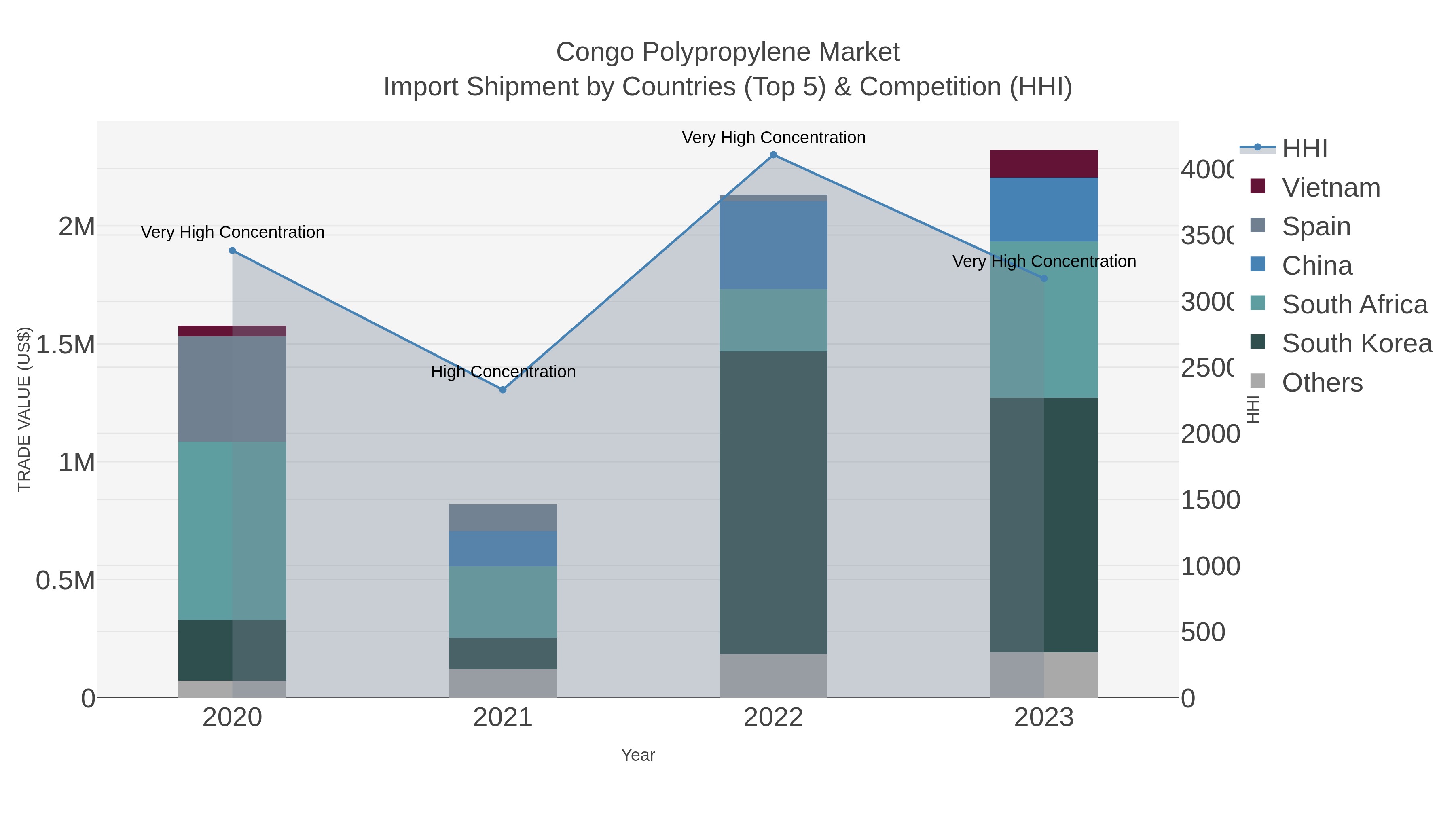
In 2023, Congo continued to see a significant influx of polypropylene import shipments, with key exporters including South Korea, South Africa, China, Vietnam, and Taiwan. The high Herfindahl-Hirschman Index (HHI) indicates a concentrated market, with limited competition among suppliers. The compound annual growth rate (CAGR) of 13.73% reflects a strong upward trend in demand for polypropylene in Congo. With a growth rate of 8.85%, this market shows promising opportunities for exporters looking to tap into the growing demand for polypropylene in the region.
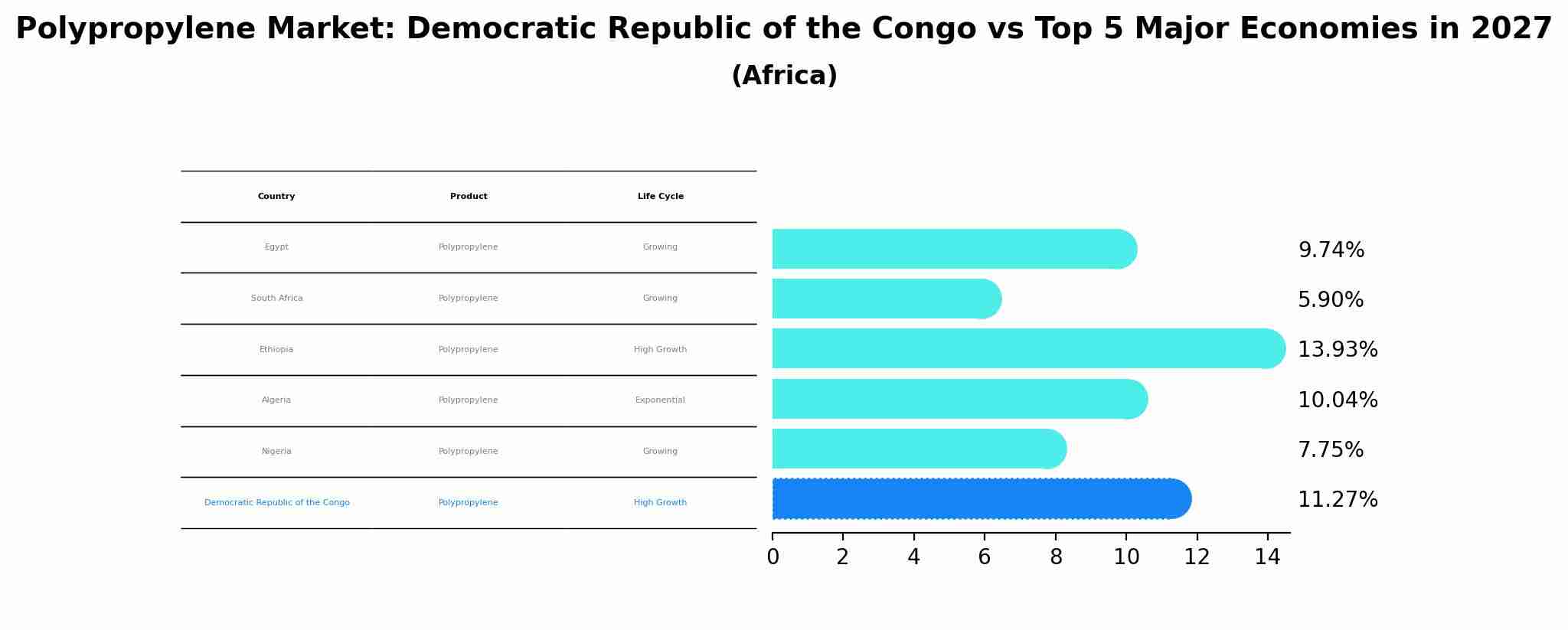
Polypropylene Market: Democratic Republic of the Congo vs Top 5 Major Economies in 2027 (Africa)
By 2027, Democratic Republic of the Congo's Polypropylene market is forecasted to achieve a high growth rate of 11.27%, with Egypt leading the Africa region, followed by South Africa, Ethiopia, Algeria and Nigeria.
Congo Polypropylene Market Overview
The Congo polypropylene market is influenced by the rising demand for polypropylene in various end-use industries, including packaging, automotive, and textiles. Polypropylene is valued for its versatility, durability, and cost-effectiveness. Market growth is supported by increasing industrialization and urbanization in Congo, leading to higher consumption of polypropylene-based products. However, the market faces challenges related to volatile raw material prices and competition from alternative materials.
Drivers of the market
The Congo polypropylene market is influenced by the increasing demand for polypropylene in various applications, including automotive parts, packaging materials, and textiles. The automotive industry`s growth drives the need for lightweight and durable polypropylene components. Additionally, the packaging sector benefits from polypropylene`s versatility and cost-effectiveness. The market is also supported by innovations in polypropylene production technologies and the development of new applications for polypropylene in different industries.
Challenges of the market
The Congo polypropylene market is challenged by the high cost and limited availability of raw materials. The local production capacity is insufficient to meet demand, leading to reliance on imports, which can be affected by fluctuating international prices and supply chain disruptions. Furthermore, the lack of local recycling infrastructure for polypropylene waste creates environmental and economic issues.
Government Policy of the market
In the broader polypropylene market, government policies aim to boost the local production and processing of polypropylene products. This includes financial incentives for manufacturers, investment in infrastructure, and support for research and development. The government also enforces regulations to ensure that polypropylene products meet safety and environmental standards. There are also efforts to diversify the polypropylene supply chain to reduce reliance on imports.
Key Highlights of the Report:
- Congo Polypropylene Market Outlook
- Market Size of Congo Polypropylene Market, 2024
- Forecast of Congo Polypropylene Market, 2031
- Historical Data and Forecast of Congo Polypropylene Revenues & Volume for the Period 2021-2031
- Congo Polypropylene Market Trend Evolution
- Congo Polypropylene Market Drivers and Challenges
- Congo Polypropylene Price Trends
- Congo Polypropylene Porter`s Five Forces
- Congo Polypropylene Industry Life Cycle
- Historical Data and Forecast of Congo Polypropylene Market Revenues & Volume By Type for the Period 2021-2031
- Historical Data and Forecast of Congo Polypropylene Market Revenues & Volume By Homopolymer for the Period 2021-2031
- Historical Data and Forecast of Congo Polypropylene Market Revenues & Volume By Copolymer for the Period 2021-2031
- Historical Data and Forecast of Congo Polypropylene Market Revenues & Volume By Application for the Period 2021-2031
- Historical Data and Forecast of Congo Polypropylene Market Revenues & Volume By Injection Molding for the Period 2021-2031
- Historical Data and Forecast of Congo Polypropylene Market Revenues & Volume By Fiber & Raffia for the Period 2021-2031
- Historical Data and Forecast of Congo Polypropylene Market Revenues & Volume By Film & Sheet for the Period 2021-2031
- Historical Data and Forecast of Congo Polypropylene Market Revenues & Volume By Blow Molding for the Period 2021-2031
- Historical Data and Forecast of Congo Polypropylene Market Revenues & Volume By End-use Industry for the Period 2021-2031
- Historical Data and Forecast of Congo Polypropylene Market Revenues & Volume By Packaging for the Period 2021-2031
- Historical Data and Forecast of Congo Polypropylene Market Revenues & Volume By Automotive for the Period 2021-2031
- Historical Data and Forecast of Congo Polypropylene Market Revenues & Volume By Building & Construction for the Period 2021-2031
- Historical Data and Forecast of Congo Polypropylene Market Revenues & Volume By Electrical & Electronics for the Period 2021-2031
- Historical Data and Forecast of Congo Polypropylene Market Revenues & Volume By Medical for the Period 2021-2031
- Congo Polypropylene Import Export Trade Statistics
- Market Opportunity Assessment By Type
- Market Opportunity Assessment By Application
- Market Opportunity Assessment By End-use Industry
- Congo Polypropylene Top Companies Market Share
- Congo Polypropylene Competitive Benchmarking By Technical and Operational Parameters
- Congo Polypropylene Company Profiles
- Congo Polypropylene Key Strategic Recommendations






































