Croatia Artificial Turf Market Size (2020-2030)
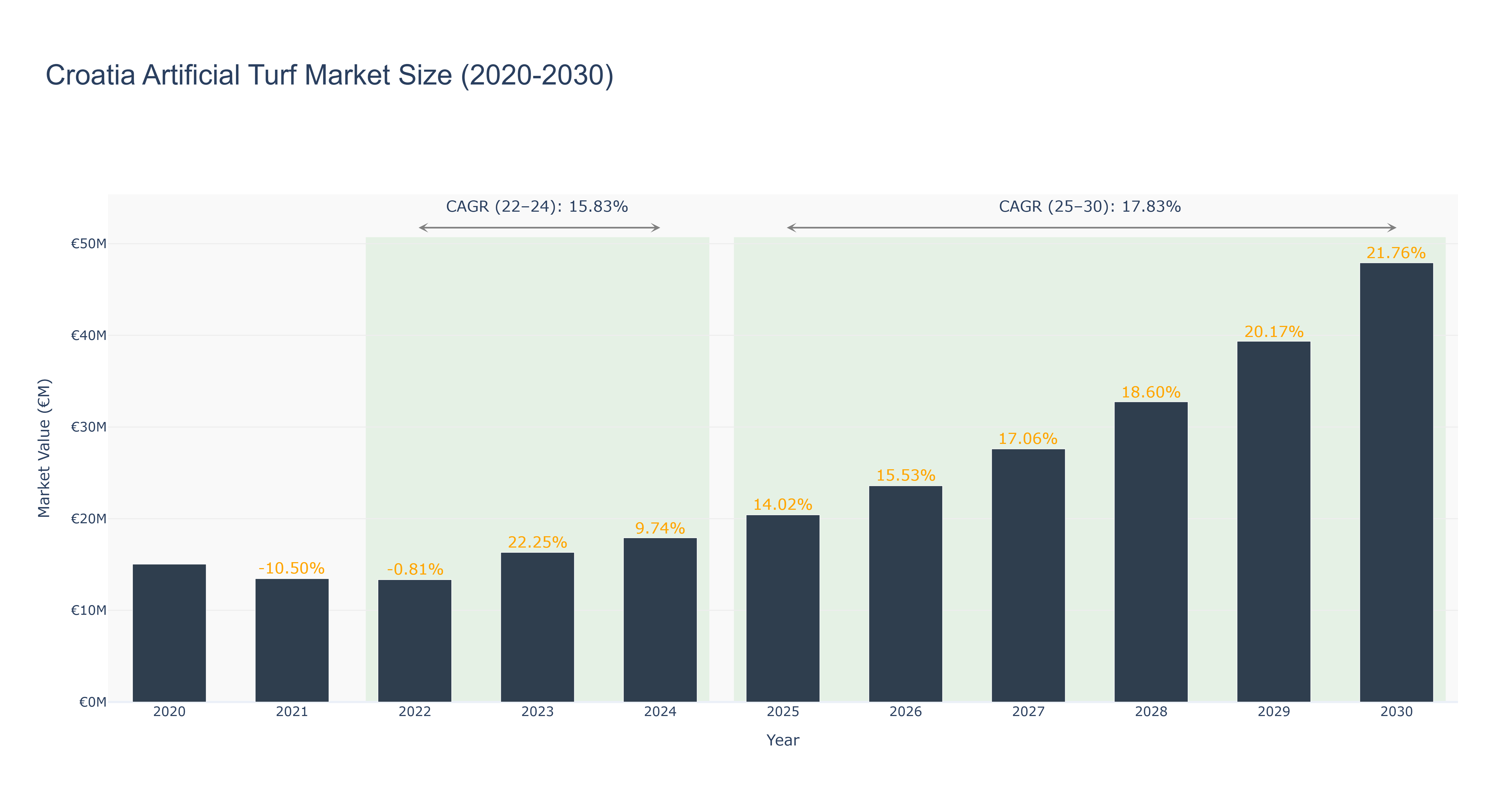
The Croatia Artificial Turf Market experienced fluctuations from 2020 to 2024, peaking in 2020 at €15.03 million before declining to €13.35 million in 2022, reflecting a negative growth trend of -10.50% in 2021 and a slight decline of -0.81% in 2022. However, a significant rebound occurred in 2023, with market size reaching €16.32 million, driven by increased investments in sports infrastructure and a growing preference for artificial turf in recreational areas. Looking ahead, the forecasted period from 2025 to 2030 anticipates robust growth, with a projected market size of €47.91 million by 2030 and a compound annual growth rate (CAGR) of 17.83%. Factors such as ongoing urban development projects and rising demand for sustainable turf solutions are expected to propel this market further. Overall, the Croatia Artificial Turf Market is set for a dynamic transformation, driven by evolving consumer preferences and infrastructural advancements.
Croatia Artificial Turf Market: Production & Trade Performance (2019-2025)
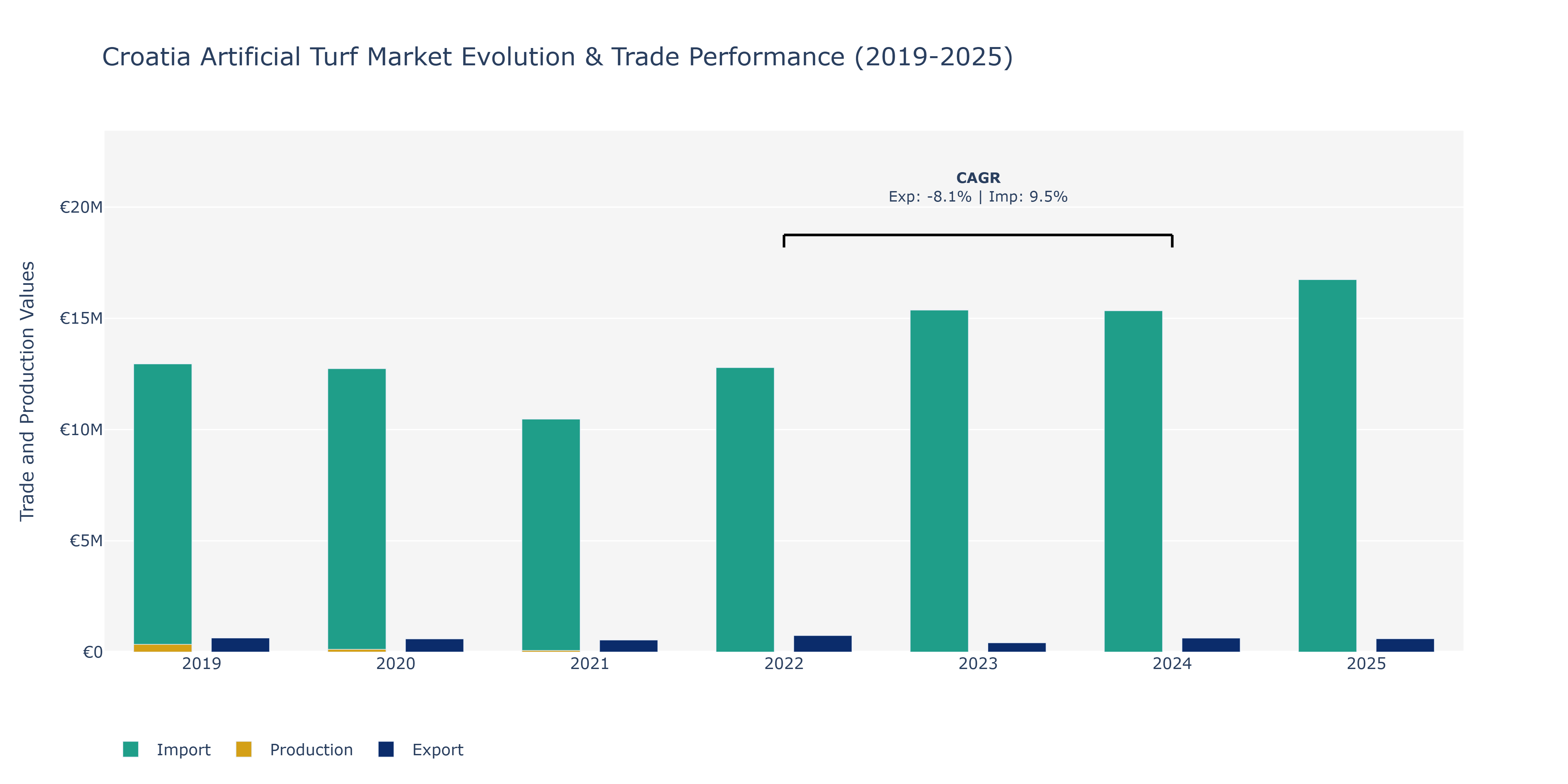
In the Croatia Artificial Turf Market, exports experienced fluctuations over the years, with a peak in 2022 at €742.77 thousand, followed by a decrease in 2023 to €413.4 thousand, then a slight recovery in 2024 to €627.35 thousand. Conversely, imports steadily increased from €12.95 million in 2019 to €16.74 million in 2025, showing a consistent upward trend. Production value showed a notable decline from €343.42 million in 2019 to €69.00 million in 2021 before stabilizing. The rise in imports can be attributed to the growing demand for artificial turf in various sectors, including sports and landscaping, reflecting Croatia's increasing urban development and infrastructure projects. On the other hand, the fluctuating Export value may be influenced by global market conditions, trade agreements, and domestic production capacity constraints.
Key Highlights of the Report:
- Croatia Artificial Turf Market Outlook
- Market Size of Croatia Artificial Turf Market, 2024
- Forecast of Croatia Artificial Turf Market, 2031
- Historical Data and Forecast of Croatia Artificial Turf Revenues & Volume for the Period 2021- 2031
- Croatia Artificial Turf Market Trend Evolution
- Croatia Artificial Turf Market Drivers and Challenges
- Croatia Artificial Turf Price Trends
- Croatia Artificial Turf Porter's Five Forces
- Croatia Artificial Turf Industry Life Cycle
- Historical Data and Forecast of Croatia Artificial Turf Market Revenues & Volume By Material for the Period 2021- 2031
- Historical Data and Forecast of Croatia Artificial Turf Market Revenues & Volume By Polyethylene for the Period 2021- 2031
- Historical Data and Forecast of Croatia Artificial Turf Market Revenues & Volume By Polypropylene for the Period 2021- 2031
- Historical Data and Forecast of Croatia Artificial Turf Market Revenues & Volume By Nylon for the Period 2021- 2031
- Historical Data and Forecast of Croatia Artificial Turf Market Revenues & Volume By Application for the Period 2021- 2031
- Historical Data and Forecast of Croatia Artificial Turf Market Revenues & Volume By Residential for the Period 2021- 2031
- Historical Data and Forecast of Croatia Artificial Turf Market Revenues & Volume By Commercial for the Period 2021- 2031
- Historical Data and Forecast of Croatia Artificial Turf Market Revenues & Volume By Sports for the Period 2021- 2031
- Croatia Artificial Turf Import Export Trade Statistics
- Market Opportunity Assessment By Material
- Market Opportunity Assessment By Application
- Croatia Artificial Turf Top Companies Market Share
- Croatia Artificial Turf Competitive Benchmarking By Technical and Operational Parameters
- Croatia Artificial Turf Company Profiles
- Croatia Artificial Turf Key Strategic Recommendations






































