Croatia Canned Tuna Market Size (2020-2030)
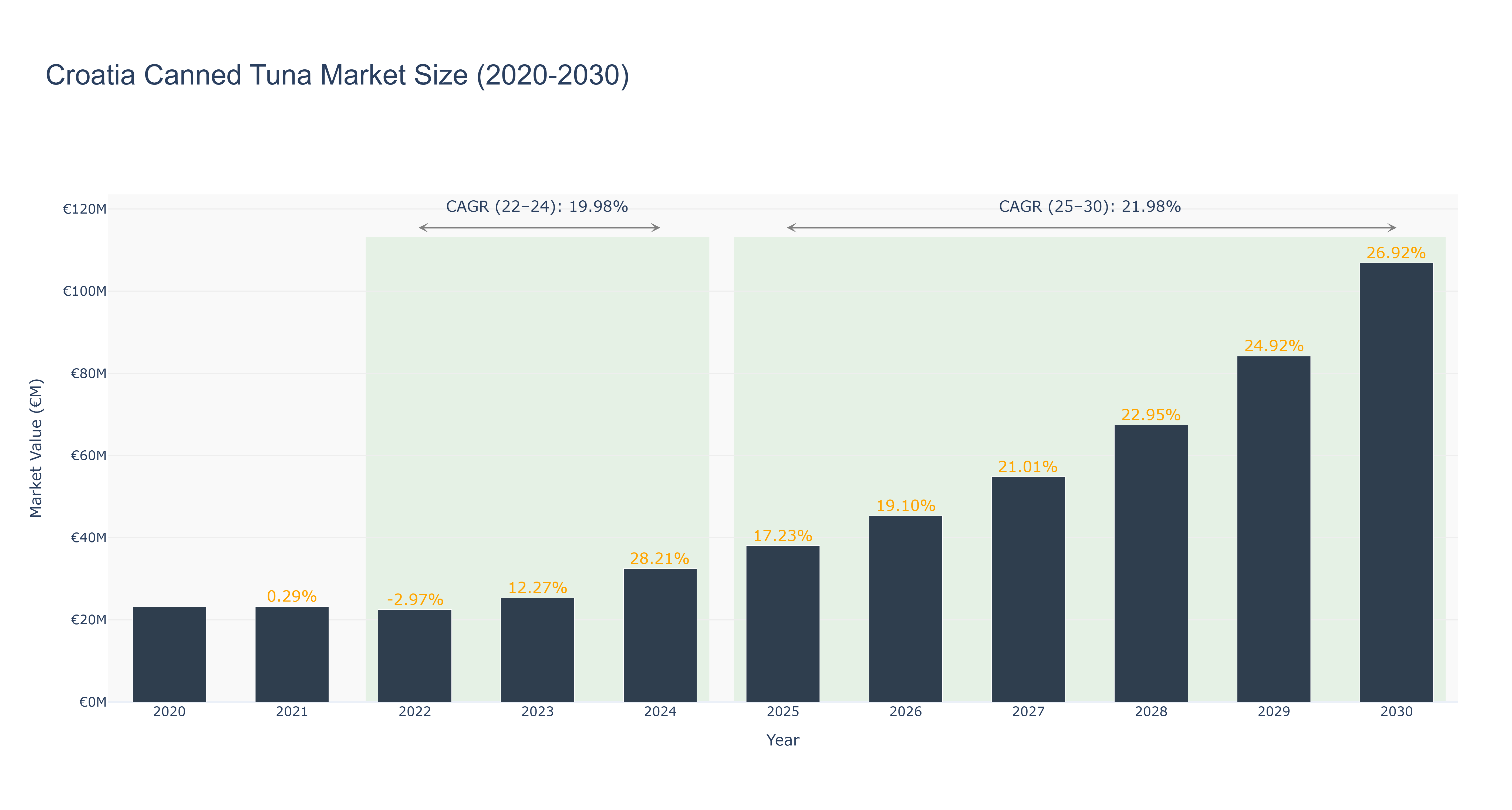
The Croatia Canned Tuna Market has experienced fluctuations in recent years, peaking at €25.31 million in 2023 after a decline to €22.55 million in 2022. The actual market growth from 2022 to 2024 is projected at a robust CAGR of 19.98%, driven by increasing consumer demand for convenient and healthy food options, alongside rising awareness of sustainability in seafood sourcing. Moving into the forecasted period from 2025 to 2030, the market is expected to expand significantly, with a projected CAGR of 21.98%, reaching €106.90 million by 2030. This growth will likely be supported by innovations in product offerings, enhancements in distribution channels, and potential investments in production technologies. As consumers continue to prioritize quality and sustainability, the Croatian canned tuna market is well-positioned for strong growth in the coming years, reflecting broader trends in the food and beverage industry.
Croatia Canned Tuna Market: Production & Trade Performance (2019-2025)
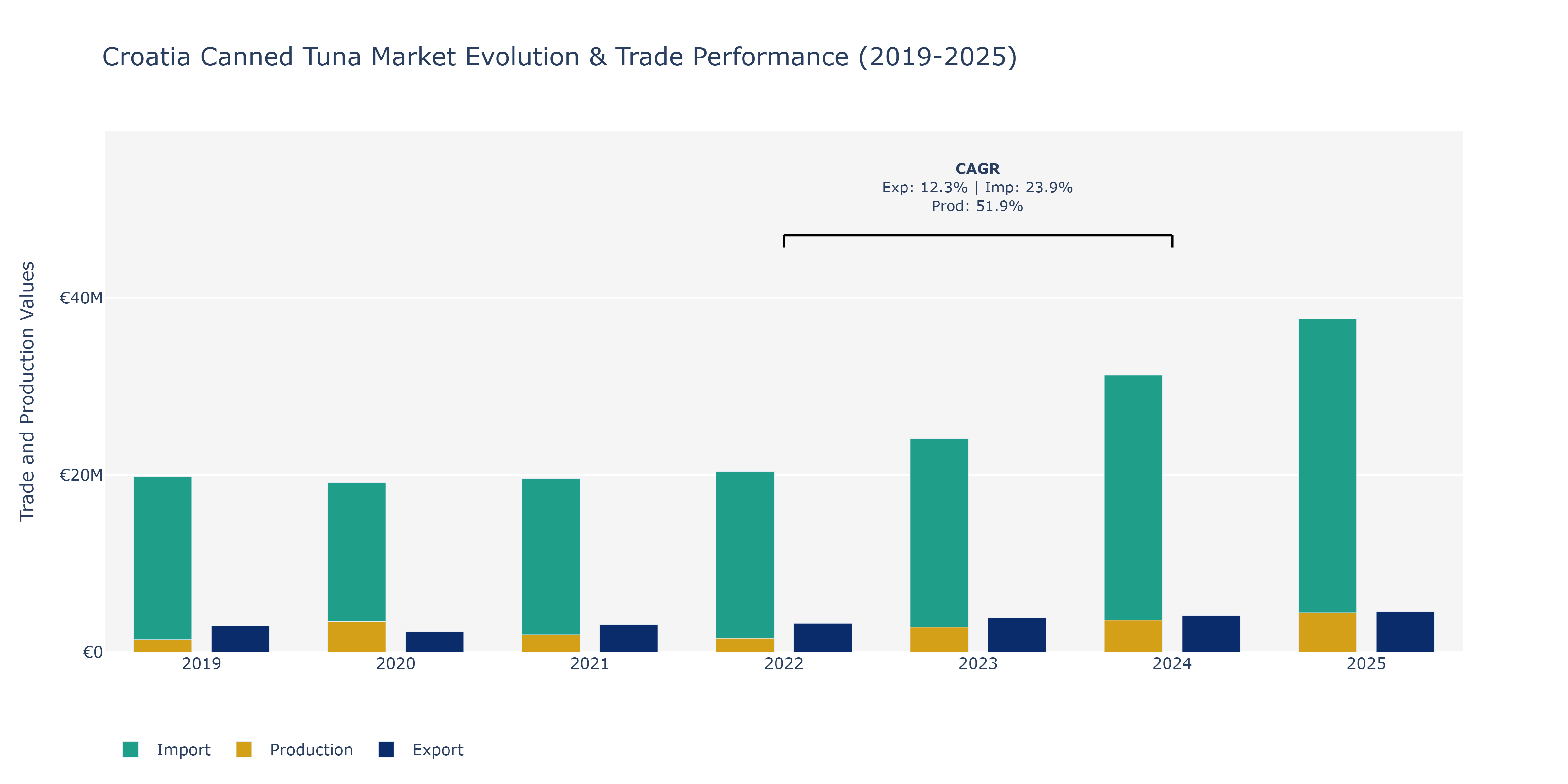
Between 2019 and 2025, Croatia's Canned Tuna Market witnessed varying performances in exports, imports, and production. In 2019, exports were at €2.95 million, dropping to €2.27 million in 2020 before gradually rising to a peak of €4.57 million in 2025. Conversely, imports demonstrated a consistent uptrend, starting at €19.81 million in 2019 and reaching €37.61 million in 2025. Production, on the other hand, experienced fluctuations, with a notable decline from €3.46 million in 2020 to €1.93 million in 2021, before surging to €4.45 million in 2025. The significant growth in production from 2021 to 2025 can be attributed to increased demand for canned tuna globally, coupled with technological advancements in the processing industry, allowing for higher output levels. The surge in imports can be linked to Croatia's expanding consumer market and possibly shifts in domestic seafood production capabilities. The fluctuations in exports could be influenced by global market conditions, trade agreements, and shifts in consumer preferences towards sustainable seafood options. To sustain this positive momentum, Croatian tuna producers may need to focus on product quality, innovation, and market diversification strategies to stay competitive in the global market landscape.
Croatia Canned Tuna Market Overview
Croatias canned tuna market is a key segment of its seafood industry, supplying both domestic and export markets. Tuna is a popular food product globally, and Croatias canned tuna market benefits from sustainable fishing practices and processing capabilities.
Drivers of the market
The growing preference for healthy, protein-rich foods is driving the demand for canned tuna in Croatia. The convenience, long shelf-life, and versatility of canned tuna make it a popular choice among consumers, contributing to the expansion of this market.
Challenges of the market
The canned tuna market in Croatia faces challenges related to raw material sourcing and regulatory compliance. The availability and price of tuna can be affected by global fishing practices and market conditions, impacting production costs and supply stability. Additionally, the market must adhere to strict food safety and labeling regulations, which can increase compliance costs. Competition from both local and international brands, along with changing consumer preferences, adds further complexity. Balancing cost-effectiveness with regulatory compliance and market demand is a key challenge for the industry.
Government Policy of the market
Regulations concerning food safety and sustainable fishing practices impact the canned tuna market in Croatia. The government enforces EU standards on product labeling, traceability, and environmental sustainability to ensure responsible sourcing and consumer safety.
Key Highlights of the Report:
- Croatia Canned Tuna Market Outlook
- Market Size of Croatia Canned Tuna Market, 2024
- Forecast of Croatia Canned Tuna Market, 2031
- Historical Data and Forecast of Croatia Canned Tuna Revenues & Volume for the Period 2021-2031
- Croatia Canned Tuna Market Trend Evolution
- Croatia Canned Tuna Market Drivers and Challenges
- Croatia Canned Tuna Price Trends
- Croatia Canned Tuna Porter`s Five Forces
- Croatia Canned Tuna Industry Life Cycle
- Historical Data and Forecast of Croatia Canned Tuna Market Revenues & Volume By Product for the Period 2021-2031
- Historical Data and Forecast of Croatia Canned Tuna Market Revenues & Volume By Skipjack for the Period 2021-2031
- Historical Data and Forecast of Croatia Canned Tuna Market Revenues & Volume By Yellowfin for the Period 2021-2031
- Historical Data and Forecast of Croatia Canned Tuna Market Revenues & Volume By Others for the Period 2021-2031
- Historical Data and Forecast of Croatia Canned Tuna Market Revenues & Volume By Distribution Channel for the Period 2021-2031
- Historical Data and Forecast of Croatia Canned Tuna Market Revenues & Volume By Hypermarket & Supermarket for the Period 2021-2031
- Historical Data and Forecast of Croatia Canned Tuna Market Revenues & Volume By Specialty Stores for the Period 2021-2031
- Historical Data and Forecast of Croatia Canned Tuna Market Revenues & Volume By Online for the Period 2021-2031
- Croatia Canned Tuna Import Export Trade Statistics
- Market Opportunity Assessment By Product
- Market Opportunity Assessment By Distribution Channel
- Croatia Canned Tuna Top Companies Market Share
- Croatia Canned Tuna Competitive Benchmarking By Technical and Operational Parameters
- Croatia Canned Tuna Company Profiles
- Croatia Canned Tuna Key Strategic Recommendations






































