Croatia Cyclohexane Market Size (2020-2030)
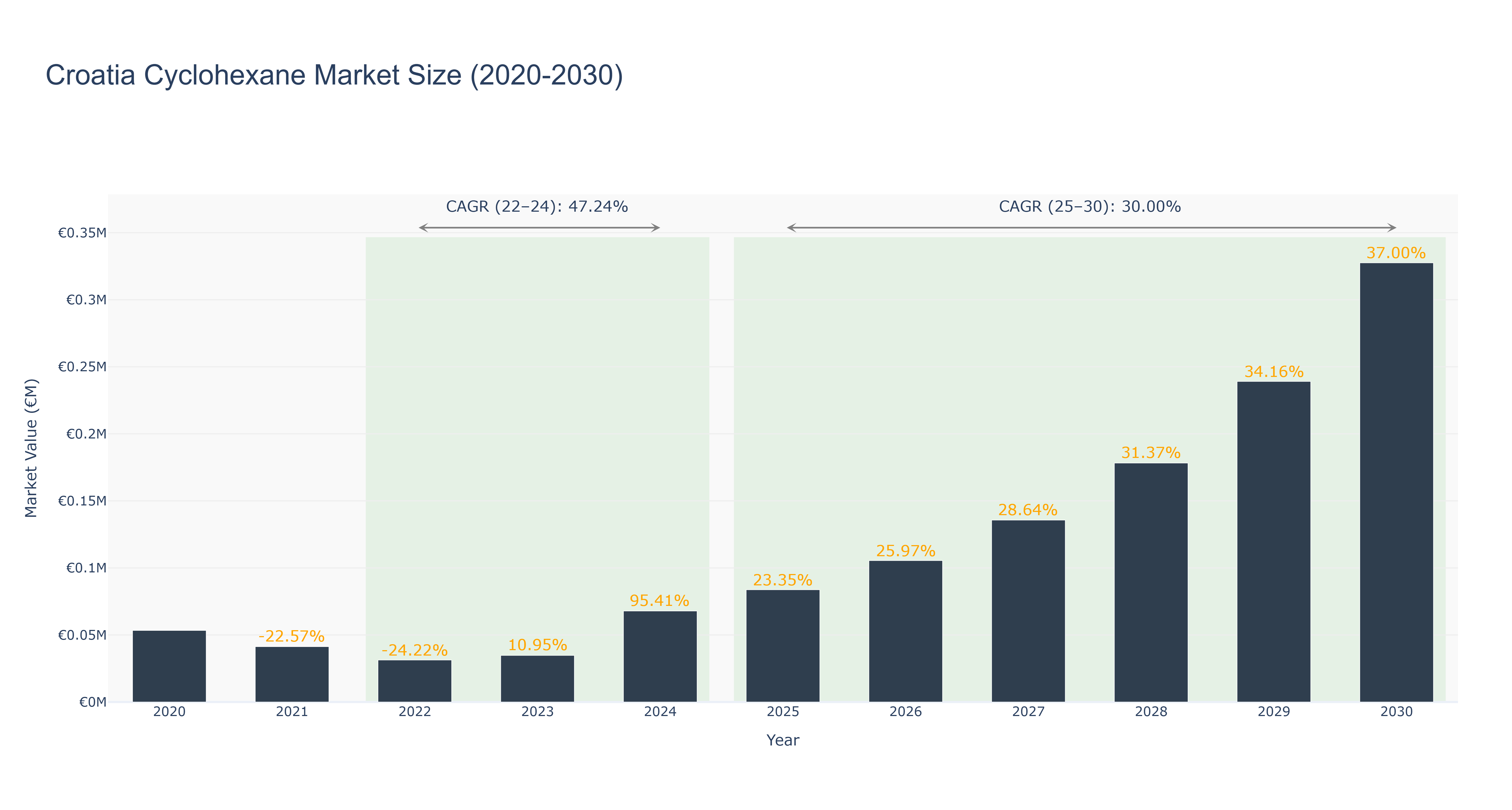
Croatia Cyclohexane Market has shown a fluctuating trend over the years. The market peaked in 2030 with a size of €0.33 million, exhibiting a steady growth trajectory. From 2020 to 2024, the market size declined from €0.05 million to €0.07 million, attributed to economic downturns and global market challenges. However, from 2025 to 2030, the market is forecasted to grow significantly, with a Compound Annual Growth Rate (CAGR) of 30.0%. The CAGR for the period 2022-24 was 47.24%, indicating a rapid recovery phase post the initial decline. Industry drivers such as technological advancements and increasing demand for cyclohexane derivatives are fueling this growth. Looking ahead, Croatia is set to launch a national initiative promoting sustainable production practices in the chemical industry, aiming to further boost market expansion and competitiveness.
Croatia Cyclohexane Market: Production & Trade Performance (2019-2025)
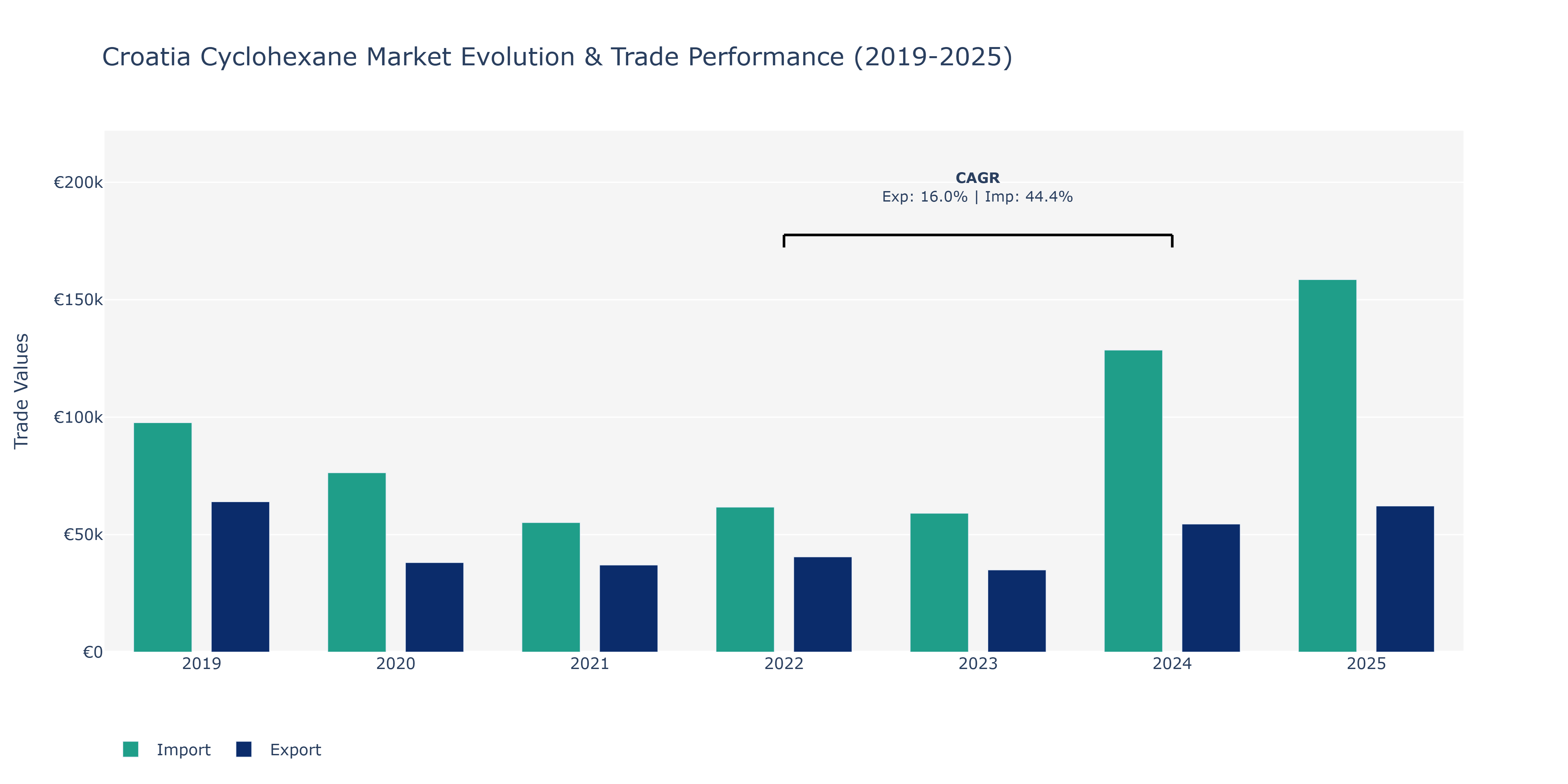
Between 2019 and 2025, Croatia's Cyclohexane Market witnessed varying trends in exports and imports. In 2019, exports stood at €63.96 thousand, declining to €37.04 thousand in 2021 before rebounding to €54.47 thousand in 2024, marking a significant peak. Conversely, imports followed a different trajectory, decreasing from €97.63 thousand in 2019 to €55.12 thousand in 2021, before reaching a peak of €158.54 thousand in 2025. The sharp increase in imports could be attributed to growing domestic demand for cyclohexane, potentially driven by increased manufacturing or industrial activities requiring this chemical compound. On the export side, fluctuations could be related to shifts in global demand, price fluctuations, or changes in market dynamics impacting Croatia's competitiveness in the cyclohexane market. The impressive CAGR for imports during 2022-2024 at 44.37% suggests a significant surge in demand, potentially fueled by infrastructure development or increased production activities requiring cyclohexane as a key input.
Croatia Cyclohexane Market Overview
The cyclohexane market in Croatia focuses on a solvent and chemical intermediate used in the production of various chemicals and materials. Cyclohexane is used in the manufacture of nylon, adhesives, and coatings. The market is influenced by demand in the chemical industry, advancements in production processes, and trends in industrial applications.
Drivers of the market
The cyclohexane market in Croatia is driven by the demand for cyclohexane as a key raw material in the production of nylon and other chemical intermediates. Cyclohexane is used in the manufacture of adipic acid and caprolactam, which are essential for producing synthetic fibers and resins. The growth of the textile and automotive industries, which utilize nylon-based materials, contributes to market demand. Additionally, advancements in cyclohexane production technologies and the expansion of industrial activities in Croatia support the growth of the cyclohexane market.
Challenges of the market
The cyclohexane market in Croatia is affected by the volatility of crude oil prices, which drives up production costs. Additionally, stringent environmental regulations on the use of cyclohexane in manufacturing processes add compliance challenges for producers.
Government Policy of the market
The Croatian government regulates the cyclohexane market to ensure the safe production, handling, and environmental compliance of this chemical used in industrial applications. Policies include standards for product safety, quality, and environmental impact. The government supports research into alternative processes and provides incentives for businesses adopting sustainable practices in cyclohexane production.
Key Highlights of the Report:
- Croatia Cyclohexane Market Outlook
- Market Size of Croatia Cyclohexane Market, 2024
- Forecast of Croatia Cyclohexane Market, 2031
- Historical Data and Forecast of Croatia Cyclohexane Revenues & Volume for the Period 2021-2031
- Croatia Cyclohexane Market Trend Evolution
- Croatia Cyclohexane Market Drivers and Challenges
- Croatia Cyclohexane Price Trends
- Croatia Cyclohexane Porter`s Five Forces
- Croatia Cyclohexane Industry Life Cycle
- Historical Data and Forecast of Croatia Cyclohexane Market Revenues & Volume By Application for the Period 2021-2031
- Historical Data and Forecast of Croatia Cyclohexane Market Revenues & Volume By Adipic acid for the Period 2021-2031
- Historical Data and Forecast of Croatia Cyclohexane Market Revenues & Volume By Caprolactam for the Period 2021-2031
- Historical Data and Forecast of Croatia Cyclohexane Market Revenues & Volume By Others for the Period 2021-2031
- Historical Data and Forecast of Croatia Cyclohexane Market Revenues & Volume By End-use for the Period 2021-2031
- Historical Data and Forecast of Croatia Cyclohexane Market Revenues & Volume By Nylon 6 for the Period 2021-2031
- Historical Data and Forecast of Croatia Cyclohexane Market Revenues & Volume By Nylon 66 for the Period 2021-2031
- Historical Data and Forecast of Croatia Cyclohexane Market Revenues & Volume By Others for the Period 2021-2031
- Croatia Cyclohexane Import Export Trade Statistics
- Market Opportunity Assessment By Application
- Market Opportunity Assessment By End-use
- Croatia Cyclohexane Top Companies Market Share
- Croatia Cyclohexane Competitive Benchmarking By Technical and Operational Parameters
- Croatia Cyclohexane Company Profiles
- Croatia Cyclohexane Key Strategic Recommendations






































