Croatia Diesel Engine Market Size (2020-2030)
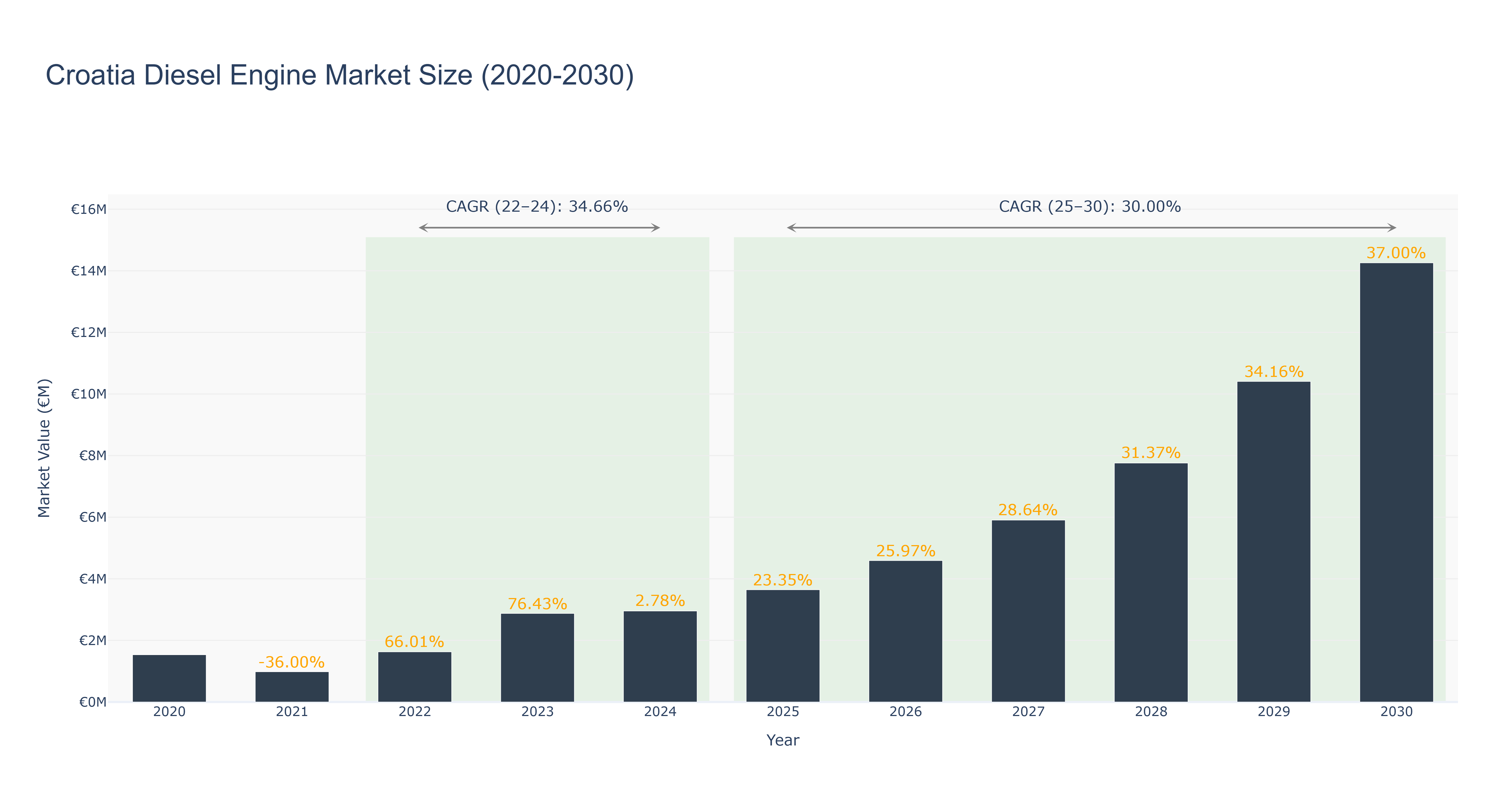
The Croatia Diesel Engine Market has demonstrated significant fluctuations over recent years, peaking at €2.95 million in 2024, following a decline to €981.37 thousand in 2021. The actual market witnessed a robust recovery from 2022 to 2024, with a CAGR of 34.66%, driven by a resurgence in demand for diesel engines amidst increasing infrastructural investments and a growing industrial sector. Looking ahead, the forecasted period from 2025 to 2030 anticipates a continued upward trajectory, with projected market sizes reaching €14.26 million in 2030 and a CAGR of 30.00%. This growth will likely be fueled by advancements in diesel technology and increased adoption of diesel engines in various applications, including transportation and agriculture. Additionally, the focus on energy efficiency and sustainability may further bolster market demand as companies seek to modernize their fleets and reduce emissions.
Croatia Diesel Engine Market: Production & Trade Performance (2019-2025)
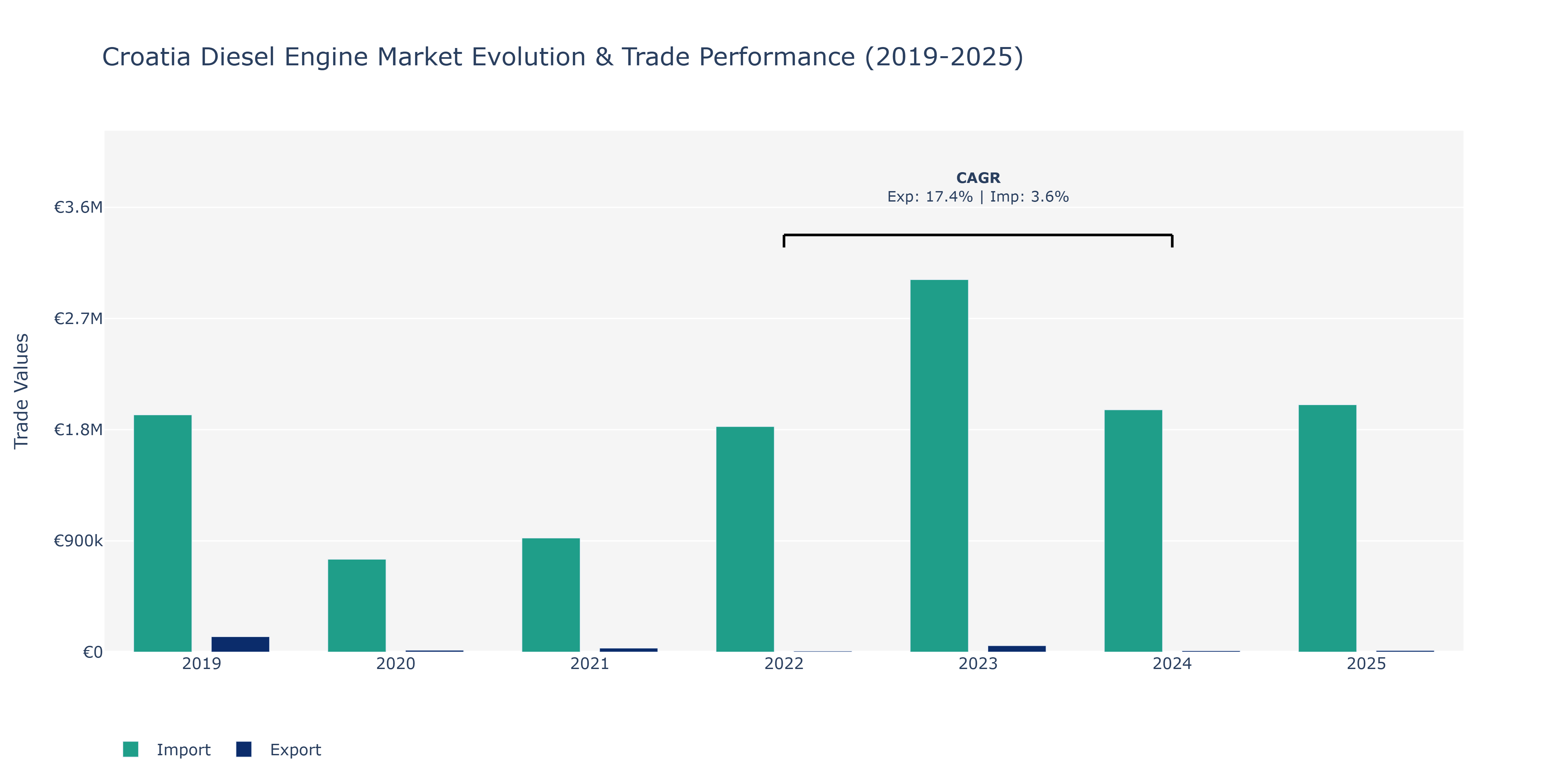
In the Croatia Diesel Engine Market, exports witnessed fluctuations over the years, with a notable decline in 2022 followed by a substantial increase in 2023, reaching €51.37 thousand and then slightly decreasing in 2024. Imports, on the other hand, experienced consistent growth from 2019 to 2021 before stabilizing in the following years at around €2.0 million. The fluctuations in exports can be attributed to varying global demand for diesel engines, influenced by economic conditions and regulatory changes impacting the market. The steady growth in imports reflects Croatia's reliance on imported diesel engines to meet domestic demand, possibly due to a lack of local manufacturing capabilities or specific technology requirements. To sustain a competitive position, stakeholders in the Croatia Diesel Engine Market may need to monitor global market trends closely and adapt to evolving industry standards and regulations.
Croatia Diesel Engine Market Overview
The Diesel Engine Market in Croatia is growing steadily due to its extensive use in automotive, marine, and industrial sectors. Diesel engines are valued for their fuel efficiency and durability, with the market benefiting from advancements in emission control technologies and the transition towards cleaner, high-performance engines.
Drivers of the market
The Croatia diesel engine market is influenced by the demand for diesel engines in automotive, construction, and industrial applications. Diesel engines are valued for their fuel efficiency and durability. The growth of infrastructure projects, agricultural mechanization, and the need for reliable power sources contribute to the market`s growth. Advances in engine technology and emissions regulations also impact market dynamics.
Challenges of the market
The diesel engine market in Croatia faces challenges related to stringent environmental regulations and the push towards more sustainable and eco-friendly alternatives. There is also a need for continuous innovation to improve engine efficiency and reduce emissions. Fluctuations in fuel prices and the high cost of advanced engine technologies add to the complexity of the market. Additionally, competition from electric and hybrid engine technologies impacts market dynamics.
Government Policy of the market
The diesel engine market in Croatia is regulated by environmental and safety standards set by the Ministry of Environment and Nature Protection. Policies focus on reducing emissions and promoting the use of cleaner technologies in diesel engines. The government also enforces regulations on the importation, manufacturing, and maintenance of diesel engines to ensure compliance with EU environmental standards.
Key Highlights of the Report:
- Croatia Diesel Engine Market Outlook
- Market Size of Croatia Diesel Engine Market, 2024
- Forecast of Croatia Diesel Engine Market, 2031
- Historical Data and Forecast of Croatia Diesel Engine Revenues & Volume for the Period 2021-2031
- Croatia Diesel Engine Market Trend Evolution
- Croatia Diesel Engine Market Drivers and Challenges
- Croatia Diesel Engine Price Trends
- Croatia Diesel Engine Porter`s Five Forces
- Croatia Diesel Engine Industry Life Cycle
- Historical Data and Forecast of Croatia Diesel Engine Market Revenues & Volume By Power Rating for the Period 2021-2031
- Historical Data and Forecast of Croatia Diesel Engine Market Revenues & Volume By 0.5 MW 1 MW for the Period 2021-2031
- Historical Data and Forecast of Croatia Diesel Engine Market Revenues & Volume By Up to 0.5 MW for the Period 2021-2031
- Historical Data and Forecast of Croatia Diesel Engine Market Revenues & Volume By 2 MW 5 MW for the Period 2021-2031
- Historical Data and Forecast of Croatia Diesel Engine Market Revenues & Volume By 1 MW 2 MW for the Period 2021-2031
- Historical Data and Forecast of Croatia Diesel Engine Market Revenues & Volume By Above 5 MW for the Period 2021-2031
- Historical Data and Forecast of Croatia Diesel Engine Market Revenues & Volume By for the Period 2021-2031
- Historical Data and Forecast of Croatia Diesel Engine Market Revenues & Volume By End User for the Period 2021-2031
- Historical Data and Forecast of Croatia Diesel Engine Market Revenues & Volume By Automotive for the Period 2021-2031
- Historical Data and Forecast of Croatia Diesel Engine Market Revenues & Volume By Non-Automotive for the Period 2021-2031
- Croatia Diesel Engine Import Export Trade Statistics
- Market Opportunity Assessment By Power Rating
- Market Opportunity Assessment By End User
- Croatia Diesel Engine Top Companies Market Share
- Croatia Diesel Engine Competitive Benchmarking By Technical and Operational Parameters
- Croatia Diesel Engine Company Profiles
- Croatia Diesel Engine Key Strategic Recommendations






































