Croatia Egg Powder Market Size (2020-2030)
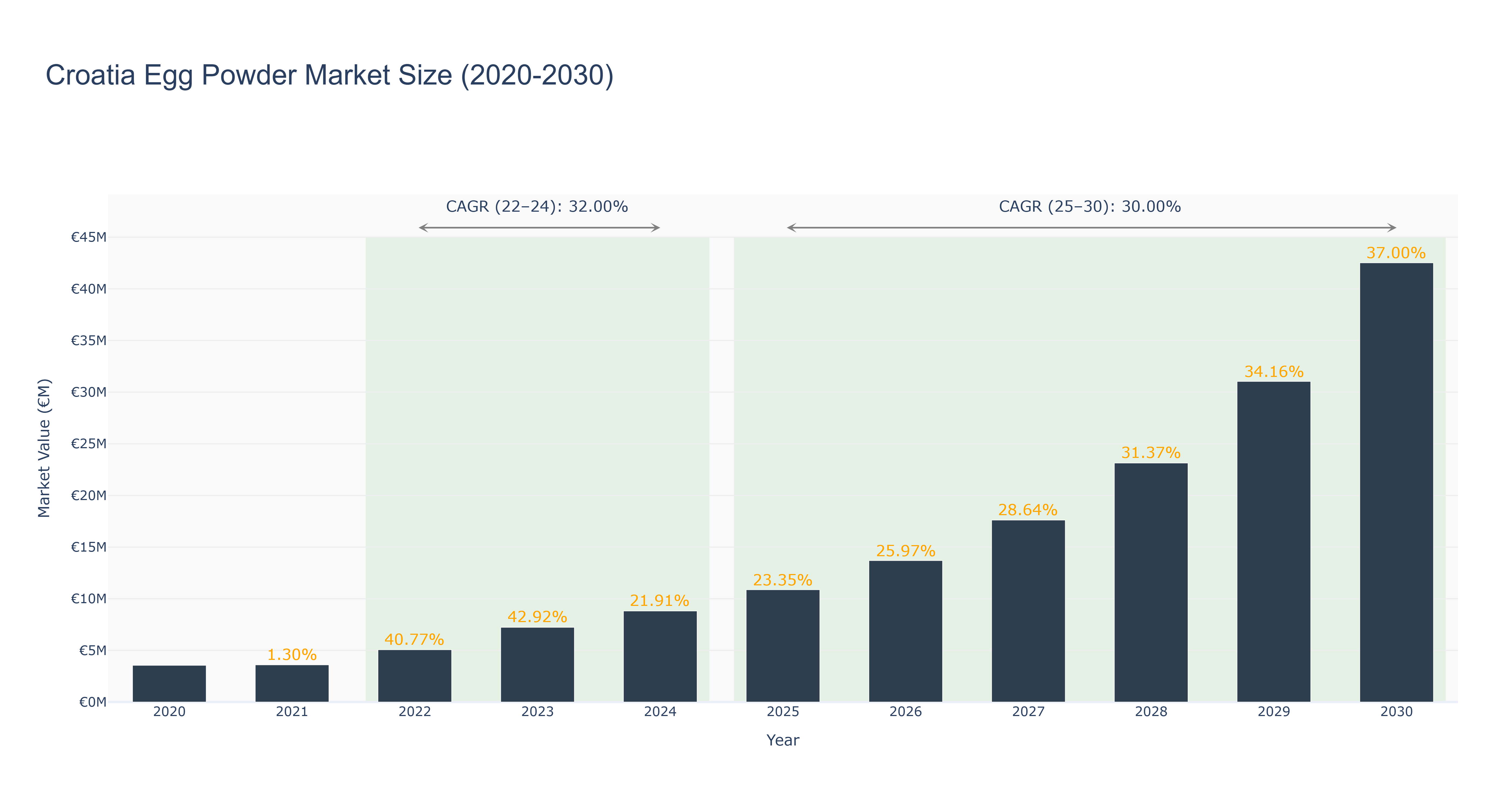
Croatia Egg Powder Market has shown a significant growth trend over the years. The peak market size of €42.52 million is forecasted for 2030, with a steady increase from €3.55 million in 2020. The market experienced a notable surge from 2022 to 2024, attributed to a CAGR of 31.99831269%, and is expected to maintain a strong growth trajectory with a CAGR of 30.0% from 2025 to 2030. The industry drivers behind this growth include increasing consumer demand for convenient food products and the rising popularity of egg powder due to its longer shelf life and ease of storage. Looking ahead to the future, Croatia is set to introduce advanced technology in egg powder production processes, enhancing efficiency and product quality to meet the growing market demands.
Croatia Egg Powder Market: Production & Trade Performance (2019-2025)
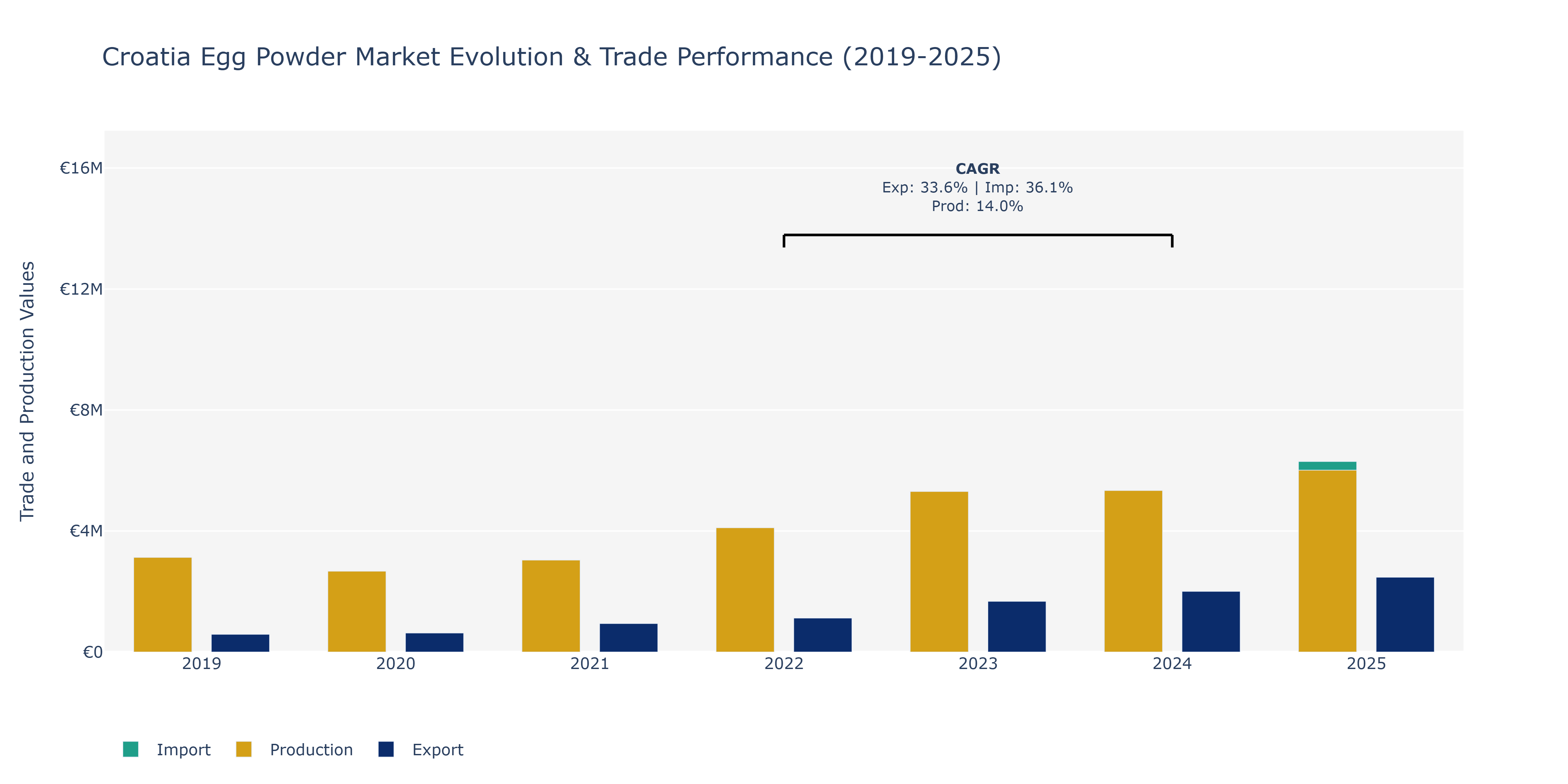
Between 2019 and 2025, the Croatia Egg Powder Market saw notable fluctuations in Exports, Imports, and Production. Exports experienced steady growth, increasing from €586.5 thousand in 2019 to €2.47 million in 2025. Imports also surged, rising from €985.94 thousand to €6.3 million during the same period. Production showed an increasing trend from €3.13 million in 2019 to €6.01 million in 2025. The peak points were observed in 2025 for all three metrics. The substantial growth in Exports can be attributed to an increasing demand for egg powder products in the international market, possibly due to their longer shelf life and convenience. The surge in Imports may indicate a growing need for raw materials or a shift in sourcing strategies by local manufacturers. The rise in Production reflects the industry's efforts to meet the escalating demand, potentially driven by advancements in production technology and efficiency improvements. Such trends align with the broader global food processing industry's focus on product innovation and export competitiveness, as consumers seek diverse and convenient food products.
Key Highlights of the Report:
- Croatia Egg Powder Market Outlook
- Market Size of Croatia Egg Powder Market, 2025
- Forecast of Croatia Egg Powder Market, 2032
- Historical Data and Forecast of Croatia Egg Powder Revenues & Volume for the Period 2022 - 2032F
- Croatia Egg Powder Market Trend Evolution
- Croatia Egg Powder Market Drivers and Challenges
- Croatia Egg Powder Price Trends
- Croatia Egg Powder Porter`s Five Forces
- Croatia Egg Powder Industry Life Cycle
- Historical Data and Forecast of Croatia Egg Powder Market Revenues & Volume By Types for the Period 2022 - 2032F
- Historical Data and Forecast of Croatia Egg Powder Market Revenues & Volume By Whole Eggfor the Period 2022 - 2032F
- Historical Data and Forecast of Croatia Egg Powder Market Revenues & Volume By Egg Yolkfor the Period 2022 - 2032F
- Historical Data and Forecast of Croatia Egg Powder Market Revenues & Volume By White Eggfor the Period 2022 - 2032F
- Historical Data and Forecast of Croatia Egg Powder Market Revenues & Volume By End-user for the Period 2022 - 2032F
- Historical Data and Forecast of Croatia Egg Powder Market Revenues & Volume By Bakery for the Period 2022 - 2032F
- Historical Data and Forecast of Croatia Egg Powder Market Revenues & Volume By Sauces, Dressings, and Mixesfor the Period 2022 - 2032F
- Historical Data and Forecast of Croatia Egg Powder Market Revenues & Volume By Others for the Period 2022 - 2032F
- Croatia Egg Powder Import Export Trade Statistics
- Market Opportunity Assessment By Types
- Market Opportunity Assessment By End-user
- Croatia Egg Powder Top Companies Market Share
- Croatia Egg Powder Competitive Benchmarking By Technical and Operational Parameters
- Croatia Egg Powder Company Profiles
- Croatia Egg Powder Key Strategic Recommendations






































