Croatia Formwork Market Size (2020-2030)
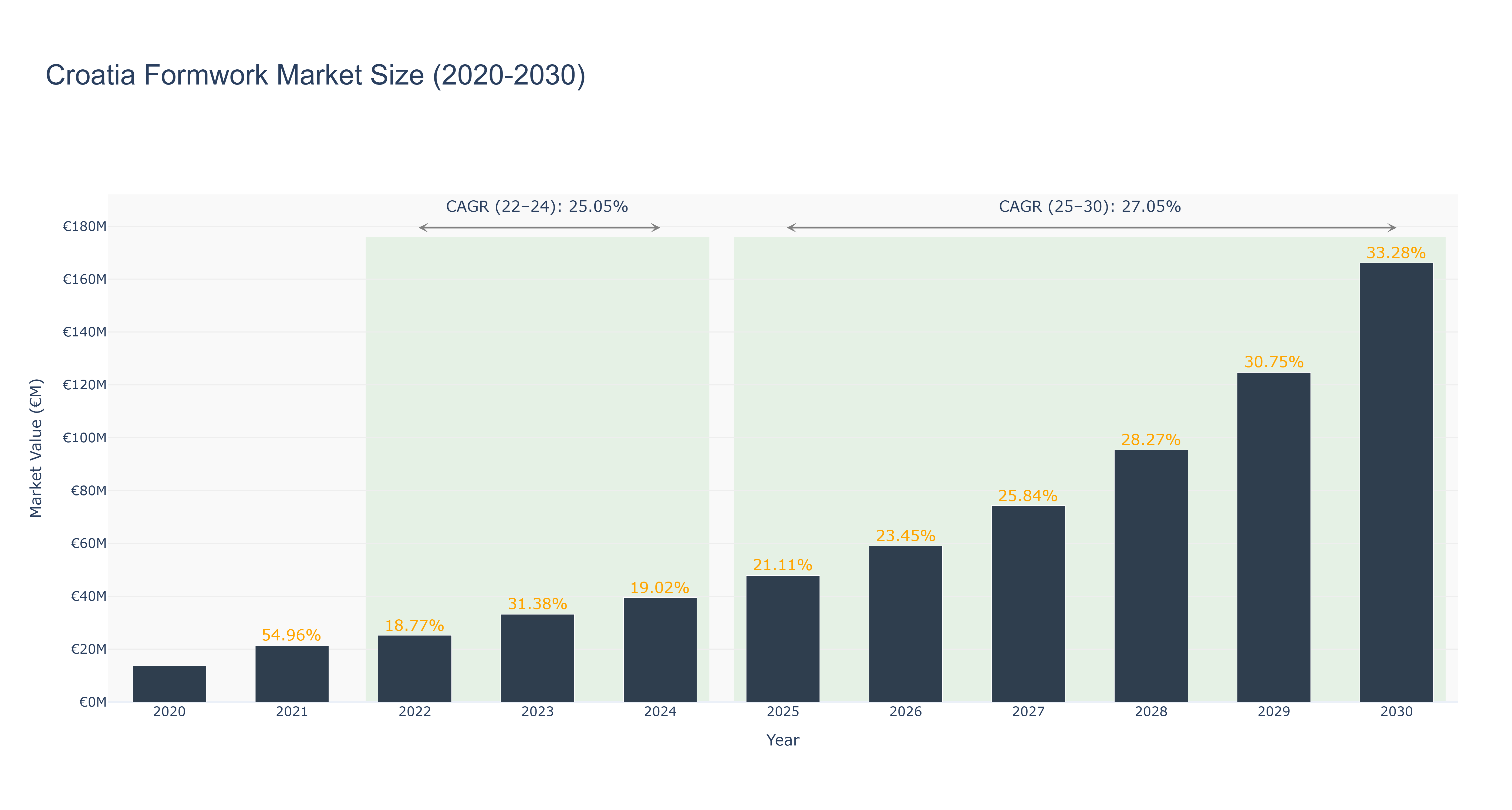
The Croatia Formwork Market has demonstrated significant growth in recent years, with an actual market size of €25.27 million in 2022, increasing to €39.51 million by 2024, reflecting a strong compound annual growth rate (CAGR) of 25.05% during this period. This growth can be attributed to the ongoing expansion in the construction sector, driven by increased infrastructure investments and urban development initiatives. Looking ahead, the market is projected to experience robust growth, with forecasted sizes of €47.85 million in 2025 and €166.16 million by 2030, indicating a CAGR of 27.05%. Key macro drivers such as government-backed construction projects, a growing population, and the increasing need for sustainable building solutions are expected to further fuel this upward trend. As Croatia continues to invest in modernization and infrastructure, the formwork market is poised for dynamic expansion, presenting ample opportunities for industry stakeholders.
Croatia Formwork Market: Production & Trade Performance (2019-2025)
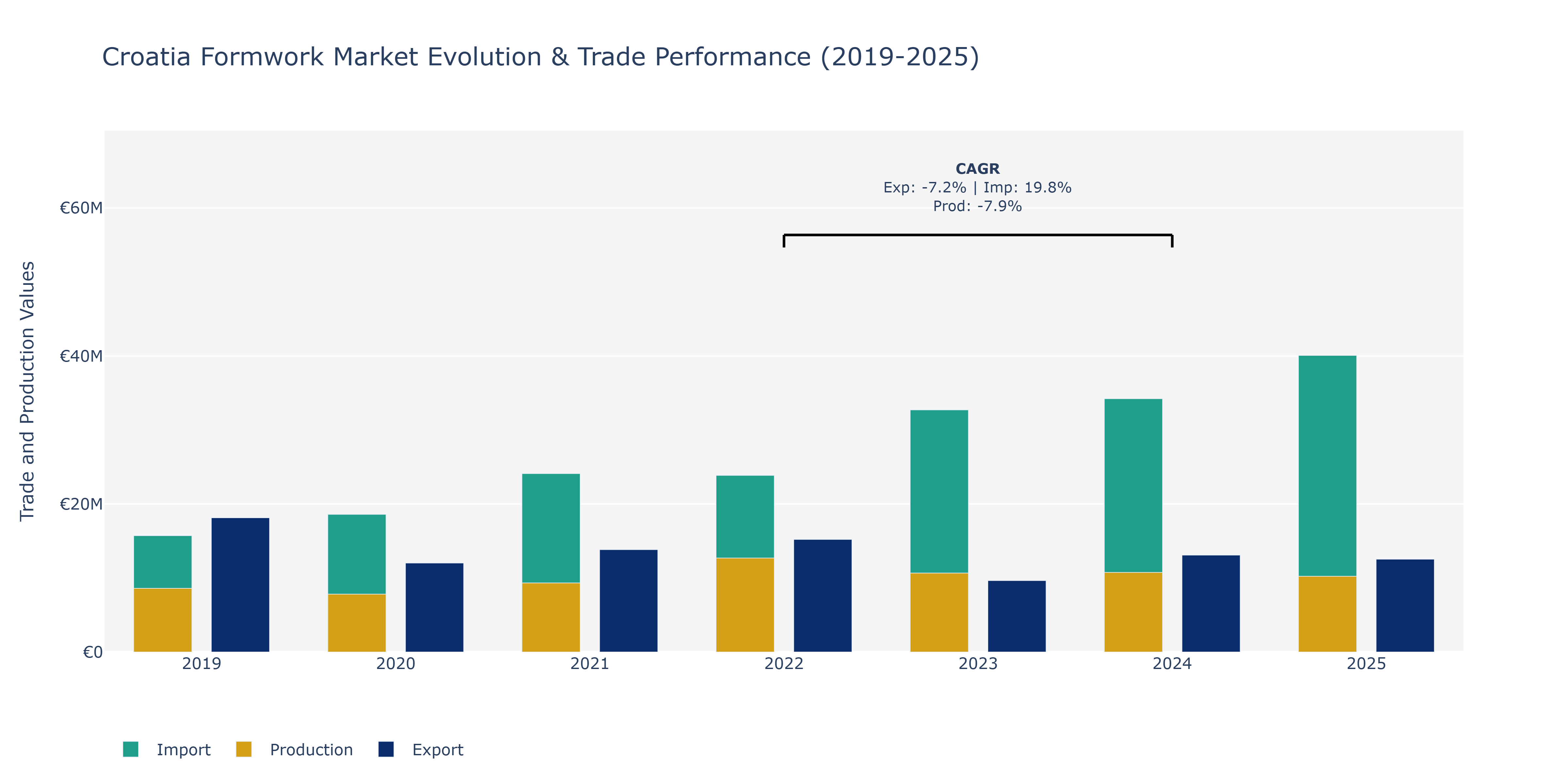
In the Croatia Formwork Market, from 2019 to 2025, exports displayed fluctuations with a peak in 2019 at €18.14 million, declining in 2020, then moving upwards again in 2021 and 2022 before decreasing notably in 2023. Imports, on the other hand, increased consistently year over year, reaching €40.07 million in 2025. Production value showed a peak in 2022 at €12.70 million but experienced a decline by 2025. These trends could be attributed to various factors such as changes in construction activity levels, economic conditions, and global market demand for formwork products. The varying export values reflect shifts in international trade patterns and competitiveness in the formwork sector. The rising Import value may indicate increased infrastructure development projects requiring imported formwork materials, impacting domestic production levels. To sustain growth, stakeholders may need to focus on enhancing product quality, innovation, and market diversification strategies in response to changing market dynamics.
Key Highlights of the Report:
- Croatia Formwork Market Outlook
- Market Size of Croatia Formwork Market, 2025
- Forecast of Croatia Formwork Market, 2032
- Historical Data and Forecast of Croatia Formwork Revenues & Volume for the Period 2022 - 2032F
- Croatia Formwork Market Trend Evolution
- Croatia Formwork Market Drivers and Challenges
- Croatia Formwork Price Trends
- Croatia Formwork Porter`s Five Forces
- Croatia Formwork Industry Life Cycle
- Historical Data and Forecast of Croatia Formwork Market Revenues & Volume By Product Type for the Period 2022 - 2032F
- Historical Data and Forecast of Croatia Formwork Market Revenues & Volume By Traditional timber formwork for the Period 2022 - 2032F
- Historical Data and Forecast of Croatia Formwork Market Revenues & Volume By Engineered Formwork System for the Period 2022 - 2032F
- Historical Data and Forecast of Croatia Formwork Market Revenues & Volume By Re-usable plastic formwork for the Period 2022 - 2032F
- Historical Data and Forecast of Croatia Formwork Market Revenues & Volume By Others for the Period 2022 - 2032F
- Historical Data and Forecast of Croatia Formwork Market Revenues & Volume By Applications for the Period 2022 - 2032F
- Historical Data and Forecast of Croatia Formwork Market Revenues & Volume By Buildings for the Period 2022 - 2032F
- Historical Data and Forecast of Croatia Formwork Market Revenues & Volume By Transportation for the Period 2022 - 2032F
- Historical Data and Forecast of Croatia Formwork Market Revenues & Volume By Industrial Facilities for the Period 2022 - 2032F
- Croatia Formwork Import Export Trade Statistics
- Market Opportunity Assessment By Product Type
- Market Opportunity Assessment By Applications
- Croatia Formwork Top Companies Market Share
- Croatia Formwork Competitive Benchmarking By Technical and Operational Parameters
- Croatia Formwork Company Profiles
- Croatia Formwork Key Strategic Recommendations






































