Croatia Fruit Pulp Market Top 5 Importing Countries and Market Competition (HHI) Analysis
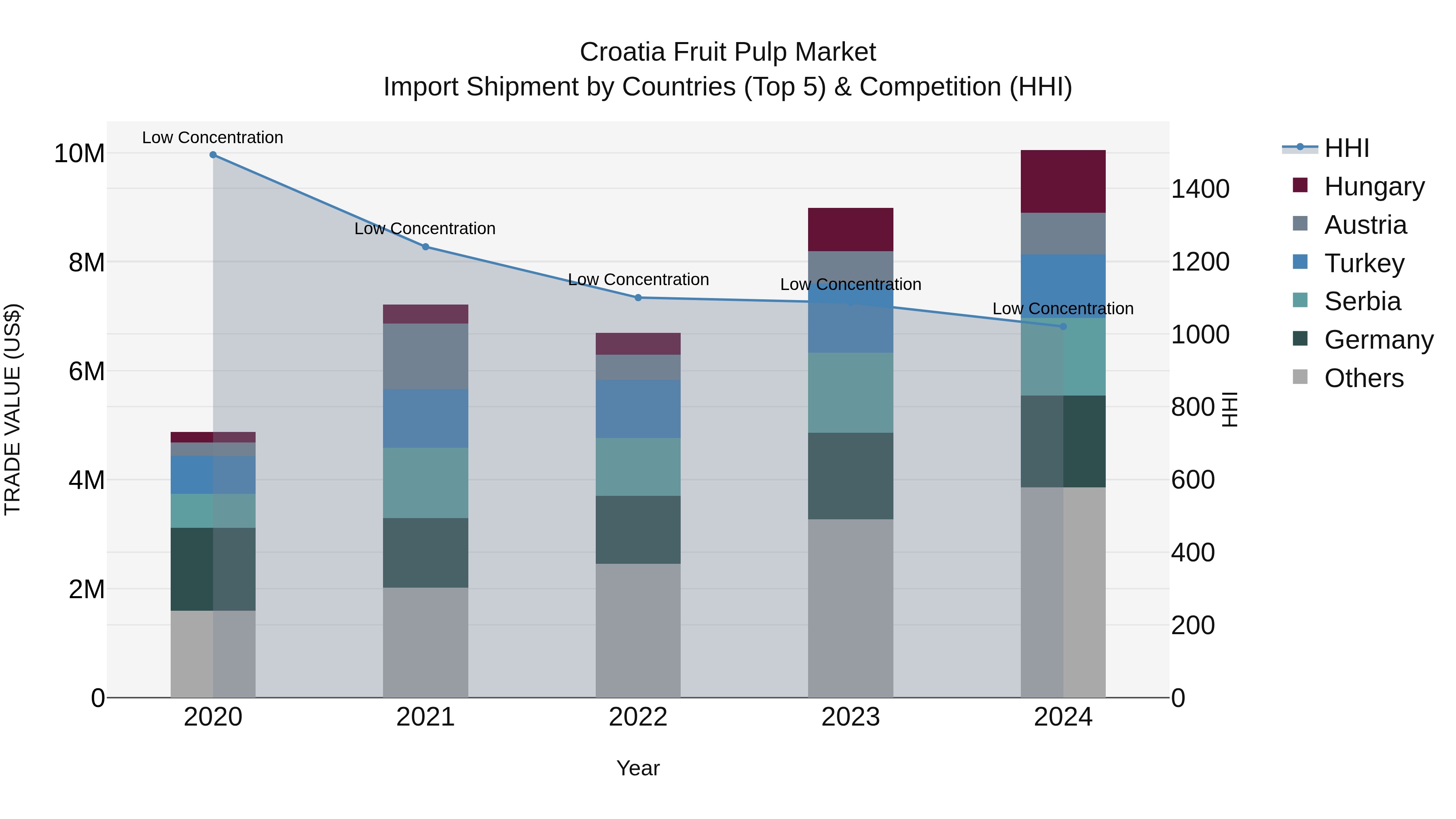
Croatia fruit pulp import market saw steady growth in 2024, with key suppliers being Germany, Serbia, Turkey, Hungary, and Italy. The market exhibited low concentration levels, indicating a diverse range of sources. The impressive compound annual growth rate (CAGR) of 19.83% from 2020 to 2024 highlights the increasing demand for fruit pulp in Croatia. Moreover, the growth rate of 11.81% from 2023 to 2024 suggests a sustained upward trend in import volumes, presenting opportunities for both suppliers and stakeholders in the fruit pulp industry.
Croatia Fruit Pulp Market Overview
The fruit pulp market in Croatia is growing due to the increasing demand for processed fruit products in the food and beverage industry. Croatia`s agricultural sector, coupled with advancements in food processing technology, supports the production of high-quality fruit pulp used in beverages, dairy products, and desserts. The market is also driven by the rising preference for natural and minimally processed foods.
Drivers of the market
The growing demand for natural and organic food products is a major driver of the fruit pulp market in Croatia. Increasing health consciousness among consumers and the rising popularity of fruit-based beverages and processed foods are further driving demand for high-quality fruit pulp. Additionally, advancements in fruit processing technologies and the expansion of the food and beverage industry are contributing to market growth.
Challenges of the market
The Croatia Fruit Pulp market faces issues with seasonal availability and the perishable nature of the raw materials. Moreover, fluctuating demand from the food and beverage industry makes it difficult for suppliers to maintain consistent growth.
Government Policy of the market
Government policies in Croatia support the fruit processing industry, including the fruit pulp market, through subsidies for local fruit production and processing. These policies aim to enhance food security and promote export competitiveness.
Key Highlights of the Report:
- Croatia Fruit Pulp Market Outlook
- Market Size of Croatia Fruit Pulp Market, 2024
- Forecast of Croatia Fruit Pulp Market, 2031
- Historical Data and Forecast of Croatia Fruit Pulp Revenues & Volume for the Period 2021-2031
- Croatia Fruit Pulp Market Trend Evolution
- Croatia Fruit Pulp Market Drivers and Challenges
- Croatia Fruit Pulp Price Trends
- Croatia Fruit Pulp Porter`s Five Forces
- Croatia Fruit Pulp Industry Life Cycle
- Historical Data and Forecast of Croatia Fruit Pulp Market Revenues & Volume By Fruit Type for the Period 2021-2031
- Historical Data and Forecast of Croatia Fruit Pulp Market Revenues & Volume By Mango for the Period 2021-2031
- Historical Data and Forecast of Croatia Fruit Pulp Market Revenues & Volume By Strawberry for the Period 2021-2031
- Historical Data and Forecast of Croatia Fruit Pulp Market Revenues & Volume By Apple for the Period 2021-2031
- Historical Data and Forecast of Croatia Fruit Pulp Market Revenues & Volume By Guava for the Period 2021-2031
- Historical Data and Forecast of Croatia Fruit Pulp Market Revenues & Volume By Berries for the Period 2021-2031
- Historical Data and Forecast of Croatia Fruit Pulp Market Revenues & Volume By Citrus Fruits for the Period 2021-2031
- Historical Data and Forecast of Croatia Fruit Pulp Market Revenues & Volume By Others for the Period 2021-2031
- Historical Data and Forecast of Croatia Fruit Pulp Market Revenues & Volume By Form for the Period 2021-2031
- Historical Data and Forecast of Croatia Fruit Pulp Market Revenues & Volume By Liquid for the Period 2021-2031
- Historical Data and Forecast of Croatia Fruit Pulp Market Revenues & Volume By Powder for the Period 2021-2031
- Historical Data and Forecast of Croatia Fruit Pulp Market Revenues & Volume By Application for the Period 2021-2031
- Historical Data and Forecast of Croatia Fruit Pulp Market Revenues & Volume By Food and Beverages for the Period 2021-2031
- Historical Data and Forecast of Croatia Fruit Pulp Market Revenues & Volume By Distribution for the Period 2021-2031
- Historical Data and Forecast of Croatia Fruit Pulp Market Revenues & Volume By E-Commerce for the Period 2021-2031
- Historical Data and Forecast of Croatia Fruit Pulp Market Revenues & Volume By Convenience Stores for the Period 2021-2031
- Historical Data and Forecast of Croatia Fruit Pulp Market Revenues & Volume By Supermarkets/Hypermarkets for the Period 2021-2031
- Historical Data and Forecast of Croatia Fruit Pulp Market Revenues & Volume By Specialty Stores for the Period 2021-2031
- Historical Data and Forecast of Croatia Fruit Pulp Market Revenues & Volume By Others for the Period 2021-2031
- Croatia Fruit Pulp Import Export Trade Statistics
- Market Opportunity Assessment By Fruit Type
- Market Opportunity Assessment By Form
- Market Opportunity Assessment By Application
- Market Opportunity Assessment By Distribution
- Croatia Fruit Pulp Top Companies Market Share
- Croatia Fruit Pulp Competitive Benchmarking By Technical and Operational Parameters
- Croatia Fruit Pulp Company Profiles
- Croatia Fruit Pulp Key Strategic Recommendations






































