Croatia Injection Molding Machine Market Size (2020-2030)
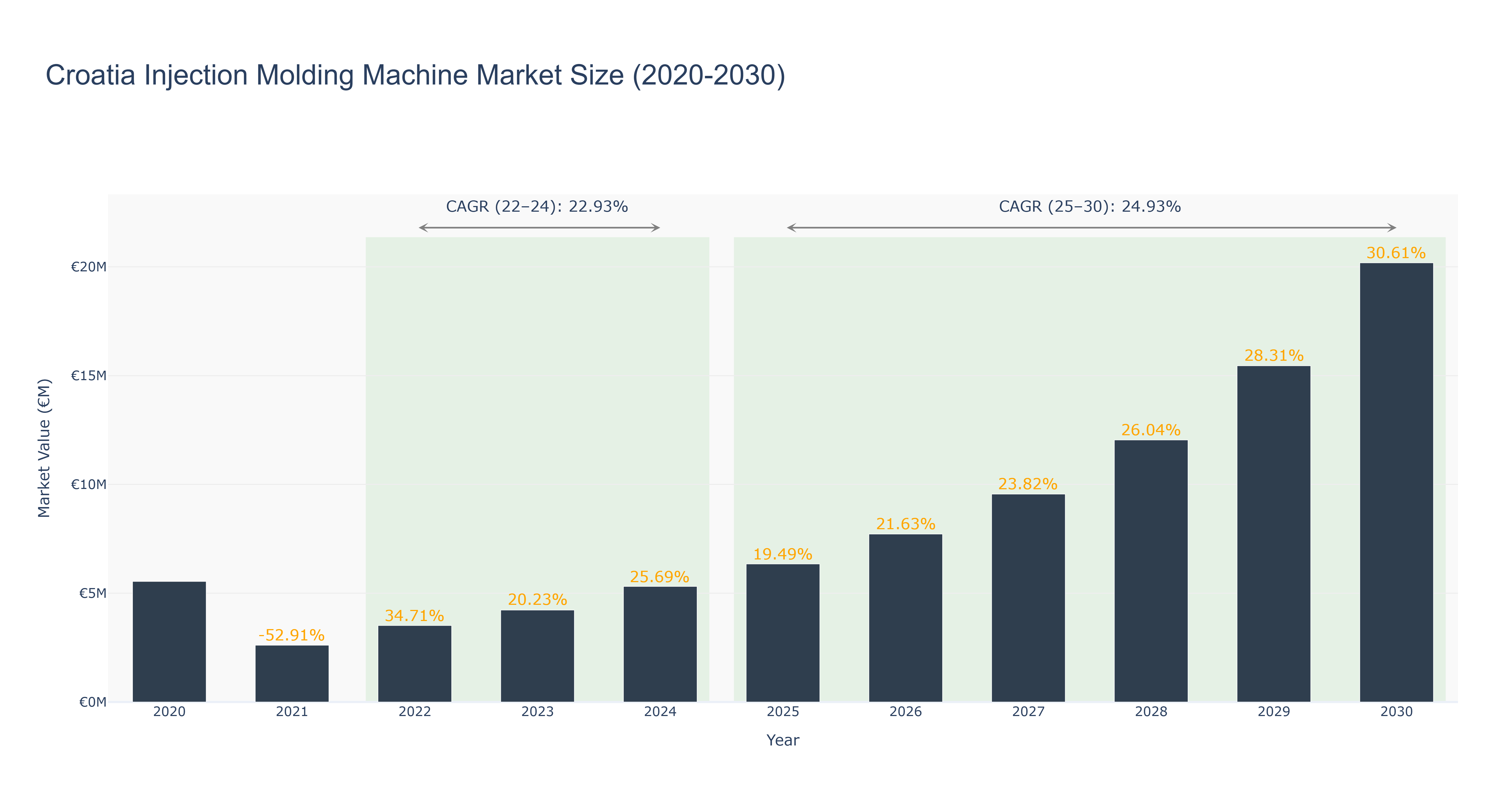
The Croatia Injection Molding Machine Market has shown a steady growth trajectory over the years. The peak market size of €20.18 million is forecasted for 2030, with significant growth observed from 2020 to 2030. The actual market size increased from €5.54 million in 2020 to €12.04 million in 2028, showcasing a robust expansion. The forecasted market size is expected to continue this upward trend, reaching €20.18 million by 2030. The CAGR for the period 2022-24 is 22.93%, while for 2025-30, it stands at 24.93%. The market's growth can be attributed to increasing industrialization, technological advancements in injection molding machines, and rising demand for plastic products across various sectors. Looking ahead, upcoming projects in Croatia's manufacturing sector are set to further boost the demand for injection molding machines, indicating a positive outlook for the market.
Croatia Injection Molding Machine Market: Production & Trade Performance (2019-2025)
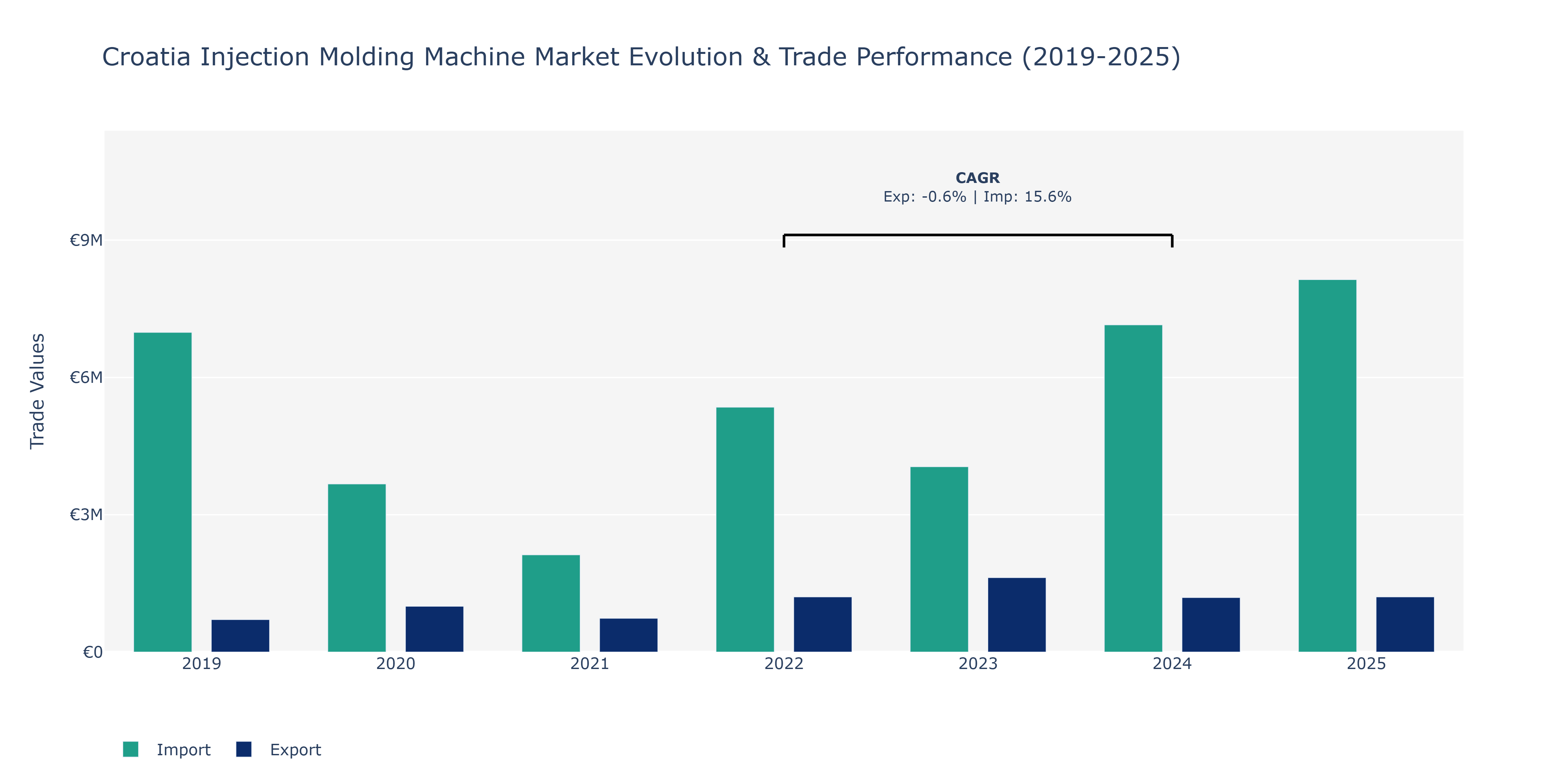
In the Croatia Injection Molding Machine Market, exports and imports displayed distinct dynamics over the years. From 2019 to 2020, exports surged from €708.42 thousand to €1.0 million, indicating a substantial increase. Conversely, imports experienced a noticeable decline from €6.98 million to €3.67 million during the same period. The year 2021 saw a slight drop in exports to €737.75 thousand, while imports decreased to €2.12 million. The following years demonstrated contrasting trends as exports peaked in 2023 at €1.63 million, whereas imports reached their highest point in 2025 at €8.14 million. The notable increase in Import value from 2024 to 2025 could be attributed to the growing demand for injection molding machines in Croatia's manufacturing sector, potentially driven by advancements in technology and an expanding industrial landscape.
Croatia Injection Molding Machine Market Overview
The injection molding machine market in Croatia is expanding as industries seek more efficient manufacturing processes. These machines are widely used for producing plastic parts in industries like automotive, electronics, and packaging. The market is driven by technological advancements, increasing automation, and the demand for precision in manufacturing.
Drivers of the market
The demand for injection molding machines in Croatia is driven by the growth of the plastics industry, especially in sectors such as automotive, packaging, and consumer goods. The increasing focus on automation and energy-efficient machinery is also shaping the market. Additionally, advancements in molding technologies and materials are contributing to market expansion.
Challenges of the market
Challenges in the Croatian injection molding machine market include the high cost of machines and their maintenance, which limits accessibility for small and medium-sized enterprises. Additionally, technological advancements require frequent upgrades, making it difficult for companies to stay competitive.
Government Policy of the market
The Croatian government supports the injection molding machine market through initiatives aimed at improving manufacturing efficiency and technology. Policies include grants for upgrading equipment and regulatory standards to ensure the safety and performance of molding machines. The government also promotes research in advanced molding technologies.
Key Highlights of the Report:
- Croatia Injection Molding Machine Market Outlook
- Market Size of Croatia Injection Molding Machine Market, 2024
- Forecast of Croatia Injection Molding Machine Market, 2031
- Historical Data and Forecast of Croatia Injection Molding Machine Revenues & Volume for the Period 2021-2031
- Croatia Injection Molding Machine Market Trend Evolution
- Croatia Injection Molding Machine Market Drivers and Challenges
- Croatia Injection Molding Machine Price Trends
- Croatia Injection Molding Machine Porter`s Five Forces
- Croatia Injection Molding Machine Industry Life Cycle
- Historical Data and Forecast of Croatia Injection Molding Machine Market Revenues & Volume By Material for the Period 2021-2031
- Historical Data and Forecast of Croatia Injection Molding Machine Market Revenues & Volume By Plastic for the Period 2021-2031
- Historical Data and Forecast of Croatia Injection Molding Machine Market Revenues & Volume By Metal for the Period 2021-2031
- Historical Data and Forecast of Croatia Injection Molding Machine Market Revenues & Volume By Others for the Period 2021-2031
- Historical Data and Forecast of Croatia Injection Molding Machine Market Revenues & Volume By Technology for the Period 2021-2031
- Historical Data and Forecast of Croatia Injection Molding Machine Market Revenues & Volume By Hydraulic for the Period 2021-2031
- Historical Data and Forecast of Croatia Injection Molding Machine Market Revenues & Volume By Electric for the Period 2021-2031
- Historical Data and Forecast of Croatia Injection Molding Machine Market Revenues & Volume By Hybrid for the Period 2021-2031
- Historical Data and Forecast of Croatia Injection Molding Machine Market Revenues & Volume By End-use for the Period 2021-2031
- Historical Data and Forecast of Croatia Injection Molding Machine Market Revenues & Volume By Automotive for the Period 2021-2031
- Historical Data and Forecast of Croatia Injection Molding Machine Market Revenues & Volume By Consumer Goods for the Period 2021-2031
- Historical Data and Forecast of Croatia Injection Molding Machine Market Revenues & Volume By Packaging for the Period 2021-2031
- Historical Data and Forecast of Croatia Injection Molding Machine Market Revenues & Volume By Electronics for the Period 2021-2031
- Historical Data and Forecast of Croatia Injection Molding Machine Market Revenues & Volume By Others for the Period 2021-2031
- Croatia Injection Molding Machine Import Export Trade Statistics
- Market Opportunity Assessment By Material
- Market Opportunity Assessment By Technology
- Market Opportunity Assessment By End-use
- Croatia Injection Molding Machine Top Companies Market Share
- Croatia Injection Molding Machine Competitive Benchmarking By Technical and Operational Parameters
- Croatia Injection Molding Machine Company Profiles
- Croatia Injection Molding Machine Key Strategic Recommendations






































