Croatia Polypropylene Market Size (2020-2030)
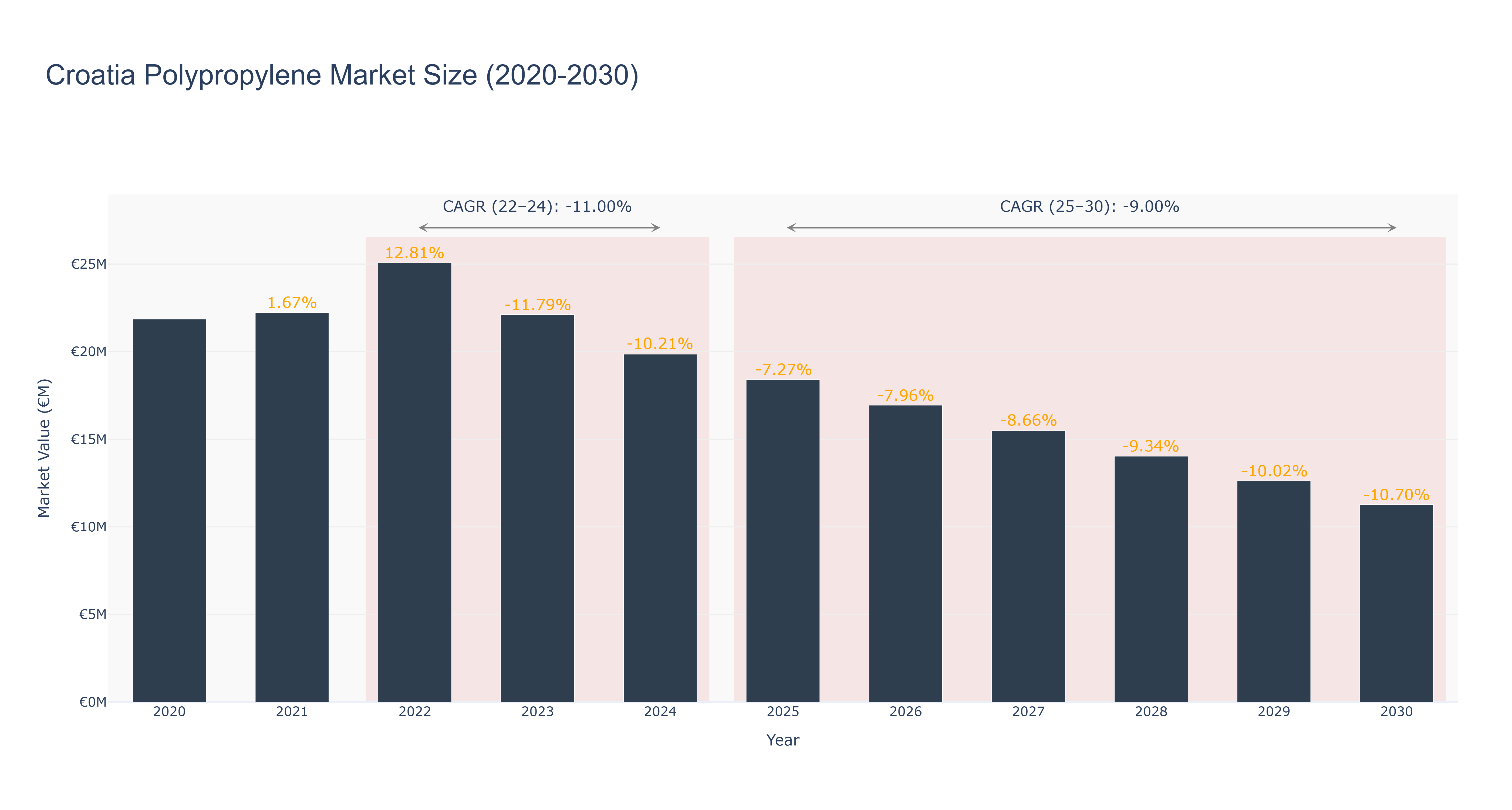
Croatia's Polypropylene Market has seen fluctuations in market size over the years. The peak market size was €25.07 million in 2022, followed by a decline to €11.28 million in 2030. The actual market size decreased from €21.86 million in 2020 to €19.86 million in 2024. Forecasted market size is expected to continue declining from 2025 to 2030. The CAGR for the period 2022-24 was -10.99986773%, while for 2025-30, it is projected to be -8.999867729%. The downward trend can be attributed to factors like economic uncertainties, changing consumer preferences, and global market conditions. Looking ahead, Croatia's Polypropylene Market is expected to focus on sustainability initiatives and technological advancements to enhance product quality and meet evolving market demands. Future developments may include collaborations with key industry players to drive innovation and competitiveness in the market.
Croatia Polypropylene Market: Production & Trade Performance (2019-2025)
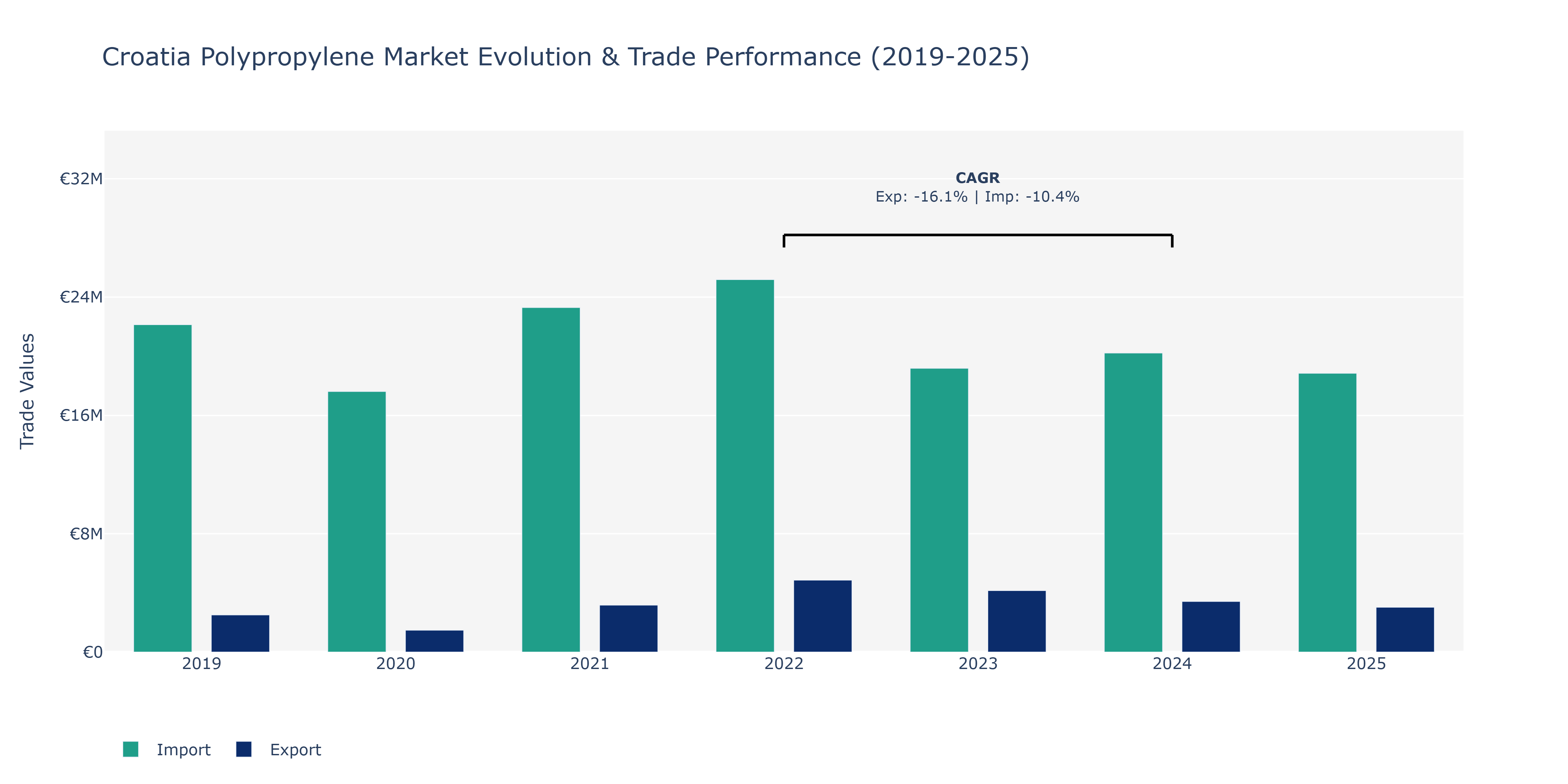
The Croatia Polypropylene Market witnessed fluctuations in both exports and imports from 2019 to 2025. Exports peaked in 2022 at €4.86 million, showing a significant increase from the previous year, but decreased in the following years, reaching €3.03 million in 2025. On the other hand, imports peaked in 2022 at €25.18 million, marking a steady upward trend since 2019. However, imports experienced a decline to €18.85 million in 2025. The market's exports were influenced by global demand shifts, possibly due to changes in consumer preferences or macroeconomic conditions affecting trade flows. The fluctuating imports could be attributed to changes in domestic consumption patterns or shifts in sourcing strategies based on cost considerations. Croatia's Polypropylene Market may benefit from strategic partnerships to stabilize trade volumes amid evolving market dynamics and to capitalize on emerging opportunities in the region.
Croatia Polypropylene Market Overview
The Croatia Polypropylene Market is a cornerstone of the plastics industry, providing a versatile polymer used in packaging, textiles, automotive, and consumer products. Polypropylene is valued for its strength, lightweight, and resistance to chemical and environmental degradation.
Drivers of the market
The polypropylene market in Croatia is driven by its wide range of applications, including in packaging, automotive, textiles, and consumer goods. The growth in these sectors, coupled with polypropylene`s cost-effectiveness and recyclability, supports market expansion. Additionally, technological advancements in polypropylene production enhance its performance and versatility.
Challenges of the market
The polypropylene market in Croatia encounters challenges such as managing raw material costs and ensuring the quality and consistency of polypropylene products. Companies must navigate regulatory requirements and address environmental concerns related to polypropylene production and disposal. Additionally, competition from alternative materials and the need for continuous innovation in polypropylene applications impact the market.
Government Policy of the market
The Croatian government supports the polypropylene market by enforcing regulations that ensure product safety and environmental compliance. Policies include standards for the production and use of polypropylene materials. The government provides incentives for research and development in polypropylene technologies and promotes the use of sustainable practices.
Key Highlights of the Report:
- Croatia Polypropylene Market Outlook
- Market Size of Croatia Polypropylene Market, 2024
- Forecast of Croatia Polypropylene Market, 2031
- Historical Data and Forecast of Croatia Polypropylene Revenues & Volume for the Period 2021-2031
- Croatia Polypropylene Market Trend Evolution
- Croatia Polypropylene Market Drivers and Challenges
- Croatia Polypropylene Price Trends
- Croatia Polypropylene Porter`s Five Forces
- Croatia Polypropylene Industry Life Cycle
- Historical Data and Forecast of Croatia Polypropylene Market Revenues & Volume By Type for the Period 2021-2031
- Historical Data and Forecast of Croatia Polypropylene Market Revenues & Volume By Homopolymer for the Period 2021-2031
- Historical Data and Forecast of Croatia Polypropylene Market Revenues & Volume By Copolymer for the Period 2021-2031
- Historical Data and Forecast of Croatia Polypropylene Market Revenues & Volume By Application for the Period 2021-2031
- Historical Data and Forecast of Croatia Polypropylene Market Revenues & Volume By Injection Molding for the Period 2021-2031
- Historical Data and Forecast of Croatia Polypropylene Market Revenues & Volume By Fiber & Raffia for the Period 2021-2031
- Historical Data and Forecast of Croatia Polypropylene Market Revenues & Volume By Film & Sheet for the Period 2021-2031
- Historical Data and Forecast of Croatia Polypropylene Market Revenues & Volume By Blow Molding for the Period 2021-2031
- Historical Data and Forecast of Croatia Polypropylene Market Revenues & Volume By End-use Industry for the Period 2021-2031
- Historical Data and Forecast of Croatia Polypropylene Market Revenues & Volume By Packaging for the Period 2021-2031
- Historical Data and Forecast of Croatia Polypropylene Market Revenues & Volume By Automotive for the Period 2021-2031
- Historical Data and Forecast of Croatia Polypropylene Market Revenues & Volume By Building & Construction for the Period 2021-2031
- Historical Data and Forecast of Croatia Polypropylene Market Revenues & Volume By Electrical & Electronics for the Period 2021-2031
- Historical Data and Forecast of Croatia Polypropylene Market Revenues & Volume By Medical for the Period 2021-2031
- Croatia Polypropylene Import Export Trade Statistics
- Market Opportunity Assessment By Type
- Market Opportunity Assessment By Application
- Market Opportunity Assessment By End-use Industry
- Croatia Polypropylene Top Companies Market Share
- Croatia Polypropylene Competitive Benchmarking By Technical and Operational Parameters
- Croatia Polypropylene Company Profiles
- Croatia Polypropylene Key Strategic Recommendations






































