Cyprus Alcoholic Spirits Market Size (2020-2030)
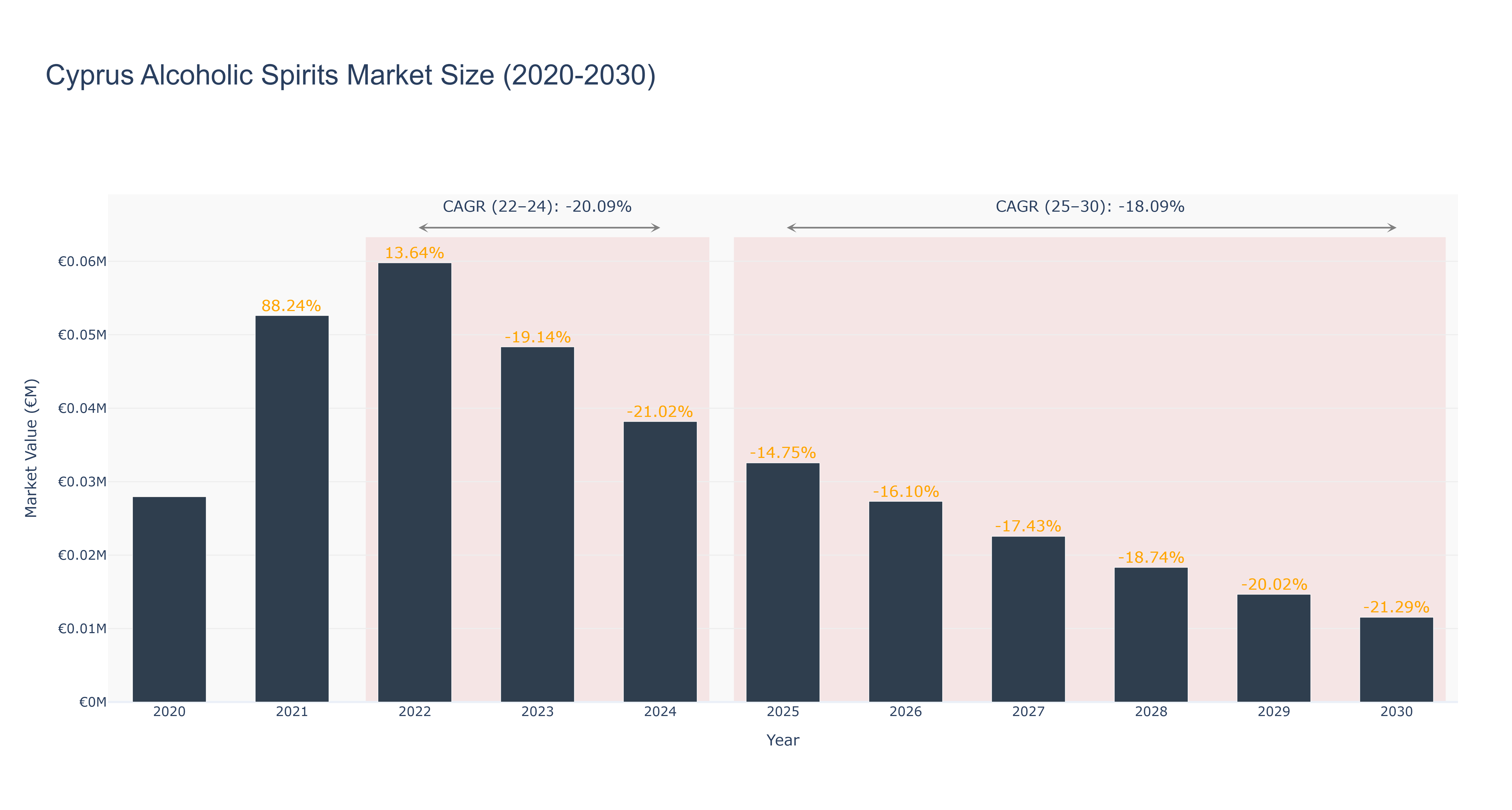
Cyprus Alcoholic Spirits Market has experienced a downward trend in market size over the years. The peak market size of €0.06 million was observed in 2022, followed by a decline to €0.01 million in 2030. Actual market size decreased from €0.06 million in 2022 to €0.04 million in 2024, with a negative CAGR of -20.09% during this period. The forecasted market size is expected to further decrease from €0.03 million in 2025 to €0.01 million in 2030, with a CAGR of -18.09% from 2025 to 2030. The market downturn can be attributed to changing consumer preferences towards healthier alternatives and stricter regulations on alcohol consumption. Looking ahead, Cyprus is planning to introduce sustainable packaging initiatives in the alcoholic spirits sector to align with global sustainability goals, aiming to attract environmentally conscious consumers and drive market growth. Industry drivers influencing the market include evolving consumer preferences, regulatory changes, and increasing health consciousness among consumers. The upcoming sustainable packaging initiatives in the alcoholic spirits market in Cyprus are expected to drive growth and cater to the growing demand for environmentally friendly products.
Cyprus Alcoholic Spirits Market: Production & Trade Performance (2019-2025)

In the Cyprus Alcoholic Spirits Market, imports experienced notable fluctuations over the years. Starting at €14.07 thousand in 2019, import values surged to €32.51 thousand in 2020, marking a substantial increase. However, the trend reversed in the following years with imports declining to €27.54 thousand in 2024 and further dropping to €23.19 thousand by 2025. The peak point for imports was observed in 2021, reaching €55.18 thousand. The fluctuations in imports can be attributed to various factors such as changing consumer preferences, economic conditions affecting purchasing power, and global supply chain disruptions. For instance, the decline in imports post-2021 could be linked to shifts in consumer demand towards other beverage categories or potential regulatory changes impacting import volumes. These dynamics highlight the market's sensitivity to both internal and external factors, requiring industry players to adapt their strategies accordingly to navigate the changing landscape effectively.
Key Highlights of the Report:
- Cyprus Alcoholic Spirits Market Outlook
- Market Size of Cyprus Alcoholic Spirits Market, 2024
- Forecast of Cyprus Alcoholic Spirits Market, 2031
- Historical Data and Forecast of Cyprus Alcoholic Spirits Revenues & Volume for the Period 2021-2031
- Cyprus Alcoholic Spirits Market Trend Evolution
- Cyprus Alcoholic Spirits Market Drivers and Challenges
- Cyprus Alcoholic Spirits Price Trends
- Cyprus Alcoholic Spirits Porter`s Five Forces
- Cyprus Alcoholic Spirits Industry Life Cycle
- Historical Data and Forecast of Cyprus Alcoholic Spirits Market Revenues & Volume By Product Type for the Period 2021-2031
- Historical Data and Forecast of Cyprus Alcoholic Spirits Market Revenues & Volume By Brandy & Cognac for the Period 2021-2031
- Historical Data and Forecast of Cyprus Alcoholic Spirits Market Revenues & Volume By Rum for the Period 2021-2031
- Historical Data and Forecast of Cyprus Alcoholic Spirits Market Revenues & Volume By Tequila for the Period 2021-2031
- Historical Data and Forecast of Cyprus Alcoholic Spirits Market Revenues & Volume By White Spirits for the Period 2021-2031
- Historical Data and Forecast of Cyprus Alcoholic Spirits Market Revenues & Volume By Whiskey for the Period 2021-2031
- Historical Data and Forecast of Cyprus Alcoholic Spirits Market Revenues & Volume By Liqueurs for the Period 2021-2031
- Historical Data and Forecast of Cyprus Alcoholic Spirits Market Revenues & Volume By Others for the Period 2021-2031
- Historical Data and Forecast of Cyprus Alcoholic Spirits Market Revenues & Volume By Distribution Channels for the Period 2021-2031
- Historical Data and Forecast of Cyprus Alcoholic Spirits Market Revenues & Volume By Supermarkets & Hypermarkets for the Period 2021-2031
- Historical Data and Forecast of Cyprus Alcoholic Spirits Market Revenues & Volume By Liquor Specialist Stores for the Period 2021-2031
- Historical Data and Forecast of Cyprus Alcoholic Spirits Market Revenues & Volume By Grocery Retailers for the Period 2021-2031
- Historical Data and Forecast of Cyprus Alcoholic Spirits Market Revenues & Volume By Online Retailing for the Period 2021-2031
- Historical Data and Forecast of Cyprus Alcoholic Spirits Market Revenues & Volume By Other for the Period 2021-2031
- Cyprus Alcoholic Spirits Import Export Trade Statistics
- Market Opportunity Assessment By Product Type
- Market Opportunity Assessment By Distribution Channels
- Cyprus Alcoholic Spirits Top Companies Market Share
- Cyprus Alcoholic Spirits Competitive Benchmarking By Technical and Operational Parameters
- Cyprus Alcoholic Spirits Company Profiles
- Cyprus Alcoholic Spirits Key Strategic Recommendations






































