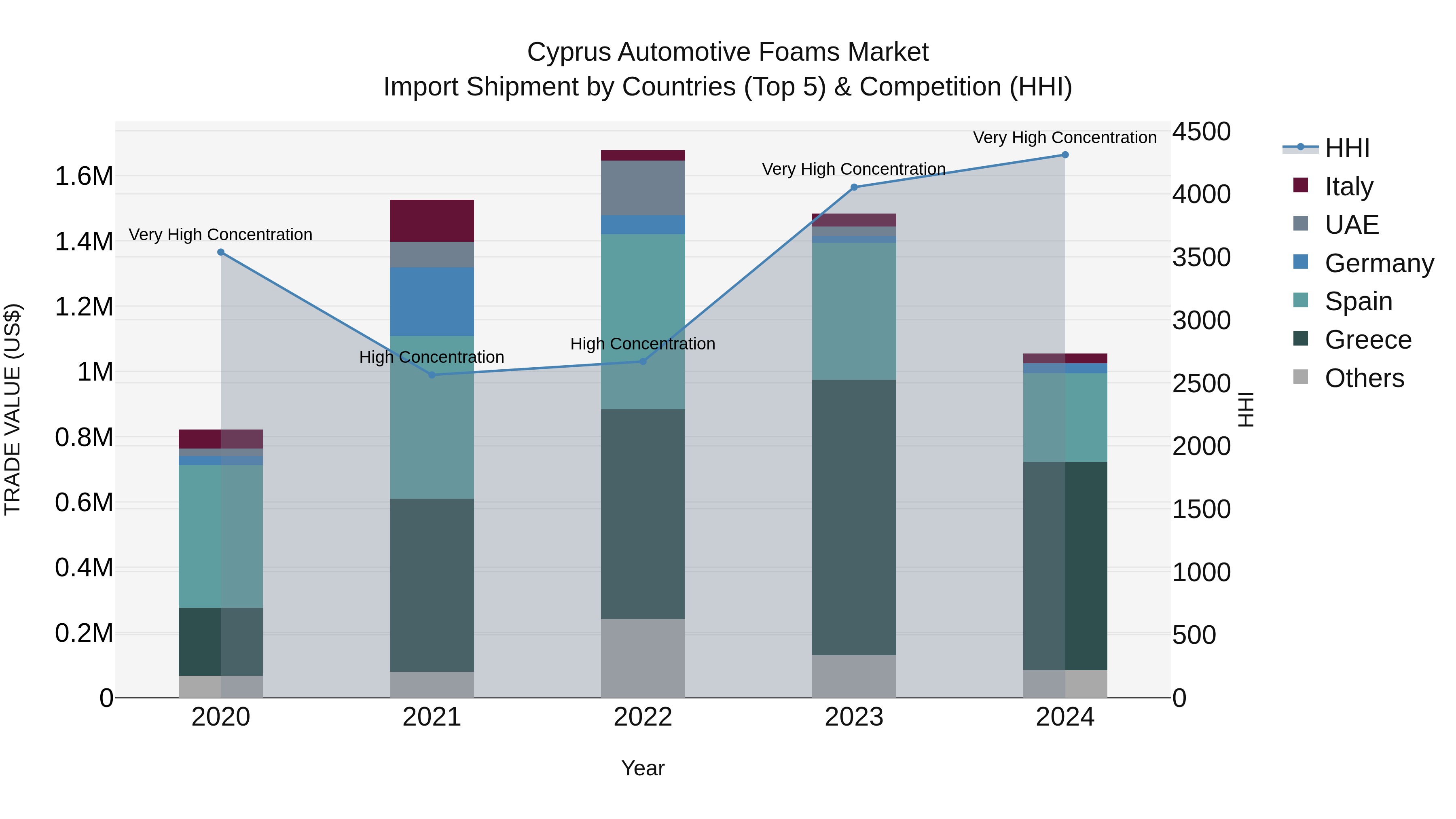
Cyprus Automotive Foams Market Import Shipment by Countries (Top 5) & Competition (HHI)
Despite a significant decline in growth rate from 2023 to 2024, Cyprus continues to import automotive foams predominantly from Greece, Spain, Germany, Italy, and Turkey, indicating strong trade relationships within Europe. The high Herfindahl-Hirschman Index (HHI) concentration suggests limited market competition, potentially leading to pricing power for key suppliers. With a healthy compound annual growth rate (CAGR) of 6.47% from 2020 to 2024, the automotive foams market in Cyprus exhibits steady expansion, highlighting the importance of these imports for the automotive sector in the country.
Key Highlights of the Report:
- Cyprus Automotive Foams Market Outlook
- Market Size of Cyprus Automotive Foams Market, 2024
- Forecast of Cyprus Automotive Foams Market, 2031
- Historical Data and Forecast of Cyprus Automotive Foams Revenues & Volume for the Period 2021- 2031
- Cyprus Automotive Foams Market Trend Evolution
- Cyprus Automotive Foams Market Drivers and Challenges
- Cyprus Automotive Foams Price Trends
- Cyprus Automotive Foams Porter's Five Forces
- Cyprus Automotive Foams Industry Life Cycle
- Historical Data and Forecast of Cyprus Automotive Foams Market Revenues & Volume By Type for the Period 2021- 2031
- Historical Data and Forecast of Cyprus Automotive Foams Market Revenues & Volume By Polyurethane (PU) Foam for the Period 2021- 2031
- Historical Data and Forecast of Cyprus Automotive Foams Market Revenues & Volume By Polyolefin Foam for the Period 2021- 2031
- Historical Data and Forecast of Cyprus Automotive Foams Market Revenues & Volume By Application for the Period 2021- 2031
- Historical Data and Forecast of Cyprus Automotive Foams Market Revenues & Volume By Seating for the Period 2021- 2031
- Historical Data and Forecast of Cyprus Automotive Foams Market Revenues & Volume By Arm and Head Rests for the Period 2021- 2031
- Historical Data and Forecast of Cyprus Automotive Foams Market Revenues & Volume By Headliners for the Period 2021- 2031
- Historical Data and Forecast of Cyprus Automotive Foams Market Revenues & Volume By Door Panels for the Period 2021- 2031
- Historical Data and Forecast of Cyprus Automotive Foams Market Revenues & Volume By Bumper System for the Period 2021- 2031
- Historical Data and Forecast of Cyprus Automotive Foams Market Revenues & Volume By Others for the Period 2021- 2031
- Historical Data and Forecast of Cyprus Automotive Foams Market Revenues & Volume By End-use for the Period 2021- 2031
- Historical Data and Forecast of Cyprus Automotive Foams Market Revenues & Volume By Cars for the Period 2021- 2031
- Historical Data and Forecast of Cyprus Automotive Foams Market Revenues & Volume By Light Commercial Vehicles for the Period 2021- 2031
- Historical Data and Forecast of Cyprus Automotive Foams Market Revenues & Volume By Heavy Commercial Vehicles for the Period 2021- 2031
- Cyprus Automotive Foams Import Export Trade Statistics
- Market Opportunity Assessment By Type
- Market Opportunity Assessment By Application
- Market Opportunity Assessment By End-use
- Cyprus Automotive Foams Top Companies Market Share
- Cyprus Automotive Foams Competitive Benchmarking By Technical and Operational Parameters
- Cyprus Automotive Foams Company Profiles
- Cyprus Automotive Foams Key Strategic Recommendations






































