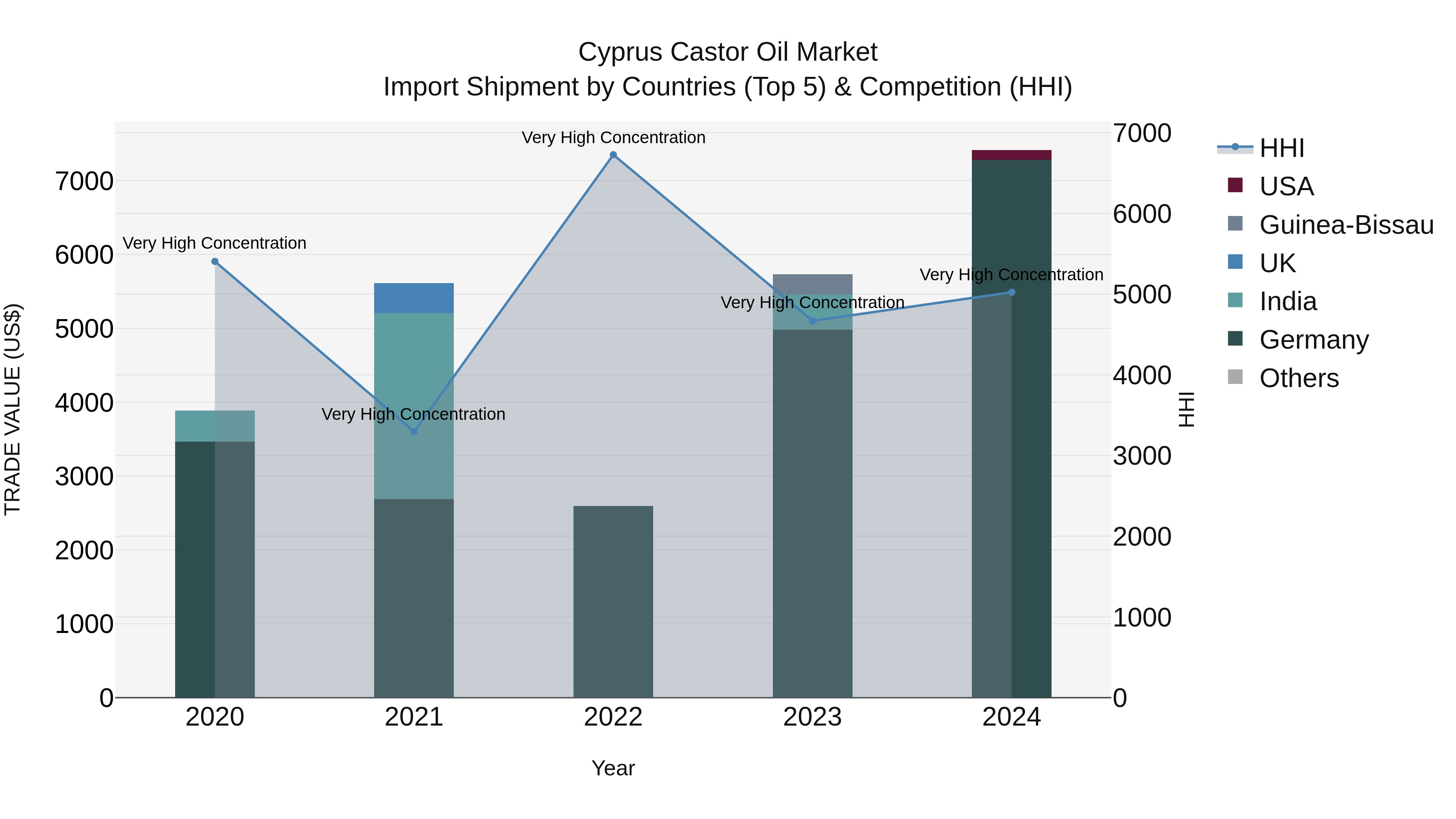
Cyprus Castor Oil Market Import Shipment by Countries (Top 5) & Competition (HHI)
Cyprus continues to experience a robust growth in castor oil imports, with a high Herfindahl-Hirschman Index indicating significant market concentration. The top exporting countries in 2024, including Germany, USA, Guinea-Bissau, India, and UK, highlight the diverse sources contributing to this growth. The impressive compound annual growth rate (CAGR) of 17.52% from 2020 to 2024 showcases sustained market expansion. Moreover, the notable growth rate of 29.24% from 2023 to 2024 underscores the increasing demand for castor oil in Cyprus.
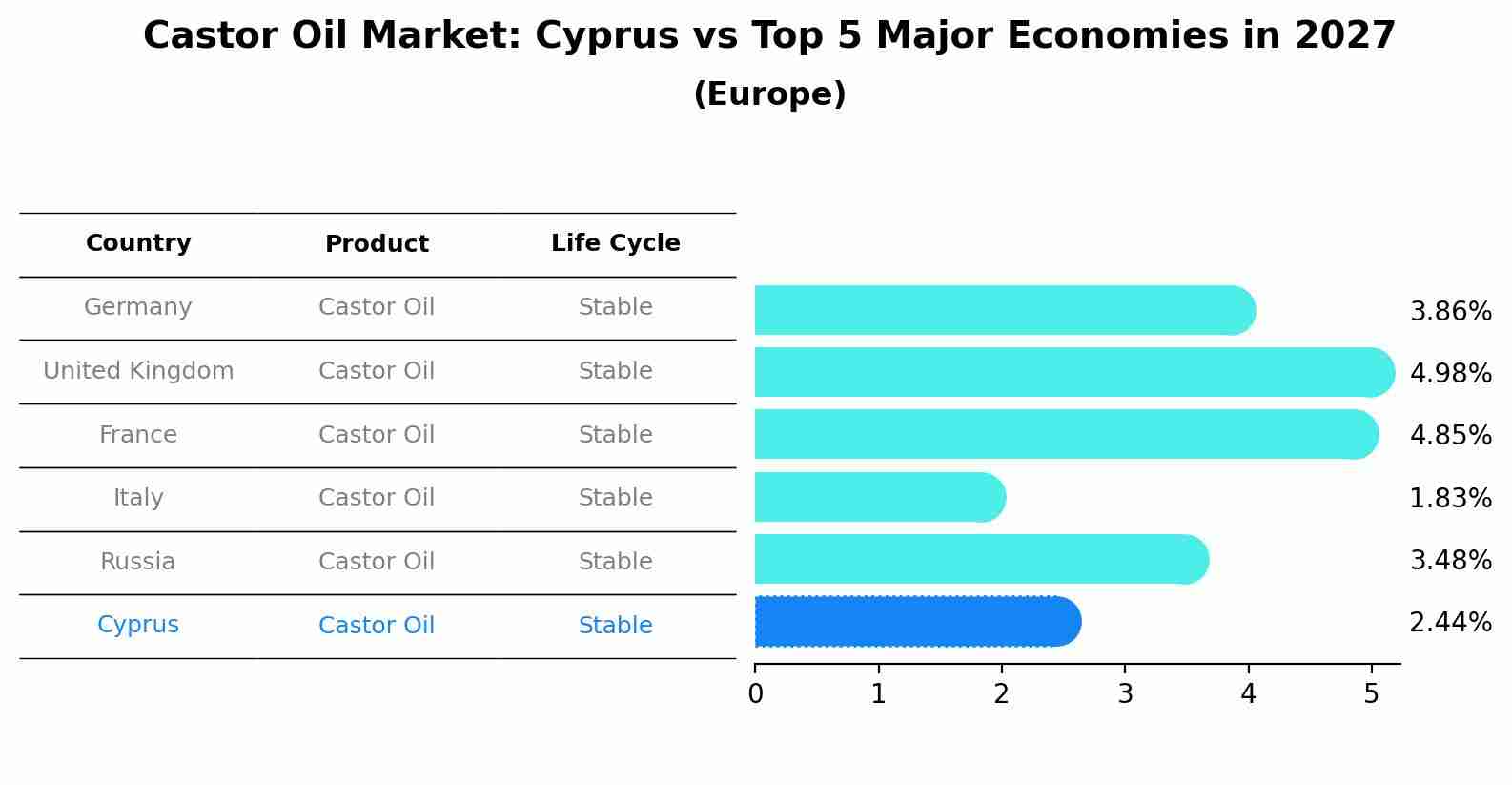
Castor Oil Market: Cyprus vs Top 5 Major Economies in 2027 (Europe)
The Castor Oil market in Cyprus is projected to grow at a stable growth rate of 2.44% by 2027, within the Europe region led by Germany, along with other countries like United Kingdom, France, Italy and Russia, collectively shaping a dynamic and evolving market environment driven by innovation and increasing adoption of emerging technologies.
Cyprus Castor Oil Market Overview
The castor oil market in Cyprus is influenced by its diverse applications in industries such as cosmetics, pharmaceuticals, and industrial manufacturing. Castor oil is valued for its emollient properties and is used in personal care products, lubricants, and as a bio-based raw material.
Drivers of the market
The castor oil market in Cyprus is driven by its use in various industries, including cosmetics, pharmaceuticals, and lubricants. As a natural, renewable resource with multiple applications, castor oil is gaining popularity for its versatility and sustainability.
Challenges of the market
The castor oil market in Cyprus faces challenges from limited demand in key sectors such as pharmaceuticals and cosmetics. The small local production and high importation costs further hinder market development.
Government Policy of the market
Cyprus regulates the castor oil market through policies that ensure the safe production and use of natural oils in various industries, including cosmetics, pharmaceuticals, and food. The government aligns with EU regulations on natural products, promoting sustainable and safe practices in the production and application of castor oil.
Key Highlights of the Report:
- Cyprus Castor Oil Market Outlook
- Market Size of Cyprus Castor Oil Market, 2024
- Forecast of Cyprus Castor Oil Market, 2031
- Historical Data and Forecast of Cyprus Castor Oil Revenues & Volume for the Period 2021-2031
- Cyprus Castor Oil Market Trend Evolution
- Cyprus Castor Oil Market Drivers and Challenges
- Cyprus Castor Oil Price Trends
- Cyprus Castor Oil Porter`s Five Forces
- Cyprus Castor Oil Industry Life Cycle
- Historical Data and Forecast of Cyprus Castor Oil Market Revenues & Volume By End Use for the Period 2021-2031
- Historical Data and Forecast of Cyprus Castor Oil Market Revenues & Volume By Pharmaceuticals for the Period 2021-2031
- Historical Data and Forecast of Cyprus Castor Oil Market Revenues & Volume By Lubricants for the Period 2021-2031
- Historical Data and Forecast of Cyprus Castor Oil Market Revenues & Volume By Paints for the Period 2021-2031
- Historical Data and Forecast of Cyprus Castor Oil Market Revenues & Volume By Soaps for the Period 2021-2031
- Historical Data and Forecast of Cyprus Castor Oil Market Revenues & Volume By Others for the Period 2021-2031
- Cyprus Castor Oil Import Export Trade Statistics
- Market Opportunity Assessment By End Use
- Cyprus Castor Oil Top Companies Market Share
- Cyprus Castor Oil Competitive Benchmarking By Technical and Operational Parameters
- Cyprus Castor Oil Company Profiles
- Cyprus Castor Oil Key Strategic Recommendations






































