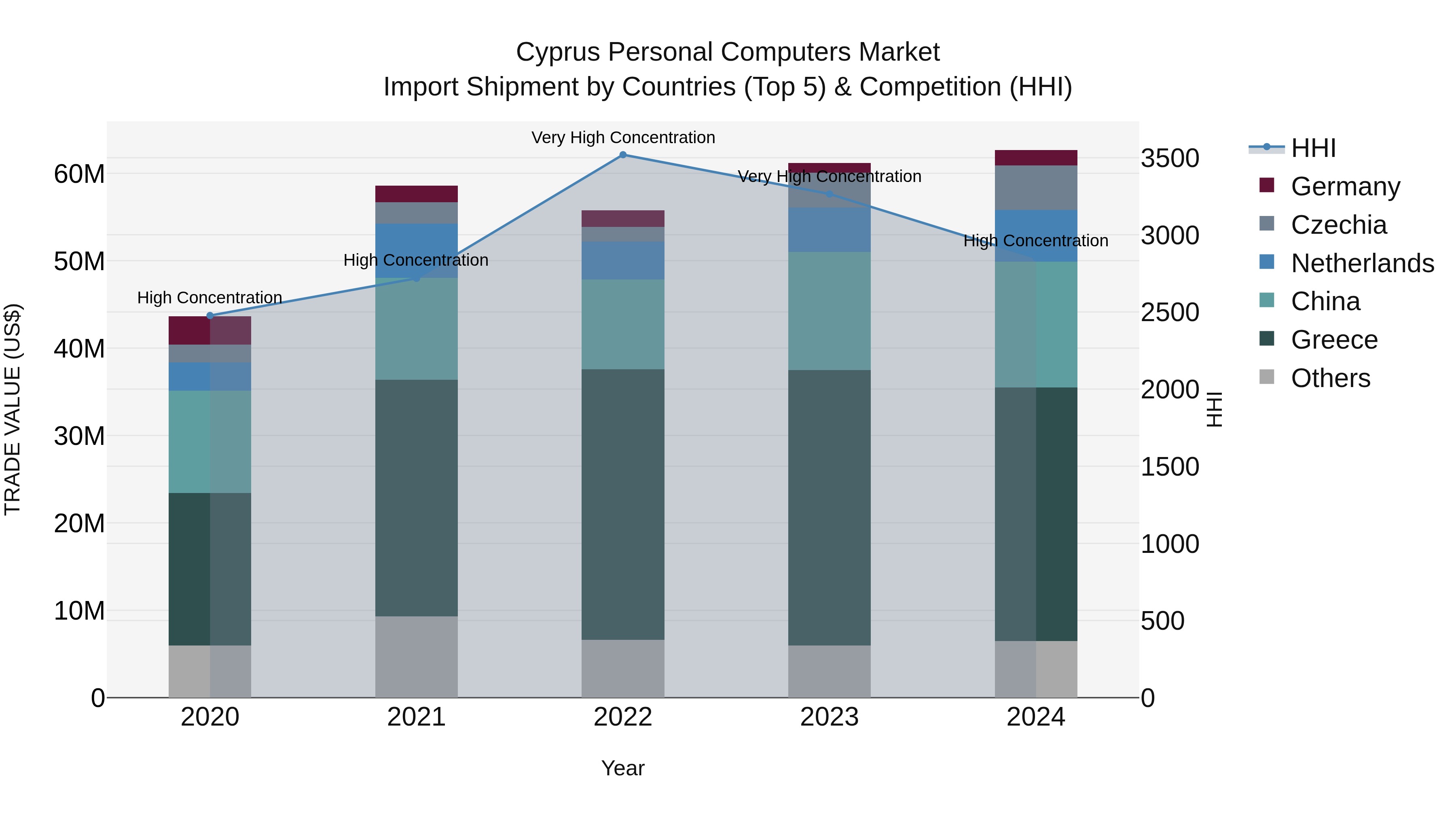
Cyprus Personal Computers Market Import Shipment by Countries (Top 5) & Competition (HHI)
Cyprus continues to see a steady increase in personal computers import shipments, with top exporters in 2024 being Greece, China, Netherlands, Czechia, and Hong Kong. The market concentration, as measured by the HHI, remains high, indicating a competitive landscape. The compound annual growth rate (CAGR) from 2020 to 2024 stands at a robust 9.45%, while the growth rate from 2023 to 2024 is a healthy 2.38%. This data suggests a growing demand for personal computers in Cyprus and highlights the importance of monitoring market trends and competition in the industry.
Key Highlights of the Report:
- Cyprus Personal Computers Market Outlook
- Market Size of Cyprus Personal Computers Market, 2024
- Forecast of Cyprus Personal Computers Market, 2031
- Historical Data and Forecast of Cyprus Personal Computers Revenues & Volume for the Period 2021-2031
- Cyprus Personal Computers Market Trend Evolution
- Cyprus Personal Computers Market Drivers and Challenges
- Cyprus Personal Computers Price Trends
- Cyprus Personal Computers Porter`s Five Forces
- Cyprus Personal Computers Industry Life Cycle
- Historical Data and Forecast of Cyprus Personal Computers Market Revenues & Volume By Product Type for the Period 2021-2031
- Historical Data and Forecast of Cyprus Personal Computers Market Revenues & Volume By Desktop for the Period 2021-2031
- Historical Data and Forecast of Cyprus Personal Computers Market Revenues & Volume By Notebook for the Period 2021-2031
- Historical Data and Forecast of Cyprus Personal Computers Market Revenues & Volume By Workstation for the Period 2021-2031
- Historical Data and Forecast of Cyprus Personal Computers Market Revenues & Volume By Others for the Period 2021-2031
- Historical Data and Forecast of Cyprus Personal Computers Market Revenues & Volume By Distribution Channel for the Period 2021-2031
- Historical Data and Forecast of Cyprus Personal Computers Market Revenues & Volume By Business-To-Business (B2B) for the Period 2021-2031
- Historical Data and Forecast of Cyprus Personal Computers Market Revenues & Volume By Business-To-Consumer (B2C) for the Period 2021-2031
- Historical Data and Forecast of Cyprus Personal Computers Market Revenues & Volume By Application for the Period 2021-2031
- Historical Data and Forecast of Cyprus Personal Computers Market Revenues & Volume By Consumer for the Period 2021-2031
- Historical Data and Forecast of Cyprus Personal Computers Market Revenues & Volume By Commercial for the Period 2021-2031
- Historical Data and Forecast of Cyprus Personal Computers Market Revenues & Volume By Industrial for the Period 2021-2031
- Cyprus Personal Computers Import Export Trade Statistics
- Market Opportunity Assessment By Product Type
- Market Opportunity Assessment By Distribution Channel
- Market Opportunity Assessment By Application
- Cyprus Personal Computers Top Companies Market Share
- Cyprus Personal Computers Competitive Benchmarking By Technical and Operational Parameters
- Cyprus Personal Computers Company Profiles
- Cyprus Personal Computers Key Strategic Recommendations






































