Nigeria Personal Computers Market Size, Share & Growth Rate
The Nigeria Personal Computers Market was estimated at USD 958 Million in 2025 and is projected to reach USD 1360 Million by 2032, growing at a CAGR of 5.1% from 2026 to 2032. This growth trajectory is largely driven by the increasing demand for both laptops and desktops, fueled by rising internet penetration and a burgeoning education sector. Additionally, the widespread shift toward remote work and digital learning has significantly heightened the necessity for personal computers across Nigeria.
Nigeria Personal Computers Market Year-wise Growth Rate and Key Drivers
This graph highlights how the Nigeria Personal Computers Market has steadily grown over the years, supported by major growth factors.
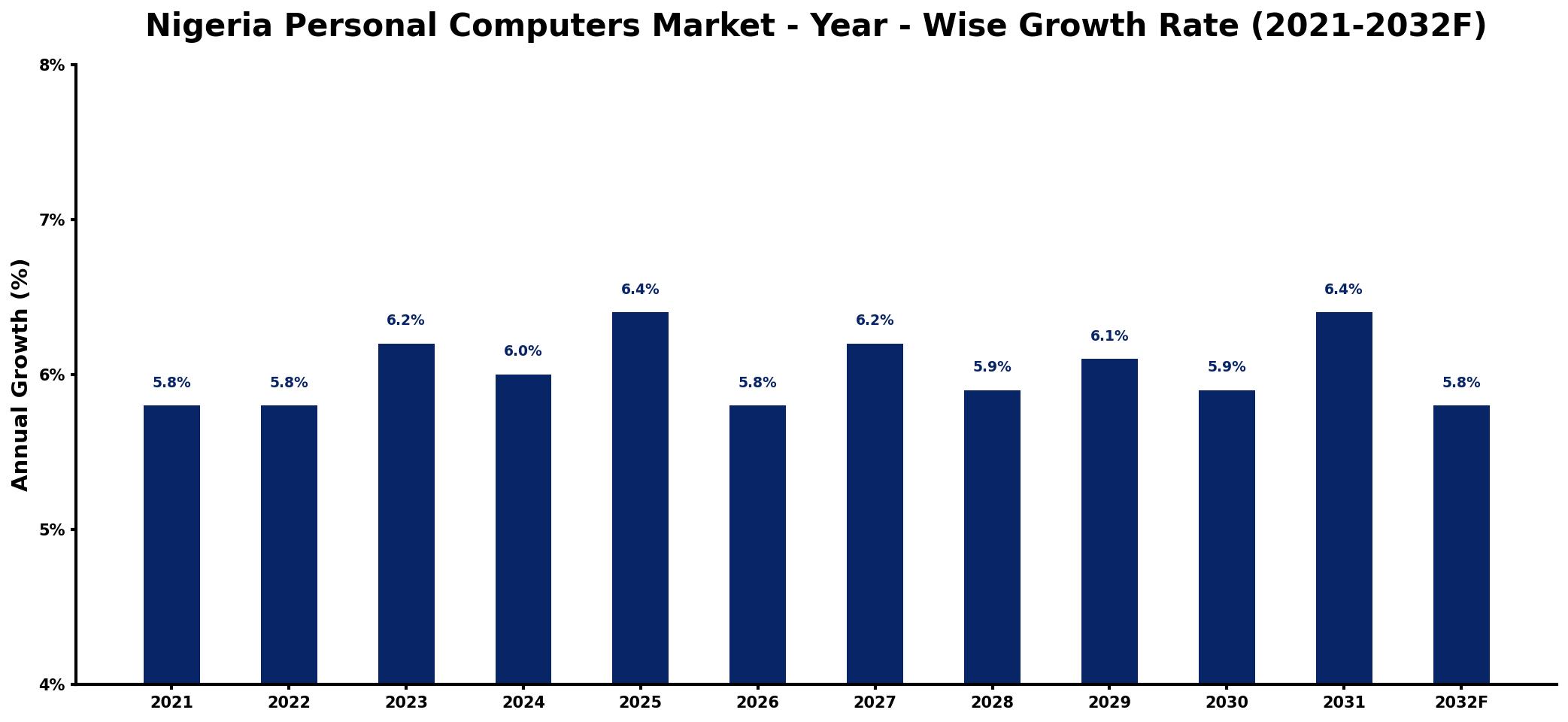
The table below presents the year‑wise growth rates along with the key drivers influencing the market
| Year | Growth Rate | Major Drivers |
| 2021 | 5.8% | Increased remote work adoption |
| 2022 | 5.8% | Growth in educational investments |
| 2023 | 6.2% | Rise in online learning platforms |
| 2024 | 6.0% | Expansion of tech infrastructure |
| 2025 | 6.4% | Increased demand for gaming |
| 2026 | 5.8% | Surge in digital content creation |
| 2027 | 6.2% | More businesses embracing digitization |
| 2028 | 5.9% | Growth of e-commerce platforms |
| 2029 | 6.1% | Increased focus on cybersecurity solutions |
| 2030 | 5.9% | expanding healthcare application demand |
| 2031 | 6.4% | improved processing technologies adoption |
| 2032 | 5.8% | Growing demand for digital collaboration |
Note: Market size estimations and growth projections presented in this report are based on 6Wresearch's proprietary forecasting methodology, utilizing the latest available industry data, government publications, and primary research inputs.
Nigeria Personal Computers Market Synopsis
In Nigeria, the demand for personal computers is witnessing a significant shift towards more portable devices, particularly laptops and tablets, which are preferred for their versatility in remote work and educational settings. This pivot is reinforced by the ongoing digital transformation across various sectors that necessitate high-performance computing solutions.
As the market evolves, manufacturers are prioritizing the development of affordable devices to cater to a broader demographic, including students and entry-level professionals. The growth of the gaming community is also prompting an uptick in demand for high-performance laptops, marking a notable trend within this dynamic market.
Nigeria Personal Computers Market Key Takeaways
- The shift towards portable computing devices, like laptops and tablets, is becoming dominant in the market.
- Government policies are creating a supportive environment for local manufacturing and assembly of PCs.
- There is an increasing demand for entry-level laptops driven by a large youth population seeking affordable technology.
- The prevalence of remote work and online education is creating consistent growth opportunities in the personal computer segment.
- Gaming laptops are gaining traction, reflecting the growing interest in gaming among Nigerian consumers.
Evaluation of Restraints in Nigeria Personal Computers Market
Despite its potential, the Nigeria Personal Computers Market faces several constraints that could impede its expansion. Limited disposable income remains a critical barrier, rendering computers less accessible to a significant portion of the population. Additionally, the economic volatility, characterized by fluctuating exchange rates and high import tariffs, further exacerbates the affordability issue. Infrastructure challenges, such as inconsistent power supply and inadequate internet connectivity, continue to deter users from fully adopting personal computers. Furthermore, the presence of counterfeit products in the market undermines consumer trust, creating additional hurdles for legitimate sales.
Nigeria Personal Computers Market Trends
The current landscape of the Nigeria Personal Computers Market is defined by several key trends. Firstly, there is a noticeable shift towards entry-level laptops that offer essential functionalities without straining consumers' budgets. Secondly, the growing acceptance of online learning has heightened demand for devices that provide reliable connectivity and performance. The gaming segment is also evolving, with more consumers seeking high-performance laptops to enhance their gaming experiences. Additionally, brands are focusing on durability and battery life, aligning product offerings with the needs of modern users.
Nigeria Personal Computers Market Opportunities
The market holds promising investment opportunities, particularly for stakeholders interested in catering to a tech-savvy youth demographic. As digital literacy initiatives gain momentum, the demand for both hardware and software solutions tailored to local needs is set to rise. Furthermore, local assembly of PCs could yield cost advantages, creating a niche for manufacturers. Investment in technical support and maintenance services also presents significant potential as consumer confidence in technology continues to grow.
Government Initiatives in the Nigeria Personal Computers Market
The Nigerian government has enacted several initiatives aimed at fostering growth in the Personal Computers Market. The National Information Technology Development Agency (NITDA) Act is pivotal in promoting IT development, while the policy to waive import duties on completely knocked down (CKD) parts for local assembly has made it easier for manufacturers to establish operations in Nigeria. Moreover, ongoing efforts to improve infrastructure and encourage foreign investment are anticipated to create a more conducive environment for the personal computer sector.
Future Insights of the Nigeria Personal Computers Market
Looking ahead to the period from 2026 to 2032, the Nigeria Personal Computers Market is positioned for continued growth. The ongoing increase in internet accessibility and the shift towards remote working solutions will catalyze the adoption of personal computers across various demographics. Additionally, as advancements in technology lead to the introduction of more affordable devices, consumer uptake is expected to rise. Nevertheless, addressing challenges such as economic uncertainty and infrastructural deficiencies will be crucial to realizing the market's full potential.
Nigeria Personal Computers Market Latest Developments (2025 - 2026)
Recent developments in the Nigeria Personal Computers Market reflect a dynamic industry response to evolving consumer needs. There is an observable increase in partnerships aimed at enhancing the distribution of affordable computing devices. Additionally, several initiatives are underway to improve digital literacy among youth, further supporting market growth. Manufacturers are increasingly focusing on local assembly processes, aligning with government incentives to boost domestic production.
Nigeria Personal Computers Market - Key Attractiveness of the Report
- 10 Years of Market Numbers
- Historical Data Starting from 2022 to 2025
- Base Year: 2025
- Forecast Data until 2032
- Key Performance Indicators Impacting the Market
- Major Upcoming Developments and Projects
Key Highlights of the Report:
- Nigeria Personal Computers Market Outlook
- Market Size of Nigeria Personal Computers Market, 2025
- Forecast of Nigeria Personal Computers Market, 2032
- Historical Data and Forecast of Nigeria Personal Computers Revenues & Volume for the Period 2022-2032F
- Nigeria Personal Computers Market Trend Evolution
- Nigeria Personal Computers Market Drivers and Challenges
- Nigeria Personal Computers Price Trends
- Nigeria Personal Computers Porter's Five Forces
- Nigeria Personal Computers Industry Life Cycle
- Historical Data and Forecast of Nigeria Personal Computers Market Revenues & Volume By Product Type for the Period 2022-2032F
- Historical Data and Forecast of Nigeria Personal Computers Market Revenues & Volume By Desktop for the Period 2022-2032F
- Historical Data and Forecast of Nigeria Personal Computers Market Revenues & Volume By Notebook for the Period 2022-2032F
- Historical Data and Forecast of Nigeria Personal Computers Market Revenues & Volume By Workstation for the Period 2022-2032F
- Historical Data and Forecast of Nigeria Personal Computers Market Revenues & Volume By Others for the Period 2022-2032F
- Historical Data and Forecast of Nigeria Personal Computers Market Revenues & Volume By Distribution Channel for the Period 2022-2032F
- Historical Data and Forecast of Nigeria Personal Computers Market Revenues & Volume By Business-To-Business (B2B) for the Period 2022-2032F
- Historical Data and Forecast of Nigeria Personal Computers Market Revenues & Volume By Business-To-Consumer (B2C) for the Period 2022-2032F
- Historical Data and Forecast of Nigeria Personal Computers Market Revenues & Volume By Application for the Period 2022-2032F
- Historical Data and Forecast of Nigeria Personal Computers Market Revenues & Volume By Consumer for the Period 2022-2032F
- Historical Data and Forecast of Nigeria Personal Computers Market Revenues & Volume By Commercial for the Period 2022-2032F
- Historical Data and Forecast of Nigeria Personal Computers Market Revenues & Volume By Industrial for the Period 2022-2032F
- Nigeria Personal Computers Import Export Trade Statistics
- Market Opportunity Assessment By Product Type
- Market Opportunity Assessment By Distribution Channel
- Market Opportunity Assessment By Application
- Nigeria Personal Computers Top Companies Market Share
- Nigeria Personal Computers Competitive Benchmarking By Technical and Operational Parameters
- Nigeria Personal Computers Company Profiles
- Nigeria Personal Computers Key Strategic Recommendations






































