Czech Republic Anti Reflective Glass Market Size, Share & Growth Rate
The Czech Republic Anti Reflective Glass Market was estimated at USD 232 Million in 2025 and is projected to reach USD 323 Million by 2032, growing at a CAGR of 4.8% from 2026 to 2032. This steady growth trajectory is propelled by the increasing demand for energy-efficient solutions across various sectors, particularly construction and automotive. As sustainability becomes a priority in project design and execution, anti-reflective glass is being recognized for its significant advantages in enhancing light transmission and minimizing glare.
Czech Republic Anti Reflective Glass Market Year-wise Growth Rate and Key Drivers
This graph highlights how the Czech Republic Anti Reflective Glass Market has steadily grown over the years, supported by major growth factors.
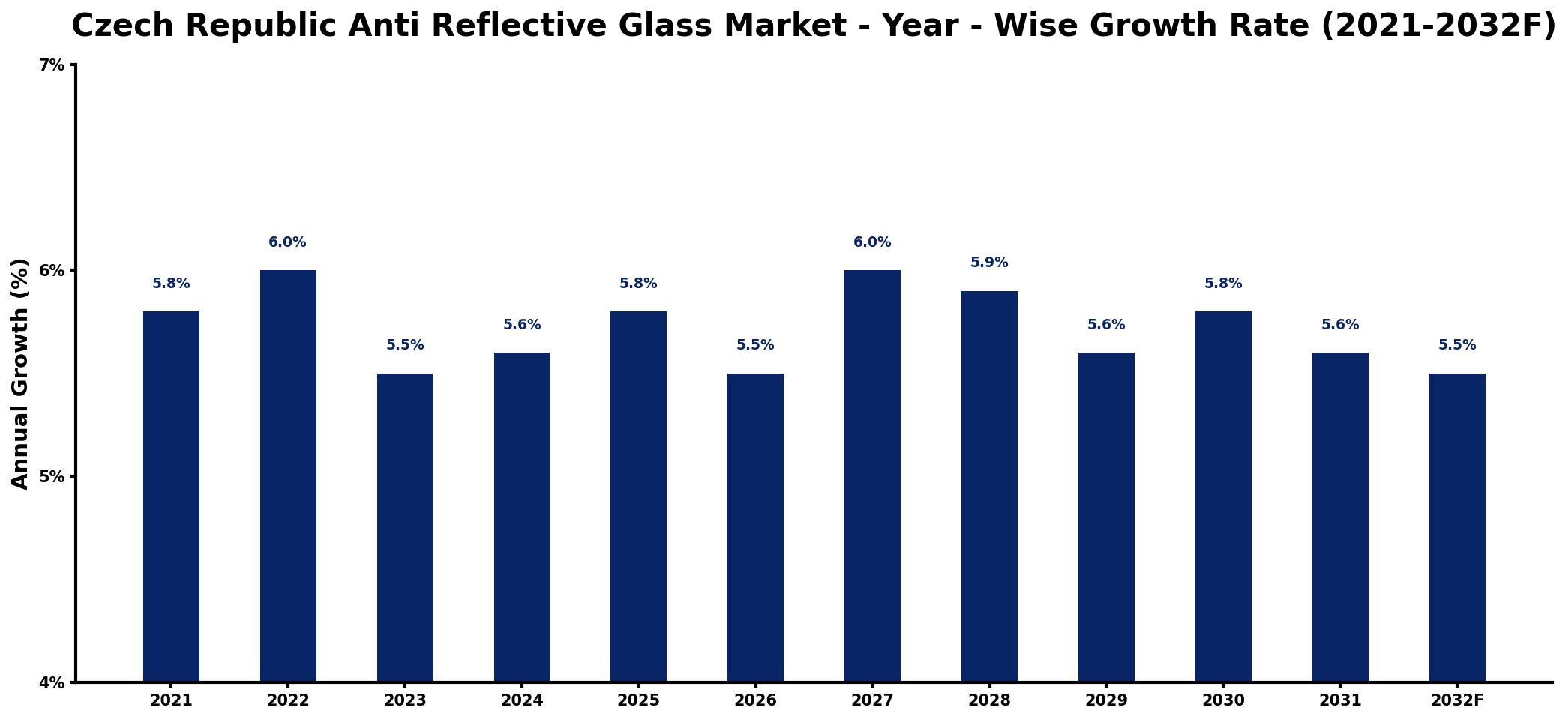
The table below presents the year‑wise growth rates along with the key drivers influencing the market
| Year | Growth Rate | Major Drivers |
| 2021 | 5.8% | Rising demand in construction industry |
| 2022 | 6.0% | Increased investments in technology |
| 2023 | 5.5% | Growing popularity of sustainable solutions |
| 2024 | 5.6% | Expansion of automotive sector applications |
| 2025 | 5.8% | Surge in residential renovations market |
| 2026 | 5.5% | Enhancements in manufacturing processes |
| 2027 | 6.0% | Emergence of new architectural trends |
| 2028 | 5.9% | Boost in consumer electronics usage |
| 2029 | 5.6% | Development of energy efficient buildings |
| 2030 | 5.8% | Increased focus on design aesthetics |
| 2031 | 5.6% | Growth in international trade agreements |
| 2032 | 5.5% | Rising awareness of optical clarity |
Note: Market size estimations and growth projections presented in this report are based on 6Wresearch's proprietary forecasting methodology, utilizing the latest available industry data, government publications, and primary research inputs.
Czech Republic Anti Reflective Glass Market Synopsis
The Czech Republic Anti Reflective Glass Market has gained momentum in recent years, with rising applications in automotive and architectural sectors. However, it is poised for even greater growth as consumer awareness and regulatory support for energy-efficient products continue to rise. This evolving landscape indicates a shift towards innovative solutions that meet aesthetic and functional demands.
Currently, the market is characterized by significant investments in product development, particularly in advanced coatings that enhance durability. As the demand for high-quality glass solutions grows, manufacturers are adjusting their offerings to cater to a broader spectrum of consumer needs in both residential and commercial domains.
Czech Republic Anti Reflective Glass Market Key Takeaways
- The market is driven by increasing demands in the automotive, architectural, and electronics sectors.
- Energy efficiency and sustainability are leading factors influencing the adoption of anti-reflective glass.
- Technological advancements are paving the way for innovative products with enhanced performance characteristics.
- Investment opportunities are robust, particularly in urban development and green building initiatives.
- Strong competition in glass coatings necessitates continuous innovation and strategic partnerships for market players.
Evaluation of Restraints in Czech Republic Anti Reflective Glass Market
The Czech Republic Anti Reflective Glass Market faces several constraints that could impede its growth. One significant factor is the increasing competition from alternative glass coatings, such as self-cleaning and energy-efficient options, which can overshadow the benefits of anti-reflective solutions. Additionally, fluctuations in raw material prices exert pricing pressures, limiting profit margins for manufacturers. Regulatory challenges concerning environmental and safety standards further complicate the landscape, as companies must navigate compliance while striving for innovation and market differentiation.
Czech Republic Anti Reflective Glass Market Trends
A clear trend is emerging within the Czech Republic Anti Reflective Glass Market, with an increasing focus on architectural applications. The integration of anti-reflective glass in facades, windows, and skylights is not only enhancing aesthetic appeal but is also contributing to energy efficiency in buildings. Moreover, there is a notable rise in the use of advanced coatings that provide greater durability and performance, reflecting a broader shift towards innovation in the industry. Consumer awareness regarding maintenance benefits is also influencing the popularity of these products.
Czech Republic Anti Reflective Glass Market Opportunities
Significant opportunities exist within the Czech Republic Anti Reflective Glass Market, particularly in response to the growing demand for high-quality glass solutions. Urbanization and infrastructure development are driving the need for energy-efficient building materials, creating a fertile ground for investment. Furthermore, the Czech Republic's strategic geographical position in Europe facilitates access to broader markets, increasing the export potential for companies involved in the anti-reflective glass sector. Innovations in product offerings that cater to consumer preferences for aesthetics and sustainability are also likely to yield substantial returns.
Government Initiatives in the Czech Republic Anti Reflective Glass Market
The Czech Republic government has actively pursued policies that enhance sustainability and energy efficiency within the construction industry. Regulations mandate the use of energy-efficient materials, which include anti-reflective glass, in various projects. Additionally, initiatives encouraging businesses to adopt eco-friendly practices, along with programs promoting renewable energy sources, provide a supportive environment for the growth of the anti-reflective glass market. These government efforts align closely with EU directives, fostering a sustainable market landscape.
Future Insights of the Czech Republic Anti Reflective Glass Market
Looking ahead to 2026-2032, the Czech Republic Anti Reflective Glass Market is set to experience promising growth, primarily driven by demand from the automotive, electronics, and construction sectors. As architectural trends increasingly favor energy-efficient solutions, anti-reflective glass will likely play an integral role in enhancing both visual appeal and functional performance. Advancements in coating technologies and an unwavering focus on sustainability are expected to further bolster the market's expansion, paving the way for innovative applications and strategic partnerships in the coming years.
Czech Republic Anti Reflective Glass Market Latest Developments (2025 - 2026)
In recent months, the Czech Republic Anti Reflective Glass Market has seen a surge in initiatives focused on product innovation and sustainability. Companies are increasingly collaborating on research and development projects aimed at enhancing the performance of anti-reflective coatings. Additionally, regulatory bodies are reinforcing standards that align with environmental objectives, influencing the adoption of greener materials. This proactive approach is indicative of a market that is adapting to consumer demands and aligning with global sustainability trends.
Czech Republic Anti Reflective Glass Market - Key Attractiveness of the Report
- 10 Years of Market Numbers
- Historical Data Starting from 2022 to 2025
- Base Year: 2025
- Forecast Data until 2032
- Key Performance Indicators Impacting the Market
- Major Upcoming Developments and Projects
Key Highlights of the Report:
- Czech Republic Anti Reflective Glass Market Outlook
- Market Size of Czech Republic Anti Reflective Glass Market, 2025
- Forecast of Czech Republic Anti Reflective Glass Market, 2032
- Historical Data and Forecast of Czech Republic Anti Reflective Glass Revenues & Volume for the Period 2022-2032F
- Czech Republic Anti Reflective Glass Market Trend Evolution
- Czech Republic Anti Reflective Glass Market Drivers and Challenges
- Czech Republic Anti Reflective Glass Price Trends
- Czech Republic Anti Reflective Glass Porter's Five Forces
- Czech Republic Anti Reflective Glass Industry Life Cycle
- Historical Data and Forecast of Czech Republic Anti Reflective Glass Market Revenues & Volume By Type for the Period 2022-2032F
- Historical Data and Forecast of Czech Republic Anti Reflective Glass Market Revenues & Volume By Double Layers for the Period 2022-2032F
- Historical Data and Forecast of Czech Republic Anti Reflective Glass Market Revenues & Volume By Four Layers for the Period 2022-2032F
- Historical Data and Forecast of Czech Republic Anti Reflective Glass Market Revenues & Volume By Others for the Period 2022-2032F
- Historical Data and Forecast of Czech Republic Anti Reflective Glass Market Revenues & Volume By Application for the Period 2022-2032F
- Historical Data and Forecast of Czech Republic Anti Reflective Glass Market Revenues & Volume By Architectural Windows for the Period 2022-2032F
- Historical Data and Forecast of Czech Republic Anti Reflective Glass Market Revenues & Volume By Instrumentation Windows for the Period 2022-2032F
- Historical Data and Forecast of Czech Republic Anti Reflective Glass Market Revenues & Volume By Electronic Displays for the Period 2022-2032F
- Historical Data and Forecast of Czech Republic Anti Reflective Glass Market Revenues & Volume By Picture Framing Glass for the Period 2022-2032F
- Historical Data and Forecast of Czech Republic Anti Reflective Glass Market Revenues & Volume By Showcase Glass for the Period 2022-2032F
- Historical Data and Forecast of Czech Republic Anti Reflective Glass Market Revenues & Volume By Cold Storage Displays for the Period 2022-2032F
- Historical Data and Forecast of Czech Republic Anti Reflective Glass Market Revenues & Volume By Lamps Glass for the Period 2022-2032F
- Historical Data and Forecast of Czech Republic Anti Reflective Glass Market Revenues & Volume By Others for the Period 2022-2032F
- Czech Republic Anti Reflective Glass Import Export Trade Statistics
- Market Opportunity Assessment By Type
- Market Opportunity Assessment By Application
- Czech Republic Anti Reflective Glass Top Companies Market Share
- Czech Republic Anti Reflective Glass Competitive Benchmarking By Technical and Operational Parameters
- Czech Republic Anti Reflective Glass Company Profiles
- Czech Republic Anti Reflective Glass Key Strategic Recommendations






































