Czech Republic Armored Vehicle Market Size, Share & Growth Rate
The Czech Republic Armored Vehicle Market was estimated at USD 428 Million in 2025 and is projected to reach USD 573 Million by 2032, growing at a CAGR of 4.3% from 2026 to 2032. This upward trajectory is primarily driven by increased defense spending and a robust focus on modernizing military capabilities. The ongoing geopolitical tensions within Europe, coupled with the Czech Republic's active participation in NATO, are intensifying the need for advanced armored vehicles that offer enhanced protection and interoperability.
Czech Republic Armored Vehicle Market Year-wise Growth Rate and Key Drivers
This graph highlights how the Czech Republic Armored Vehicle Market has steadily grown over the years, supported by major growth factors.
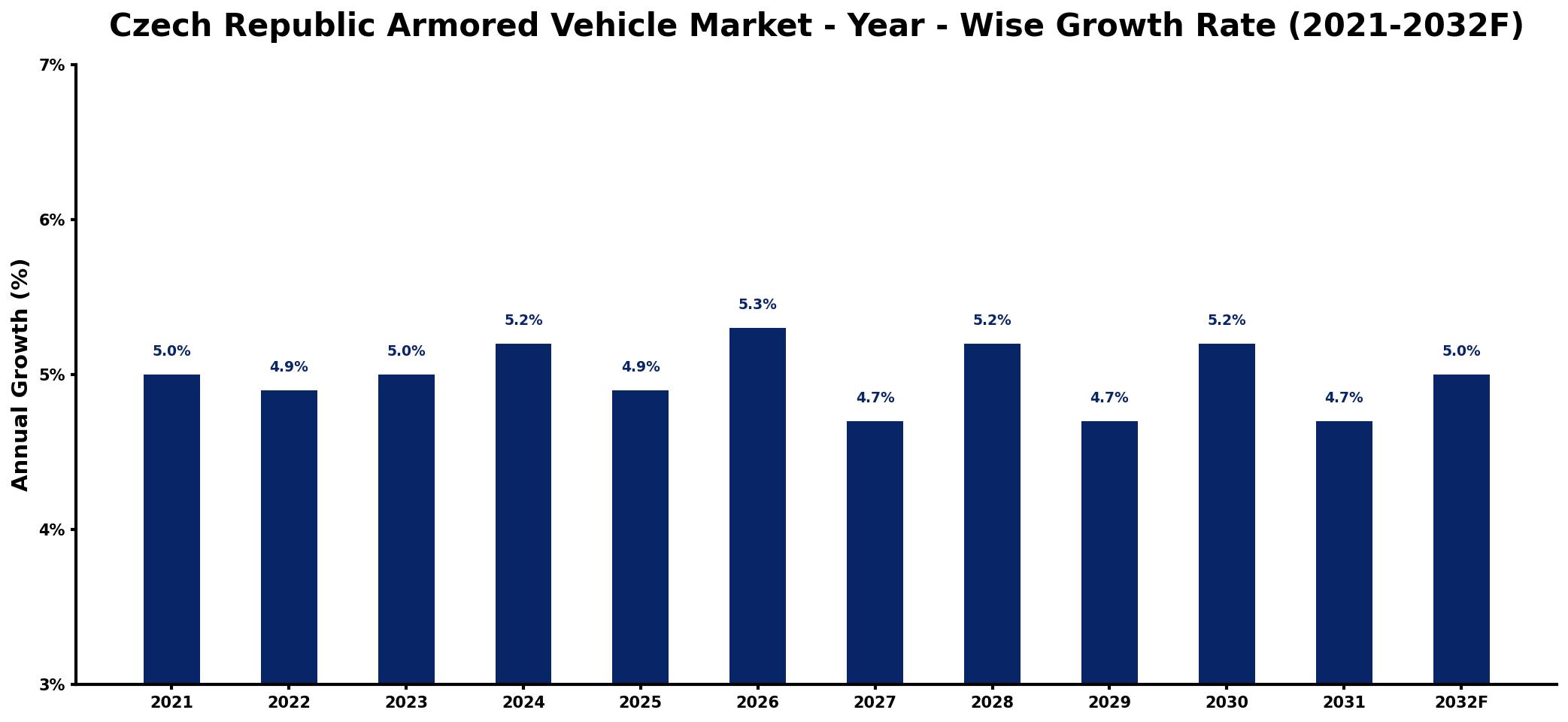
The table below presents the year‑wise growth rates along with the key drivers influencing the market
| Year | Growth Rate | Major Drivers |
| 2021 | 5.0% | Increased defense spending initiatives |
| 2022 | 4.9% | Growing regional security concerns |
| 2023 | 5.0% | Rising demand for modernization efforts |
| 2024 | 5.2% | Expansion of defense contracts awarded |
| 2025 | 4.9% | Boost in international collaborations |
| 2026 | 5.3% | Technological advancements driving investments |
| 2027 | 4.7% | Government support for local procurement |
| 2028 | 5.2% | Increased focus on military readiness |
| 2029 | 4.7% | Emerging markets attracting investments |
| 2030 | 5.2% | Strengthening alliances with NATO partners |
| 2031 | 4.7% | Enhanced research and development funding |
| 2032 | 5.0% | Focus on sustainable defense solutions |
Note: Market size estimations and growth projections presented in this report are based on 6Wresearch's proprietary forecasting methodology, utilizing the latest available industry data, government publications, and primary research inputs.
Czech Republic Armored Vehicle Market Synopsis
The Czech Republic's armored vehicle market is characterized by a significant transformation, focusing on upgrading existing fleets to meet contemporary security challenges. With a rising emphasis on multi-role vehicles, the Czech Armed Forces are prioritizing flexibility in military operations, which is driving demand for versatile armored solutions.
Moreover, the strategic position of the Czech Republic in Central Europe is prompting collaborations with international defense manufacturers. This dynamic is further bolstered by government policies aimed at enhancing national defense capabilities and supporting local production initiatives, ensuring that the market remains agile and responsive to both national and international requirements.
Czech Republic Armored Vehicle Market Key Takeaways
- The market is witnessing a notable increase in defense budgets, encouraging procurement of modern armored vehicles.
- Technological advancements are shaping vehicle upgrades, with a focus on multi-role capabilities for diverse mission execution.
- The Czech Republic's NATO membership enhances the demand for interoperable defense solutions.
- Government initiatives are geared towards promoting local manufacturing and reducing dependency on foreign suppliers.
- Strategic collaborations with global defense contractors are expected to further accelerate market growth.
Evaluation of Restraints in Czech Republic Armored Vehicle Market
Despite the promising growth potential, the Czech Republic Armored Vehicle Market faces several constraints. A limited defense budget can delay the timely modernization of military assets, hindering operational efficiency. Additionally, the market's competitiveness is intensified by international suppliers who may provide superior technology at lower costs, challenging local manufacturers. Furthermore, compliance with rigorous regulations surrounding defense contracts can create hurdles for both domestic and international firms, making it essential for stakeholders to devise strategic, innovative solutions to navigate these challenges effectively.
Czech Republic Armored Vehicle Market Trends
The current trends in the Czech Republic Armored Vehicle Market indicate a strong shift towards modernization and technology integration. There is a growing demand for vehicles equipped with cutting-edge surveillance, communication, and protection systems. Additionally, the increasing focus on cyber warfare and asymmetric threats is steering armed forces to adopt vehicles that are not only mobile but also resilient to modern warfare tactics. This trend is complemented by the Czech militarys desire for multi-role vehicles capable of adapting to various operational contexts, thereby enhancing overall defense efficacy.
Czech Republic Armored Vehicle Market Opportunities
Investment opportunities in the Czech Republic Armored Vehicle Market are expanding, driven by the need for modernization within the armed forces. As defense spending increases, there is a clear opportunity for stakeholders to engage in procurement processes, especially as the government prioritizes local production. Additionally, potential export opportunities to neighboring nations provide a promising avenue for growth. Collaborations with local defense firms can further enhance market entry strategies for international players looking to capitalize on these trends.
Government Initiatives in the Czech Republic Armored Vehicle Market
Government policies are pivotal in shaping the Czech Republic Armored Vehicle Market, focusing on modernization and self-sufficiency in defense capabilities. Initiatives aimed at increasing military spending reflect the Czech governments commitment to enhancing national security through the procurement of advanced armored vehicles. Efforts to promote domestic production are also evident, as regulations support local manufacturers and incentivize the development of new technologies in alignment with NATO standards.
Future Insights of the Czech Republic Armored Vehicle Market
Looking ahead, the Czech Republic Armored Vehicle Market is set to expand further as defense priorities shift toward modernization and technological advancement. The anticipated growth in defense budgets, coupled with an emphasis on NATO interoperability, will foster demand for advanced armored systems. As geopolitical dynamics evolve, the market will likely see an increased reliance on collaborative defense strategies, positioning both local and international manufacturers at the forefront of this growing sector.
Czech Republic Armored Vehicle Market Latest Developments (2025 - 2026)
Recent developments in the Czech Republic Armored Vehicle Market underscore a shift towards enhanced military capabilities. The government is actively pursuing procurement programs aimed at upgrading existing fleets with next-generation technology. Collaborations with various international defense contractors have been initiated, focusing on joint ventures that emphasize local production and technology transfer. Additionally, modernization initiatives are gaining momentum, ensuring that the Czech military remains capable of addressing contemporary security challenges.
Czech Republic Armored Vehicle Market - Key Attractiveness of the Report
- 10 Years of Market Numbers
- Historical Data Starting from 2022 to 2025
- Base Year: 2025
- Forecast Data until 2032
- Key Performance Indicators Impacting the Market
- Major Upcoming Developments and Projects
Key Highlights of the Report:
- Czech Republic Armored Vehicle Market Outlook
- Market Size of Czech Republic Armored Vehicle Market, 2025
- Forecast of Czech Republic Armored Vehicle Market, 2032
- Historical Data and Forecast of Czech Republic Armored Vehicle Revenues & Volume for the Period 2022-2032F
- Czech Republic Armored Vehicle Market Trend Evolution
- Czech Republic Armored Vehicle Market Drivers and Challenges
- Czech Republic Armored Vehicle Price Trends
- Czech Republic Armored Vehicle Porter's Five Forces
- Czech Republic Armored Vehicle Industry Life Cycle
- Historical Data and Forecast of Czech Republic Armored Vehicle Market Revenues & Volume By Platform for the Period 2022-2032F
- Historical Data and Forecast of Czech Republic Armored Vehicle Market Revenues & Volume By Combat Vehicles for the Period 2022-2032F
- Historical Data and Forecast of Czech Republic Armored Vehicle Market Revenues & Volume By Combat Support Vehicles for the Period 2022-2032F
- Historical Data and Forecast of Czech Republic Armored Vehicle Market Revenues & Volume By Unmanned Armored Ground Vehicles for the Period 2022-2032F
- Historical Data and Forecast of Czech Republic Armored Vehicle Market Revenues & Volume By Mobility for the Period 2022-2032F
- Historical Data and Forecast of Czech Republic Armored Vehicle Market Revenues & Volume By Wheeled for the Period 2022-2032F
- Historical Data and Forecast of Czech Republic Armored Vehicle Market Revenues & Volume By Tracked for the Period 2022-2032F
- Historical Data and Forecast of Czech Republic Armored Vehicle Market Revenues & Volume By System for the Period 2022-2032F
- Historical Data and Forecast of Czech Republic Armored Vehicle Market Revenues & Volume By Engine for the Period 2022-2032F
- Historical Data and Forecast of Czech Republic Armored Vehicle Market Revenues & Volume By Drive System for the Period 2022-2032F
- Historical Data and Forecast of Czech Republic Armored Vehicle Market Revenues & Volume By Ballistic Armor for the Period 2022-2032F
- Historical Data and Forecast of Czech Republic Armored Vehicle Market Revenues & Volume By Turret Drives for the Period 2022-2032F
- Historical Data and Forecast of Czech Republic Armored Vehicle Market Revenues & Volume By Ammunition Handling System for the Period 2022-2032F
- Historical Data and Forecast of Czech Republic Armored Vehicle Market Revenues & Volume By Fire Control Systems (FCS) for the Period 2022-2032F
- Historical Data and Forecast of Czech Republic Armored Vehicle Market Revenues & Volume By Armaments for the Period 2022-2032F
- Historical Data and Forecast of Czech Republic Armored Vehicle Market Revenues & Volume By Countermeasure System for the Period 2022-2032F
- Czech Republic Armored Vehicle Import Export Trade Statistics
- Market Opportunity Assessment By Platform
- Market Opportunity Assessment By Mobility
- Market Opportunity Assessment By System
- Czech Republic Armored Vehicle Top Companies Market Share
- Czech Republic Armored Vehicle Competitive Benchmarking By Technical and Operational Parameters
- Czech Republic Armored Vehicle Company Profiles
- Czech Republic Armored Vehicle Key Strategic Recommendations






































