Czech Republic Carbon Credit Market Size, Share & Growth Rate
The Czech Republic Carbon Credit Market was estimated at USD 159 Million in 2025 and is projected to reach USD 215 Million by 2032, growing at a CAGR of 4.4% from 2026 to 2032. This trajectory is largely propelled by the increasing commitment to renewable energy projects and the government's proactive stance on emissions reduction. Moreover, the rising awareness among businesses about sustainability practices is further stimulating demand for carbon credits in the region.
Czech Republic Carbon Credit Market Year-wise Growth Rate and Key Drivers
This graph highlights how the Czech Republic Carbon Credit Market has steadily grown over the years, supported by major growth factors.
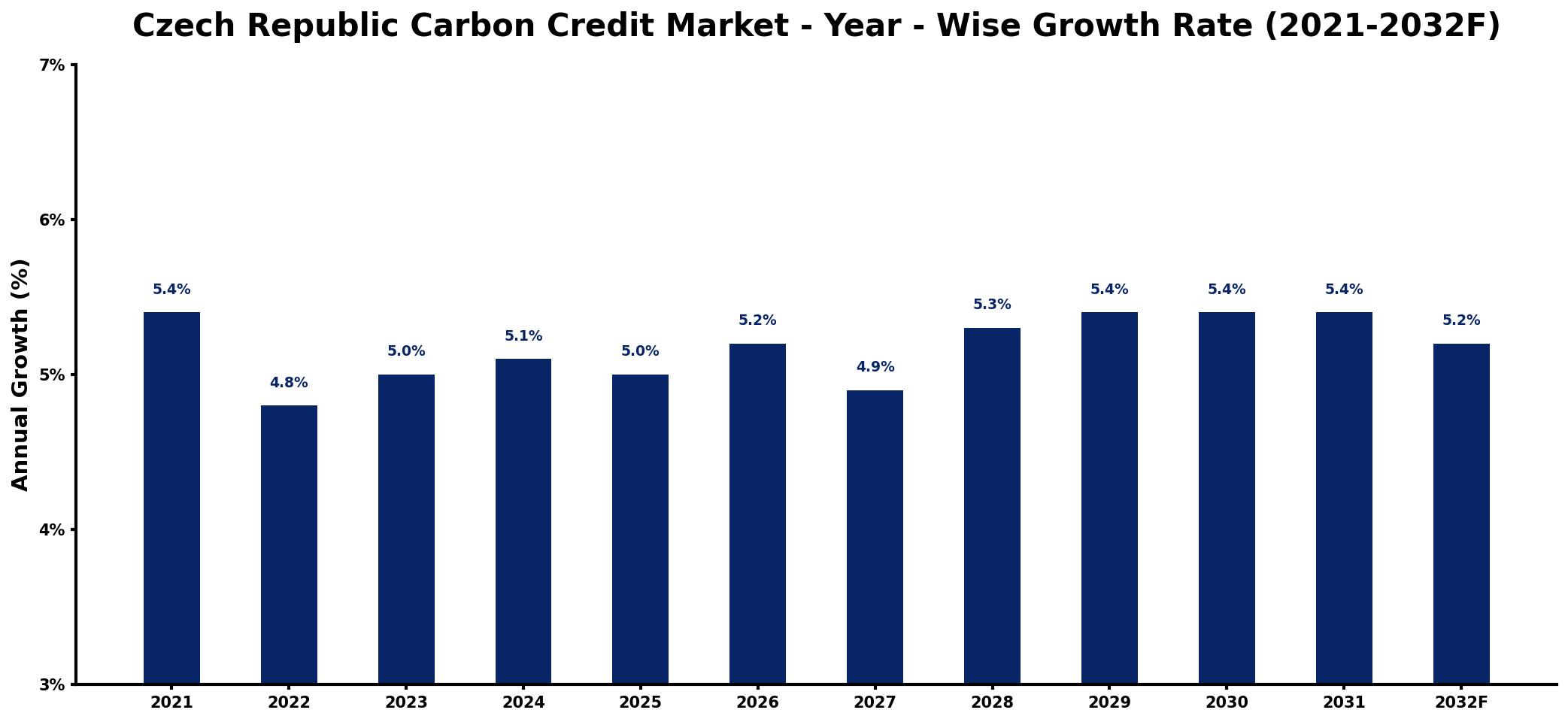
The table below presents the year‑wise growth rates along with the key drivers influencing the market
| Year | Growth Rate | Major Drivers |
| 2021 | 5.4% | Rising investments in renewable energy |
| 2022 | 4.8% | Increased corporate sustainability initiatives |
| 2023 | 5.0% | Growing demand for green technologies |
| 2024 | 5.1% | Expansion of regulatory frameworks |
| 2025 | 5.0% | rising infrastructure development spending |
| 2026 | 5.2% | Strengthened international climate agreements |
| 2027 | 4.9% | Development of innovative financing models |
| 2028 | 5.3% | Heightened consumer awareness on sustainability |
| 2029 | 5.4% | Collaborations between public private sectors |
| 2030 | 5.4% | Advancements in emissions reduction technologies |
| 2031 | 5.4% | growing commercial sector adoption |
| 2032 | 5.2% | Enhanced corporate social responsibility efforts |
Note: Market size estimations and growth projections presented in this report are based on 6Wresearch's proprietary forecasting methodology, utilizing the latest available industry data, government publications, and primary research inputs.
Czech Republic Carbon Credit Market Synopsis
The most influential force currently shaping the Czech Republic Carbon Credit Market is the governments commitment to stringent climate targets under the EU ETS framework. This commitment has led to a surge in investments in renewable energy, energy efficiency, and forestry projects aimed at reducing greenhouse gas emissions.
Furthermore, the Czech Republic is witnessing a marked interest from various sectors in carbon offset initiatives. Companies are increasingly looking to purchase carbon credits as a viable strategy to achieve compliance with emission reduction requirements while simultaneously enhancing their corporate sustainability profiles.
Czech Republic Carbon Credit Market Key Takeaways
- The Czech Republic's carbon credit market is on an upward growth trajectory fueled by strong government policies and international climate commitments.
- Renewable energy projects are the primary drivers of carbon credit demand, with increasing investments in sustainable technologies.
- Companies across various industries are actively seeking carbon credits as part of their emissions management strategies.
- Challenges such as regulatory uncertainty and fluctuating carbon prices remain but are being addressed through evolving market frameworks.
- The projected growth rate indicates a robust long-term investment potential for stakeholders in the carbon trading sector.
Evaluation of Restraints in Czech Republic Carbon Credit Market
Despite a favorable growth outlook, the Czech Republic Carbon Credit Market faces significant restraints. Regulatory uncertainty surrounding carbon pricing and trading frameworks can hinder investor confidence. Companies are often left navigating a complex landscape, making long-term planning difficult. Additionally, fluctuations in carbon credit prices may affect project viability, particularly for those reliant on consistent revenue streams from carbon credits. Finally, inconsistent government support for renewable initiatives creates barriers for new entrants and stifles innovation, ultimately limiting the market's full potential.
Czech Republic Carbon Credit Market Trends
The current landscape of the Czech Republic Carbon Credit Market is characterized by increasing investments in renewable energy projects, particularly solar and wind. Furthermore, the growth of energy efficiency initiatives is gaining traction as companies seek to minimize emissions. Another notable trend is the rising consumer and corporate demand for transparency in sustainability practices, urging businesses to pursue credible carbon offset strategies. The intersection of technology and carbon management, including digital platforms for trading credits, is also emerging as a transformative trend, facilitating more efficient transactions and accountability.
Czech Republic Carbon Credit Market Opportunities
Investment opportunities within the Czech Republic Carbon Credit Market are abundant, particularly for entities aiming to align with global sustainability goals. The increased focus on renewable energy provides a fertile ground for companies to develop projects that generate carbon credits for trading. Moreover, innovative solutions that enhance carbon sequestration, such as advanced forestry practices and land-use strategies, present further avenues for investment. The growing trend of corporate social responsibility (CSR) among businesses underscores the potential for partnerships in carbon offsetting, thus enhancing market participation.
Government Initiatives in the Czech Republic Carbon Credit Market
The Czech government actively supports the Carbon Credit Market through compliance with EU regulations and the establishment of emission reduction targets across various sectors. Allowances are allocated based on these targets, incentivizing companies to invest in green technologies. Additionally, the government promotes renewable energy development through various subsidies and incentives aimed at fostering sustainable practices. This support extends to forestry and land-use projects that sequester carbon, amplifying opportunities for engagement in the carbon offsetting space.
Future Insights of the Czech Republic Carbon Credit Market
Looking ahead to the years 2026 through 2032, the Czech Republic Carbon Credit Market is poised for growth, driven by the ongoing commitment to achieving ambitious emissions targets set by the EU. As the market matures, we can expect enhanced stability in carbon pricing and a more robust regulatory environment that facilitates the growth of green technologies. The increasing demand for carbon credits, both domestically and internationally, will position the Czech Republic favorably as a competitive player in the broader European carbon trading landscape.
Czech Republic Carbon Credit Market Latest Developments (2025 - 2026)
Recent developments within the Czech Republic Carbon Credit Market indicate a strengthening of regulations aimed at enhancing market transparency and efficiency. Furthermore, initiatives promoting partnerships between private sector players and governmental bodies have emerged, fostering collaborative efforts to accelerate carbon offset projects. As more companies commit to carbon neutrality goals, the demand for carbon credits continues to rise, signaling a positive trajectory for market expansion.
Czech Republic Carbon Credit Market - Key Attractiveness of the Report
- 10 Years of Market Numbers
- Historical Data Starting from 2022 to 2025
- Base Year: 2025
- Forecast Data until 2032
- Key Performance Indicators Impacting the Market
- Major Upcoming Developments and Projects
Key Highlights of the Report:
- Czech Republic Carbon Credit Market Outlook
- Market Size of Czech Republic Carbon Credit Market, 2025
- Forecast of Czech Republic Carbon Credit Market, 2032
- Historical Data and Forecast of Czech Republic Carbon Credit Revenues & Volume for the Period 2022-2032F
- Czech Republic Carbon Credit Market Trend Evolution
- Czech Republic Carbon Credit Market Drivers and Challenges
- Czech Republic Carbon Credit Price Trends
- Czech Republic Carbon Credit Porter's Five Forces
- Czech Republic Carbon Credit Industry Life Cycle
- Historical Data and Forecast of Czech Republic Carbon Credit Market Revenues & Volume By Sector for the Period 2022-2032F
- Historical Data and Forecast of Czech Republic Carbon Credit Market Revenues & Volume By Energy for the Period 2022-2032F
- Historical Data and Forecast of Czech Republic Carbon Credit Market Revenues & Volume By Transportation for the Period 2022-2032F
- Historical Data and Forecast of Czech Republic Carbon Credit Market Revenues & Volume By Residential And Commercial Buildings for the Period 2022-2032F
- Historical Data and Forecast of Czech Republic Carbon Credit Market Revenues & Volume By Industry for the Period 2022-2032F
- Historical Data and Forecast of Czech Republic Carbon Credit Market Revenues & Volume By Agriculture for the Period 2022-2032F
- Historical Data and Forecast of Czech Republic Carbon Credit Market Revenues & Volume By Forestry for the Period 2022-2032F
- Historical Data and Forecast of Czech Republic Carbon Credit Market Revenues & Volume By Water And Wastewater for the Period 2022-2032F
- Czech Republic Carbon Credit Import Export Trade Statistics
- Market Opportunity Assessment By Sector
- Czech Republic Carbon Credit Top Companies Market Share
- Czech Republic Carbon Credit Competitive Benchmarking By Technical and Operational Parameters
- Czech Republic Carbon Credit Company Profiles
- Czech Republic Carbon Credit Key Strategic Recommendations






































