Czech Republic Cat Food Market Size (2020-2030)
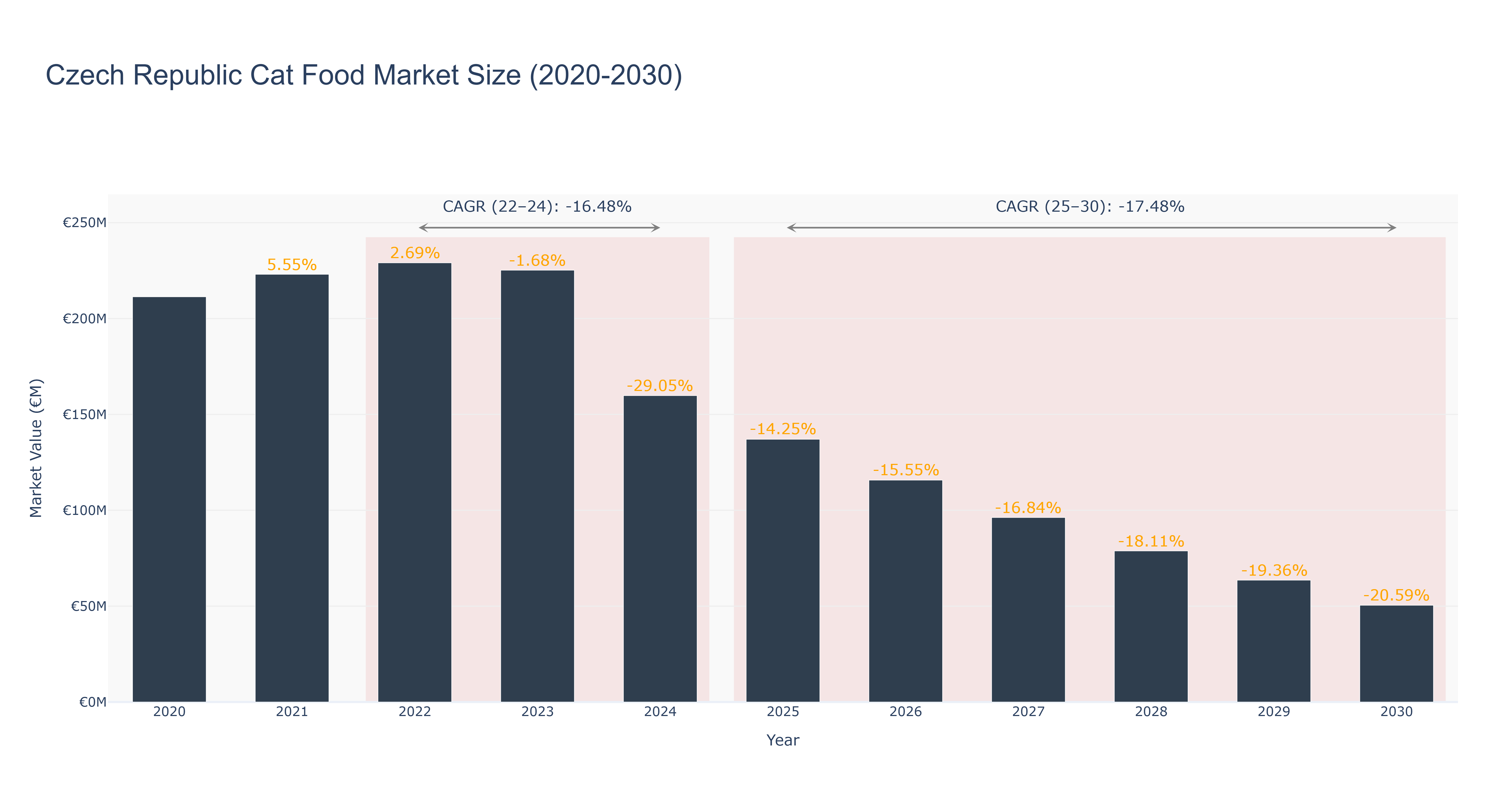
Czech Republic Cat Food Market has experienced a notable decline in market size over the past few years. The peak market size of €229.04 million was observed in 2022, followed by a sharp decrease to €50.46 million in 2030. The CAGR from 2022 to 2024 was -16.48%, while from 2025 to 2030, it is projected to be -17.48%. The market faced challenges due to changing consumer preferences towards more natural and organic pet food options, as well as increased competition from other pet food categories. Looking ahead, the market is expected to focus on product innovation and marketing strategies to regain its position in the pet food industry. Additionally, there are plans for collaborations with local animal shelters to promote adoption and responsible pet ownership in the country.
Czech Republic Cat Food Market: Production & Trade Performance (2019-2025)
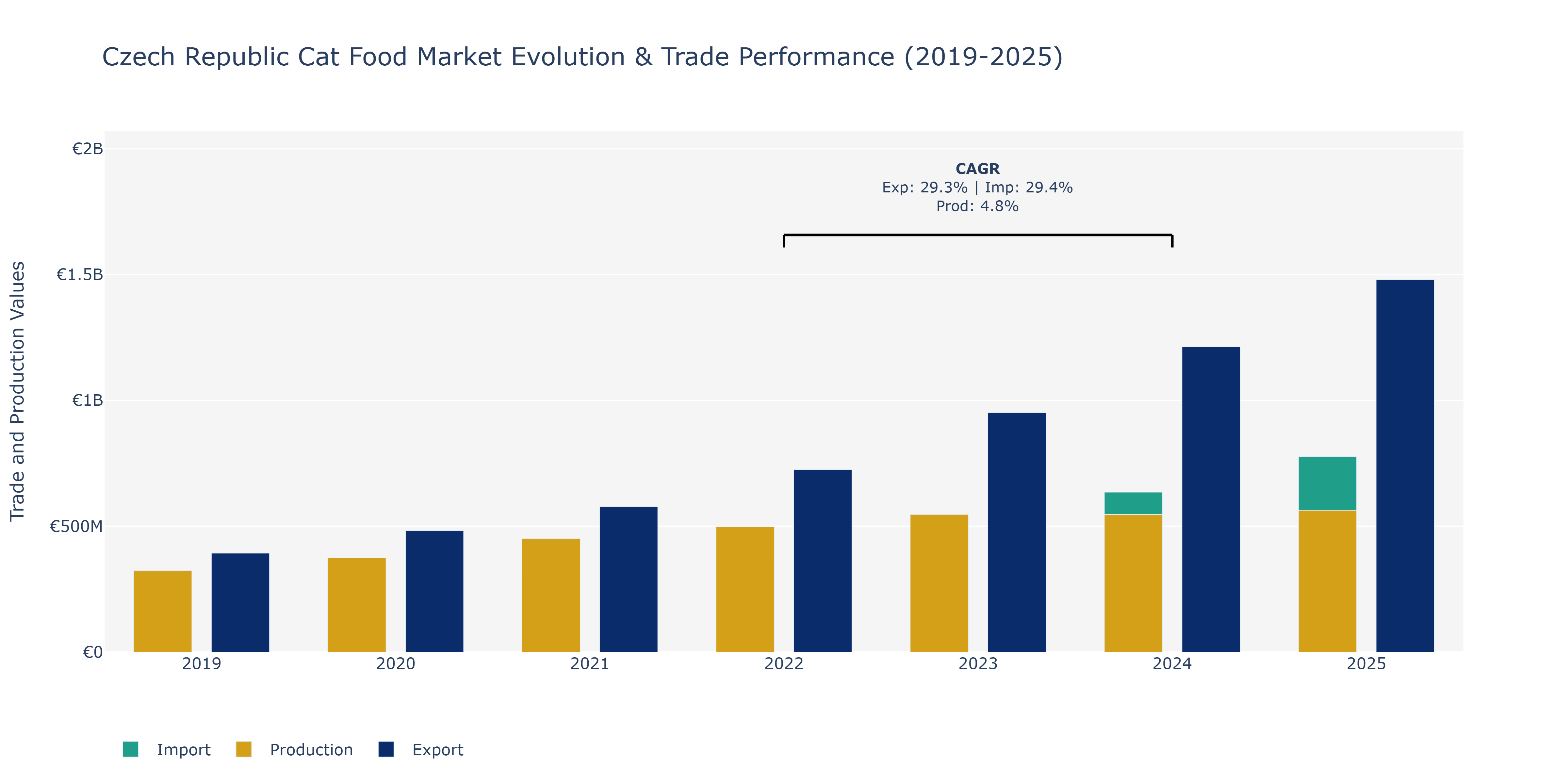
The Czech Republic Cat Food Market witnessed a consistent upward trajectory in exports, imports, and production from 2019 to 2025. Exports increased steadily from €392.96 million in 2019 to a peak of €1.48 billion in 2025, reflecting a growing demand for Czech cat food products internationally. Imports also experienced a notable surge, rising from €229.87 million in 2019 to €776.14 million in 2025, possibly indicating a shift in consumer preferences towards imported cat food varieties. Production showed a slight increase over the years, reaching €563.29 million in 2025. The surge in exports and imports could be attributed to the Czech Republic's reputation for high-quality pet food products, increased marketing efforts, and expansions in distribution networks. The steady growth in production might be influenced by investments in production facilities and technology to meet the rising demand both domestically and abroad.
Czech Republic Cat Food Market Overview
The cat food market in the Czech Republic is experiencing steady growth as pet ownership increases and consumers prioritize high-quality nutrition for their pets. The demand for premium, organic, and specialized cat food products, including grain-free and functional foods, is on the rise. Pet owners are increasingly seeking out products that promote their pets health and well-being, driving the market forward.
Drivers of the market
The cat food market in the Czech Republic is experiencing growth due to the rising pet ownership and the increasing focus on pet health and nutrition. As consumers seek high-quality and specialized food products for their pets, the demand for premium cat food is rising. The trend towards natural and organic ingredients, as well as the growth of online pet supply retail, is further driving the expansion of the cat food market.
Challenges of the market
The Cat Food Market in the Czech Republic faces challenges related to shifting consumer preferences and increasing competition from premium brands. As pet owners become more discerning about their pets` diets, there is a growing demand for high-quality, natural, and organic cat food products. This trend poses challenges for traditional cat food manufacturers, who must reformulate their products to meet evolving consumer expectations. Additionally, competition from emerging premium brands requires established companies to enhance their marketing strategies and product offerings to retain market share.
Government Policy of the market
In the cat food market, the Czech government enforces regulations to ensure food safety and quality for pet products. Compliance with EU standards for pet food production is mandatory, focusing on ingredient transparency and nutritional adequacy. The government supports research initiatives aimed at improving pet nutrition and exploring innovative formulations. Public awareness campaigns are also conducted to educate pet owners about responsible feeding practices and the importance of high-quality cat food.
Key Highlights of the Report:
- Czech Republic Cat Food Market Outlook
- Market Size of Czech Republic Cat Food Market, 2025
- Forecast of Czech Republic Cat Food Market, 2032
- Historical Data and Forecast of Czech Republic Cat Food Revenues & Volume for the Period 2022-2032F
- Czech Republic Cat Food Market Trend Evolution
- Czech Republic Cat Food Market Drivers and Challenges
- Czech Republic Cat Food Price Trends
- Czech Republic Cat Food Porter's Five Forces
- Czech Republic Cat Food Industry Life Cycle
- Historical Data and Forecast of Czech Republic Cat Food Market Revenues & Volume By Nature for the Period 2022-2032F
- Historical Data and Forecast of Czech Republic Cat Food Market Revenues & Volume By Organic for the Period 2022-2032F
- Historical Data and Forecast of Czech Republic Cat Food Market Revenues & Volume By Monoprotein for the Period 2022-2032F
- Historical Data and Forecast of Czech Republic Cat Food Market Revenues & Volume By Conventional for the Period 2022-2032F
- Historical Data and Forecast of Czech Republic Cat Food Market Revenues & Volume By Source for the Period 2022-2032F
- Historical Data and Forecast of Czech Republic Cat Food Market Revenues & Volume By Animal Derived for the Period 2022-2032F
- Historical Data and Forecast of Czech Republic Cat Food Market Revenues & Volume By Plant-derived for the Period 2022-2032F
- Historical Data and Forecast of Czech Republic Cat Food Market Revenues & Volume By Insect- Derived for the Period 2022-2032F
- Historical Data and Forecast of Czech Republic Cat Food Market Revenues & Volume By Product Type for the Period 2022-2032F
- Historical Data and Forecast of Czech Republic Cat Food Market Revenues & Volume By Kibble/dry for the Period 2022-2032F
- Historical Data and Forecast of Czech Republic Cat Food Market Revenues & Volume By Treats And Chews for the Period 2022-2032F
- Historical Data and Forecast of Czech Republic Cat Food Market Revenues & Volume By Dehydrated Food for the Period 2022-2032F
- Historical Data and Forecast of Czech Republic Cat Food Market Revenues & Volume By Freeze Dried Food for the Period 2022-2032F
- Historical Data and Forecast of Czech Republic Cat Food Market Revenues & Volume By Freeze-dried Raw for the Period 2022-2032F
- Historical Data and Forecast of Czech Republic Cat Food Market Revenues & Volume By Wet Food for the Period 2022-2032F
- Historical Data and Forecast of Czech Republic Cat Food Market Revenues & Volume By Frozen for the Period 2022-2032F
- Historical Data and Forecast of Czech Republic Cat Food Market Revenues & Volume By Powder for the Period 2022-2032F
- Historical Data and Forecast of Czech Republic Cat Food Market Revenues & Volume By Pet Type for the Period 2022-2032F
- Historical Data and Forecast of Czech Republic Cat Food Market Revenues & Volume By Kitten for the Period 2022-2032F
- Historical Data and Forecast of Czech Republic Cat Food Market Revenues & Volume By Senior for the Period 2022-2032F
- Historical Data and Forecast of Czech Republic Cat Food Market Revenues & Volume By Packaging Type for the Period 2022-2032F
- Historical Data and Forecast of Czech Republic Cat Food Market Revenues & Volume By Pouches for the Period 2022-2032F
- Historical Data and Forecast of Czech Republic Cat Food Market Revenues & Volume By Bags for the Period 2022-2032F
- Historical Data and Forecast of Czech Republic Cat Food Market Revenues & Volume By Folding Cartons for the Period 2022-2032F
- Historical Data and Forecast of Czech Republic Cat Food Market Revenues & Volume By Tubs & Cups for the Period 2022-2032F
- Historical Data and Forecast of Czech Republic Cat Food Market Revenues & Volume By Can for the Period 2022-2032F
- Historical Data and Forecast of Czech Republic Cat Food Market Revenues & Volume By Bottles & Jars for the Period 2022-2032F
- Historical Data and Forecast of Czech Republic Cat Food Market Revenues & Volume By Distribution Channel for the Period 2022-2032F
- Historical Data and Forecast of Czech Republic Cat Food Market Revenues & Volume By Store-based Retailing for the Period 2022-2032F
- Historical Data and Forecast of Czech Republic Cat Food Market Revenues & Volume By Online Retailers for the Period 2022-2032F
- Czech Republic Cat Food Import Export Trade Statistics
- Market Opportunity Assessment By Nature
- Market Opportunity Assessment By Source
- Market Opportunity Assessment By Product Type
- Market Opportunity Assessment By Pet Type
- Market Opportunity Assessment By Packaging Type
- Market Opportunity Assessment By Distribution Channel
- Czech Republic Cat Food Top Companies Market Share
- Czech Republic Cat Food Competitive Benchmarking By Technical and Operational Parameters
- Czech Republic Cat Food Company Profiles
- Czech Republic Cat Food Key Strategic Recommendations






































