Czech Republic Cold Chain Market Size, Share & Growth Rate
The Czech Republic Cold Chain Market was estimated at USD 1399 Million in 2025 and is projected to reach USD 2478 Million by 2032, growing at a CAGR of 8.5% from 2026 to 2032. This robust growth is being propelled by an increasing demand for temperature-sensitive goods, particularly within the food and pharmaceutical sectors. Furthermore, as regulatory frameworks tighten and consumer expectations rise for quality assurance, the need for reliable cold chain solutions is expected to intensify.
Czech Republic Cold Chain Market Year-wise Growth Rate and Key Drivers
This graph highlights how the Czech Republic Cold Chain Market has steadily grown over the years, supported by major growth factors.
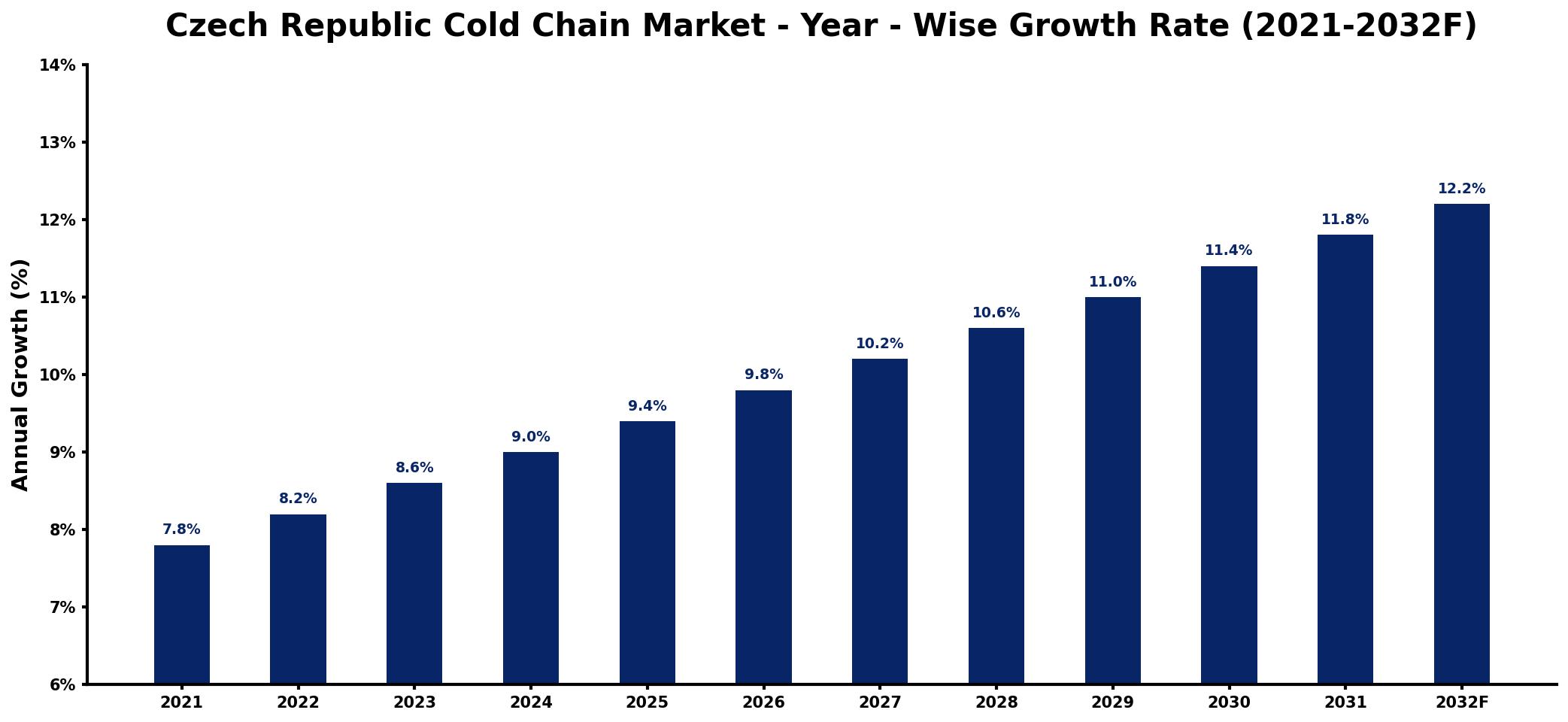
The table below presents the year‑wise growth rates along with the key drivers influencing the market
| Year | Growth Rate | Major Drivers |
| 2021 | 7.8% | Rising demand for pharmaceuticals distribution |
| 2022 | 8.2% | Expansion of e-commerce food delivery |
| 2023 | 8.6% | Increased investment in logistics technology |
| 2024 | 9.0% | increased production capacity utilization |
| 2025 | 9.4% | Strengthening regulations for food safety |
| 2026 | 9.8% | strengthening underlying market demand |
| 2027 | 10.2% | Development of regional distribution centers |
| 2028 | 10.6% | Emergence of new market players |
| 2029 | 11.0% | Advancements in temperature monitoring systems |
| 2030 | 11.4% | Enhanced focus on sustainability practices |
| 2031 | 11.8% | Increasing globalization of food supply |
| 2032 | 12.2% | Growing need for last-mile solutions |
Note: Market size estimations and growth projections presented in this report are based on 6Wresearch's proprietary forecasting methodology, utilizing the latest available industry data, government publications, and primary research inputs.
Czech Republic Cold Chain Market Synopsis
The Czech Republic Cold Chain Market is currently characterized by its advanced infrastructure, which includes a network of cold storage facilities and refrigerated transport systems. This well-established framework is essential for ensuring the freshness and safety of perishable goods, particularly in the context of rising health and safety standards.
With increasing consumer awareness regarding food safety and the efficacy of pharmaceuticals, the market is witnessing an upsurge in investments aimed at enhancing operational efficiency. Technologies like IoT-based monitoring systems are becoming integral, ensuring compliance with stringent regulations while minimizing wastage.
Czech Republic Cold Chain Market Key Takeaways
- The market is experiencing significant growth due to heightened demand in food and pharmaceutical industries.
- Technological advancements, such as IoT and blockchain, are transforming cold chain logistics.
- Sustainability initiatives are driving investments in energy-efficient storage and transportation solutions.
- Regulatory bodies are enforcing stricter guidelines to ensure compliance and safety in operations.
- Investment opportunities are abundant for stakeholders looking to enhance cold chain infrastructure.
Evaluation of Restraints in Czech Republic Cold Chain Market
Despite its potential, the Czech Republic Cold Chain Market faces significant constraints. A notable issue is the infrastructure gap, where inadequacies in cold storage facilities and transportation systems may jeopardize the integrity of temperature-sensitive products. Additionally, the continuously evolving regulatory landscape poses challenges for companies striving to maintain compliance. These issues necessitate urgent attention to ensure that the market can meet both current and future demands effectively.
Czech Republic Cold Chain Market Trends
A noteworthy trend within the Czech Republic Cold Chain Market is the pivot towards sustainability, with an increasing focus on energy-efficient practices and eco-friendly refrigerants. The influence of the COVID-19 pandemic has also emphasized the importance of a resilient cold chain, particularly for vaccine distribution, resulting in investments aimed at expanding storage capacities. Moreover, technological innovations, like blockchain for enhanced supply chain transparency, are gaining traction as businesses strive to ensure the integrity of their cold chain operations.
Czech Republic Cold Chain Market Opportunities
Investment opportunities abound in the Czech Republic Cold Chain Market as companies seek to upgrade their logistics and storage capabilities. The surge in e-commerce and shifting consumer preferences towards fresh and frozen goods signify a growing need for sophisticated cold chain solutions. Opportunities exist in developing advanced temperature monitoring technologies and expanding refrigerated transportation services. Additionally, the drive towards sustainability presents avenues for innovation in environmentally friendly practices, making this market ripe for investment.
Government Initiatives in the Czech Republic Cold Chain Market
The Czech government is proactive in establishing regulations that enhance the quality and safety of cold chain operations. The State Veterinary Administration oversees crucial regulations concerning food safety, while the Ministry of Agriculture develops guidelines for the transport and storage of perishables. The implementation of EU regulations ensures that the Czech Republic aligns with international standards, facilitating safer and more efficient distribution of temperature-sensitive products across the supply chain.
Future Insights of the Czech Republic Cold Chain Market
Looking ahead to the period between 2026 and 2032, the Czech Republic Cold Chain Market is poised for continued expansion. Factors such as rising investments in cold chain infrastructure, technological advancements, and the increasing focus on food safety regulations will underpin this growth. Moreover, the evolution of consumer preferences, particularly towards fresh and organic products, is set to drive further demand for robust cold chain solutions. Businesses that prioritize efficiency and sustainability are likely to thrive in this dynamic landscape.
Czech Republic Cold Chain Market Latest Developments (2025 - 2026)
Recent developments in the Czech Republic Cold Chain Market indicate a strategic focus on enhancing infrastructure and leveraging technology. Notably, various initiatives are underway to expand cold storage capacities, specifically aimed at accommodating the rising demand for temperature-controlled logistics. Additionally, the adoption of advanced monitoring systems continues to gain momentum, underscoring the commitment to maintaining the integrity of the cold chain amid evolving industry challenges.
Czech Republic Cold Chain Market - Key Attractiveness of the Report
- 10 Years of Market Numbers
- Historical Data Starting from 2022 to 2025
- Base Year: 2025
- Forecast Data until 2032
- Key Performance Indicators Impacting the Market
- Major Upcoming Developments and Projects
Key Highlights of the Report:
- Czech Republic Cold Chain Market Outlook
- Market Size of Czech Republic Cold Chain Market, 2025
- Forecast of Czech Republic Cold Chain Market, 2032
- Historical Data and Forecast of Czech Republic Cold Chain Revenues & Volume for the Period 2022-2032F
- Czech Republic Cold Chain Market Trend Evolution
- Czech Republic Cold Chain Market Drivers and Challenges
- Czech Republic Cold Chain Price Trends
- Czech Republic Cold Chain Porter's Five Forces
- Czech Republic Cold Chain Industry Life Cycle
- Historical Data and Forecast of Czech Republic Cold Chain Market Revenues & Volume By Temperature Type for the Period 2022-2032F
- Historical Data and Forecast of Czech Republic Cold Chain Market Revenues & Volume By Frozen for the Period 2022-2032F
- Historical Data and Forecast of Czech Republic Cold Chain Market Revenues & Volume By Chilled for the Period 2022-2032F
- Historical Data and Forecast of Czech Republic Cold Chain Market Revenues & Volume By Type for the Period 2022-2032F
- Historical Data and Forecast of Czech Republic Cold Chain Market Revenues & Volume By Refrigerated warehousing for the Period 2022-2032F
- Historical Data and Forecast of Czech Republic Cold Chain Market Revenues & Volume By Refrigerated transport for the Period 2022-2032F
- Historical Data and Forecast of Czech Republic Cold Chain Market Revenues & Volume By Application for the Period 2022-2032F
- Historical Data and Forecast of Czech Republic Cold Chain Market Revenues & Volume By Dairy & frozen desserts for the Period 2022-2032F
- Historical Data and Forecast of Czech Republic Cold Chain Market Revenues & Volume By Fish, meat, and seafood products for the Period 2022-2032F
- Historical Data and Forecast of Czech Republic Cold Chain Market Revenues & Volume By Bakery & confectionery products for the Period 2022-2032F
- Historical Data and Forecast of Czech Republic Cold Chain Market Revenues & Volume By Fruits & vegetables for the Period 2022-2032F
- Historical Data and Forecast of Czech Republic Cold Chain Market Revenues & Volume By Others for the Period 2022-2032F
- Czech Republic Cold Chain Import Export Trade Statistics
- Market Opportunity Assessment By Temperature Type
- Market Opportunity Assessment By Type
- Market Opportunity Assessment By Application
- Czech Republic Cold Chain Top Companies Market Share
- Czech Republic Cold Chain Competitive Benchmarking By Technical and Operational Parameters
- Czech Republic Cold Chain Company Profiles
- Czech Republic Cold Chain Key Strategic Recommendations






































