Czech Republic Fatty Alcohol Market Size (2020-2030)
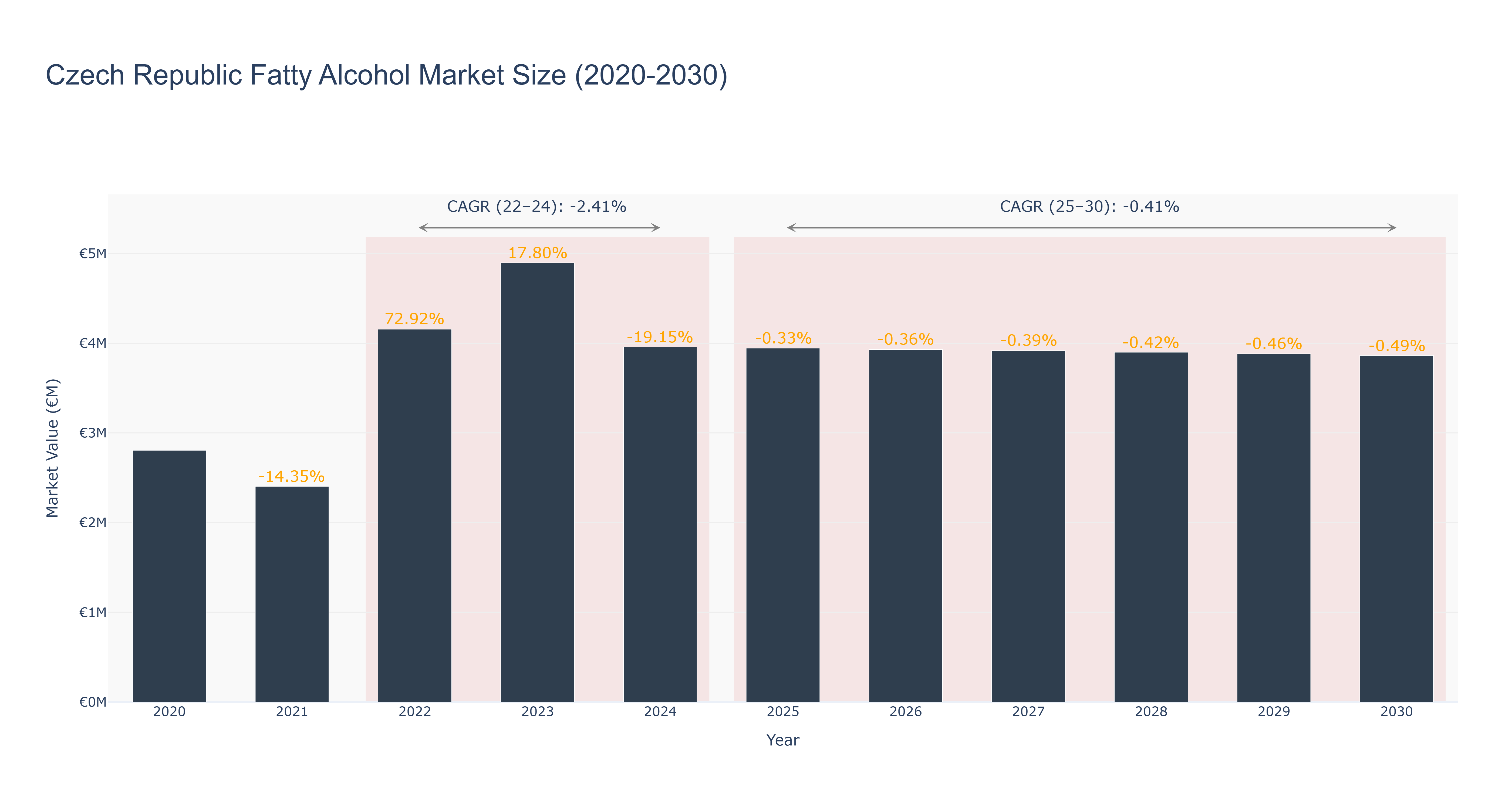
Czech Republic Fatty Alcohol Market has seen fluctuations in market size over the years. The market peaked at €4.90 million in 2023, showing a steady growth trend until a decline in 2024 to €3.96 million. The forecasted market size from 2025 to 2030 indicates a gradual decrease, with an expected market size of €3.86 million in 2030. The CAGR for the period 2022-24 was -2.41%, while for 2025-30, it is projected at -0.41%. The downward trend in market size can be attributed to factors such as changing consumer preferences, regulatory challenges, and market saturation. Looking ahead, the Czech Republic Fatty Alcohol Market is anticipated to focus on sustainability initiatives and technological advancements to drive growth. Recent developments include partnerships with renewable energy suppliers to reduce carbon footprint and enhance product sustainability.
Czech Republic Fatty Alcohol Market: Production & Trade Performance (2019-2025)
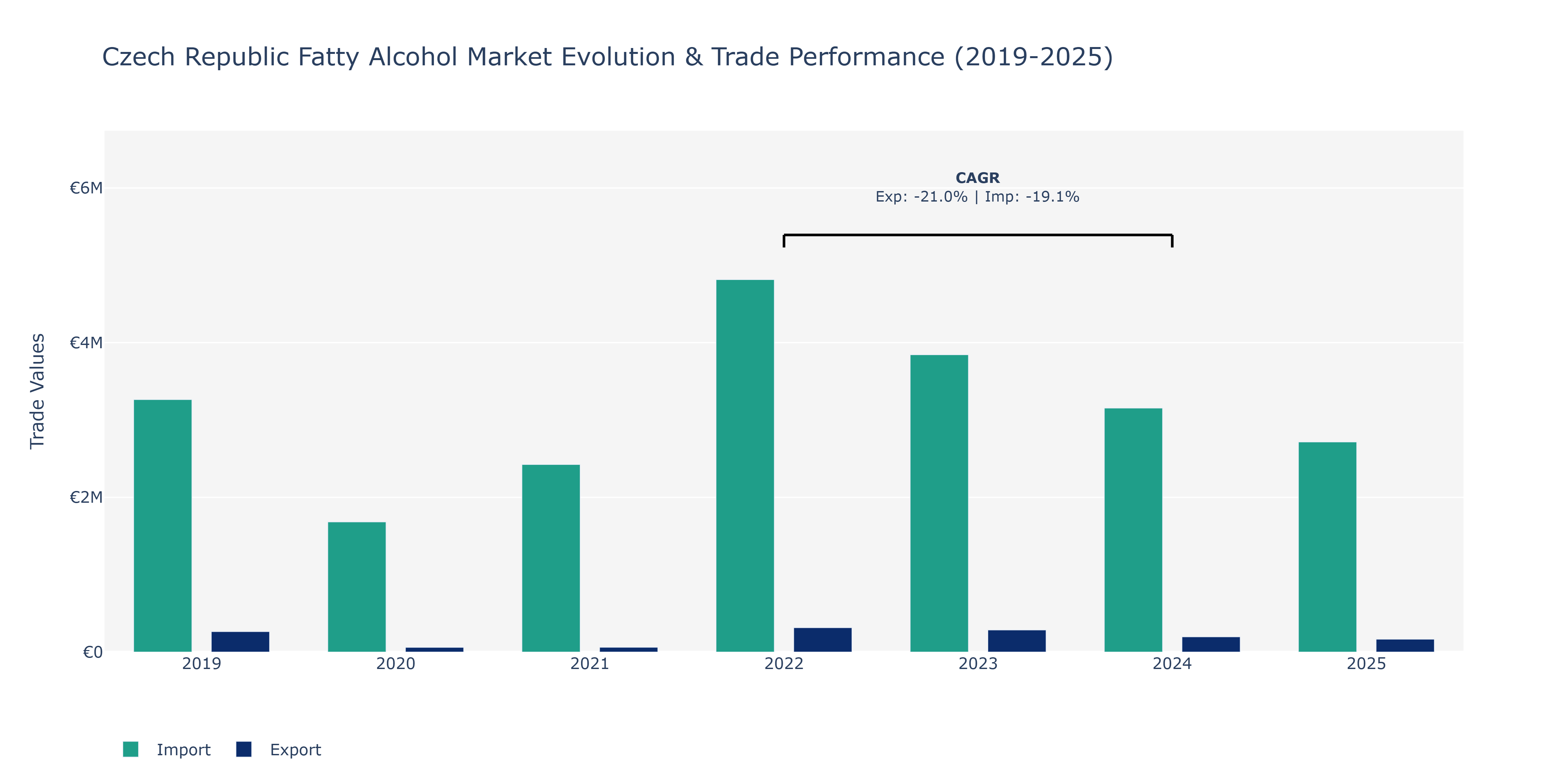
In the Czech Republic Fatty Alcohol Market, exports experienced fluctuations over the years, starting at €263.64 thousand in 2019, then declining sharply in 2020 to €59.83 thousand before showing a significant increase to €314.78 thousand in 2022. This surge was followed by a slight decrease in 2023 and a further decline in 2024 to €196.49 thousand. The trend continued in 2025 with exports amounting to €166.01 thousand. On the imports side, a similar pattern emerged with noticeable fluctuations. Imports stood at €3.26 million in 2019, decreased to €1.68 million in 2020, and then rose steadily to €4.82 million in 2022 before experiencing a slight drop in 2023 and 2024, amounting to €3.15 million. In 2025, imports were recorded at €2.72 million. These fluctuations can be attributed to various factors like changes in global demand for fatty alcohols, shifts in production capacities, and evolving trade regulations impacting the Czech Republic market. For instance, the decline in 2020 could be linked to the disruptions caused by the COVID-19 pandemic, while the subsequent recovery might reflect the market's resilience and adaptability to changing circumstances.
Czech Republic Fatty Alcohol Market Synopsis
The Czech Republic Fatty Alcohol Market is experiencing steady growth driven by factors such as increasing demand from various industries including personal care, pharmaceuticals, and agrochemicals. Fatty alcohols are widely used in the production of cosmetics, detergents, and pharmaceuticals due to their emollient and surfactant properties. The market is characterized by the presence of key players such as Sasol, BASF SE, and KLK OLEO, who are investing in research and development activities to introduce innovative products. The growing consumer awareness regarding sustainable and eco-friendly products is also influencing market trends, leading to the adoption of bio-based fatty alcohols. Additionally, the increasing focus on product differentiation and marketing strategies by manufacturers is expected to drive further growth in the Czech Republic Fatty Alcohol Market.
Czech Republic Fatty Alcohol Market Trends
The Czech Republic fatty alcohol market is experiencing steady growth due to the increasing demand for fatty alcohols in various industries such as personal care, pharmaceuticals, and cleaning products. The market is driven by the rising awareness about the benefits of fatty alcohols in skincare and haircare products, as well as their use as emollients and emulsifiers. Manufacturers are focusing on developing sustainable and eco-friendly fatty alcohol products to meet the growing consumer preference for natural ingredients. Additionally, the market is witnessing a trend towards the use of fatty alcohols in the production of biofuels and lubricants, further contributing to market growth. Overall, the Czech Republic fatty alcohol market is expected to continue its positive trajectory in the coming years.
Czech Republic Fatty Alcohol Market Challenges
In the Czech Republic Fatty Alcohol Market, one of the main challenges faced is the presence of strong competition from international manufacturers. These foreign companies often have larger production capacities, established distribution networks, and access to advanced technologies, which can make it difficult for local players to compete effectively. Additionally, fluctuating raw material prices and regulatory requirements pose challenges for market players in terms of cost management and compliance. Another challenge is the growing consumer demand for sustainable and environmentally-friendly products, which requires companies to invest in research and development to innovate their product offerings. Overall, navigating these challenges requires Czech Republic fatty alcohol market players to continuously adapt their strategies to remain competitive in the market.
Czech Republic Fatty Alcohol Market Investment Opportunities
In the Czech Republic, the fatty alcohol market presents promising investment opportunities due to the increasing demand for sustainable and eco-friendly products in industries such as personal care, pharmaceuticals, and industrial chemicals. The market is driven by factors such as growing consumer awareness, rising disposable incomes, and stringent regulations promoting the use of natural ingredients. Investing in the Czech fatty alcohol market can be attractive for companies looking to capitalize on this trend by offering innovative, high-quality products that meet the evolving needs of consumers. Additionally, the country`s strategic location in Central Europe provides access to a wider market, enhancing export opportunities for investors. Overall, the Czech Republic`s fatty alcohol market offers a favorable environment for investments with potential for growth and profitability.
Jordan Agar Market Government Policies
The Czech Republic has implemented various policies related to the fatty alcohol market, aimed at promoting sustainable production and consumption. These policies include regulations on environmental protection, waste management, and energy efficiency to ensure that fatty alcohol production processes are conducted in an environmentally friendly manner. Additionally, the government has established quality standards and labeling requirements to guarantee consumer safety and transparency in the market. Furthermore, there are initiatives in place to support research and development in the fatty alcohol industry, encouraging innovation and technological advancements. Overall, the Czech Republic`s policies focus on fostering a competitive and sustainable fatty alcohol market while prioritizing environmental protection and consumer welfare.
Czech Republic Fatty Alcohol Market Future Outlook
The Czech Republic fatty alcohol market is expected to witness steady growth in the coming years due to increasing demand from various industries such as personal care, pharmaceuticals, and industrial applications. The market is likely to be driven by factors such as growing population, rising disposable incomes, and changing consumer preferences towards natural and sustainable products. Additionally, the shift towards eco-friendly products and increasing awareness about the benefits of fatty alcohols in skincare and haircare products are expected to further fuel market growth. However, factors such as fluctuating raw material prices and regulatory challenges may pose some hindrance to market expansion. Overall, the Czech Republic fatty alcohol market is anticipated to experience moderate growth in the foreseeable future.
Key Highlights of the Report:
- Czech Republic Fatty Alcohol Market Outlook
- Market Size of Czech Republic Fatty Alcohol Market, 2021
- Forecast of Czech Republic Fatty Alcohol Market, 2031
- Historical Data and Forecast of Czech Republic Fatty Alcohol Revenues & Volume for the Period 2018 - 2031
- Czech Republic Fatty Alcohol Market Trend Evolution
- Czech Republic Fatty Alcohol Market Drivers and Challenges
- Czech Republic Fatty Alcohol Price Trends
- Czech Republic Fatty Alcohol Porter's Five Forces
- Czech Republic Fatty Alcohol Industry Life Cycle
- Historical Data and Forecast of Czech Republic Fatty Alcohol Market Revenues & Volume By Product for the Period 2018 - 2031
- Historical Data and Forecast of Czech Republic Fatty Alcohol Market Revenues & Volume By C6-C10 for the Period 2018 - 2031
- Historical Data and Forecast of Czech Republic Fatty Alcohol Market Revenues & Volume By C11-C14 for the Period 2018 - 2031
- Historical Data and Forecast of Czech Republic Fatty Alcohol Market Revenues & Volume By C15-C22 for the Period 2018 - 2031
- Historical Data and Forecast of Czech Republic Fatty Alcohol Market Revenues & Volume By Application for the Period 2018 - 2031
- Historical Data and Forecast of Czech Republic Fatty Alcohol Market Revenues & Volume By Soaps & Detergents for the Period 2018 - 2031
- Historical Data and Forecast of Czech Republic Fatty Alcohol Market Revenues & Volume By Personal Care for the Period 2018 - 2031
- Historical Data and Forecast of Czech Republic Fatty Alcohol Market Revenues & Volume By Lubricants for the Period 2018 - 2031
- Historical Data and Forecast of Czech Republic Fatty Alcohol Market Revenues & Volume By Amines for the Period 2018 - 2031
- Historical Data and Forecast of Czech Republic Fatty Alcohol Market Revenues & Volume By Others for the Period 2018 - 2031
- Czech Republic Fatty Alcohol Import Export Trade Statistics
- Market Opportunity Assessment By Product
- Market Opportunity Assessment By Application
- Czech Republic Fatty Alcohol Top Companies Market Share
- Czech Republic Fatty Alcohol Competitive Benchmarking By Technical and Operational Parameters
- Czech Republic Fatty Alcohol Company Profiles
- Czech Republic Fatty Alcohol Key Strategic Recommendations






































