Czech Republic Fitness Equipment Market: Import Trend Analysis
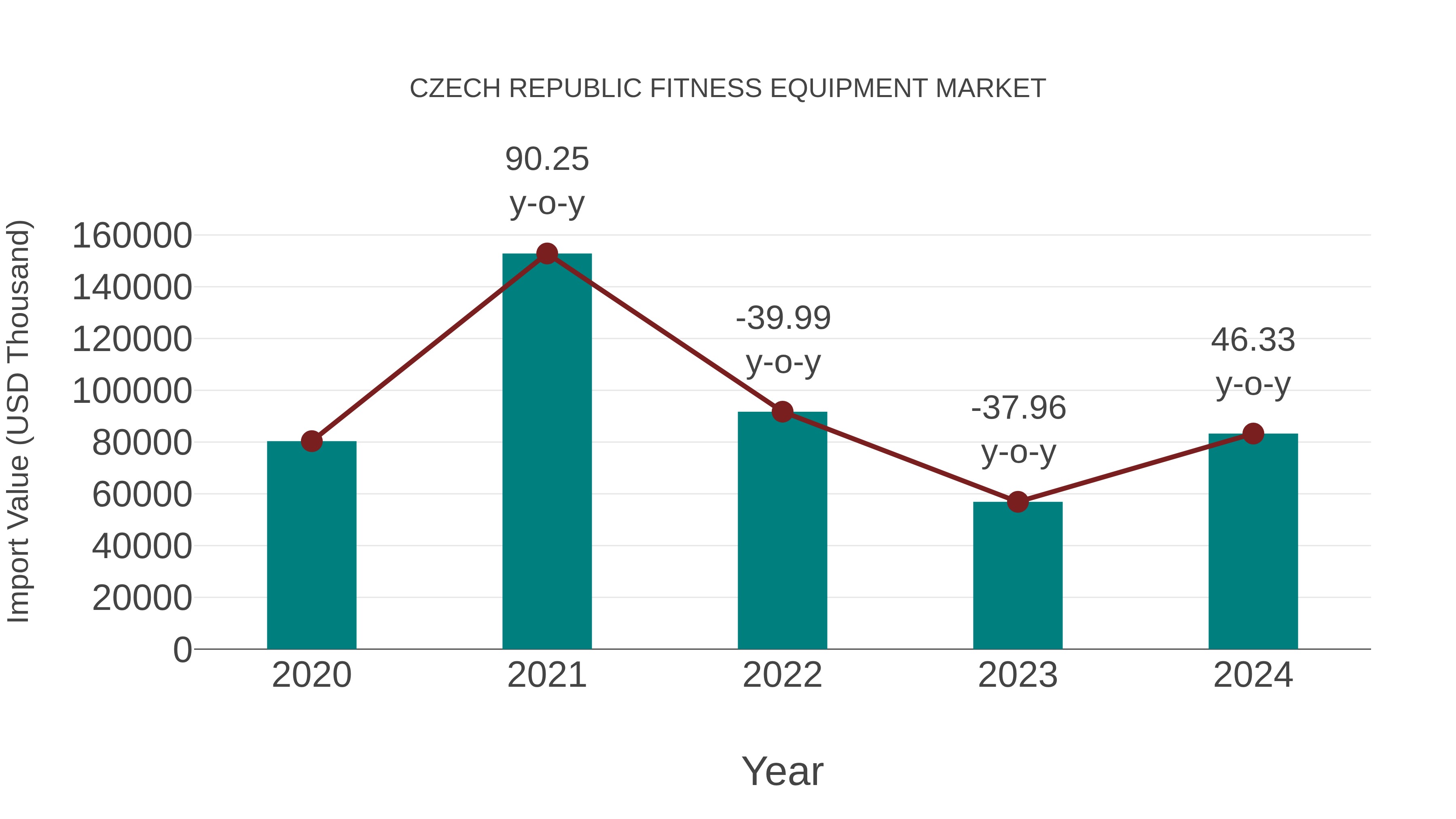
The import trend of fitness equipment in the Czech Republic market witnessed a steady increase from 2020 to 2024, with a Compound Annual Growth Rate (CAGR) of 0.90%. Notably, the year-on-year growth rate spiked to 46.33% in 20232024, indicating a significant surge in imports during that period.
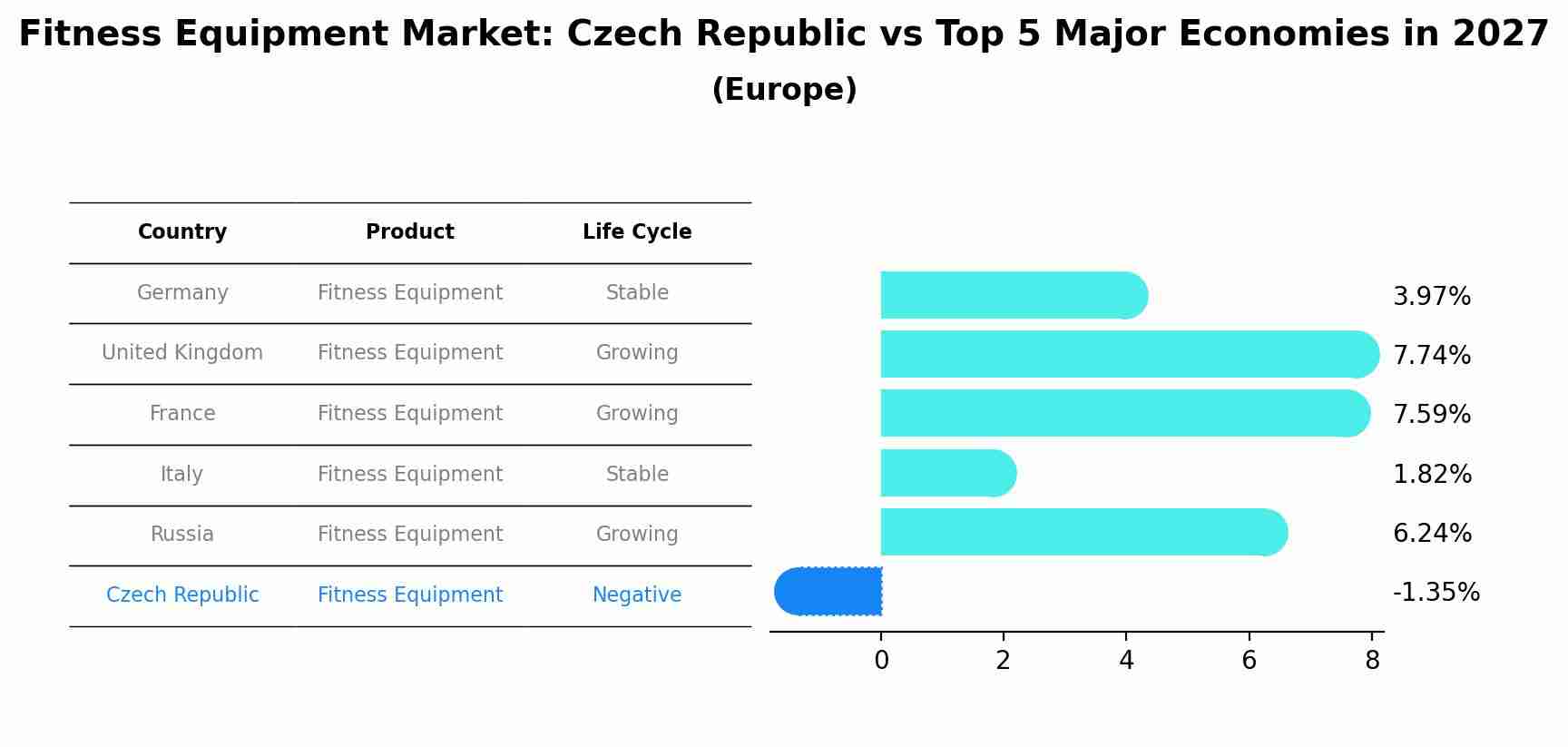
Fitness Equipment Market: Czech Republic vs Top 5 Major Economies in 2027 (Europe)
By 2027, Czech Republic's Fitness Equipment market is forecasted to achieve a negative growth rate of -1.35%, with Germany leading the Europe region, followed by United Kingdom, France, Italy and Russia.
Czech Republic Fitness Equipment Market Synopsis
The fitness equipment market in the Czech Republic is expected to grow at a CAGR of 3.2% during 2020?2026, driven by increasing demand for home-based fitness solutions and an increase in health consciousness. The growing prevalence of obesity and other lifestyle diseases has led to increased awareness about physical health, which is expected to drive the growth of the market over the forecast period. Additionally, technological advancements such as connected fitness services are also providing impetus to market growth. Furthermore, manufacturers are introducing new products with innovative designs that can be used for various exercises, thereby contributing to the rise in revenue from this industry over the forecast period
Key Highlights of the Report:
- Czech Republic Fitness Equipment Market Outlook
- Market Size of Czech Republic Fitness Equipment Market, 2019
- Forecast of Czech Republic Fitness Equipment Market, 2026
- Historical Data and Forecast of Czech Republic Fitness Equipment Revenues & Volume for the Period 2016 - 2026
- Czech Republic Fitness Equipment Market Trend Evolution
- Czech Republic Fitness Equipment Market Drivers and Challenges
- Czech Republic Fitness Equipment Price Trends
- Czech Republic Fitness Equipment Porter's Five Forces
- Czech Republic Fitness Equipment Industry Life Cycle
- Historical Data and Forecast of Czech Republic Fitness Equipment Market Revenues & Volume By Type for the Period 2016 - 2026
- Historical Data and Forecast of Czech Republic Fitness Equipment Market Revenues & Volume By Cardiovascular Training Equipment for the Period 2016 - 2026
- Historical Data and Forecast of Czech Republic Fitness Equipment Market Revenues & Volume By Strength Training Equipment for the Period 2016 - 2026
- Historical Data and Forecast of Czech Republic Fitness Equipment Market Revenues & Volume By Other Equipment for the Period 2016 - 2026
- Historical Data and Forecast of Czech Republic Fitness Equipment Market Revenues & Volume By End-users for the Period 2016 - 2026
- Historical Data and Forecast of Czech Republic Fitness Equipment Market Revenues & Volume By Home consumer for the Period 2016 - 2026
- Historical Data and Forecast of Czech Republic Fitness Equipment Market Revenues & Volume By Health club/gym for the Period 2016 - 2026
- Historical Data and Forecast of Czech Republic Fitness Equipment Market Revenues & Volume By Other commercial user for the Period 2016 - 2026
- Czech Republic Fitness Equipment Import Export Trade Statistics
- Market Opportunity Assessment By Type
- Market Opportunity Assessment By End-users
- Czech Republic Fitness Equipment Top Companies Market Share
- Czech Republic Fitness Equipment Competitive Benchmarking By Technical and Operational Parameters
- Czech Republic Fitness Equipment Company Profiles
- Czech Republic Fitness Equipment Key Strategic Recommendations






































