Industrial Fasteners Market: Czech Republic vs Top 5 Major Economies in 2027 (Europe)
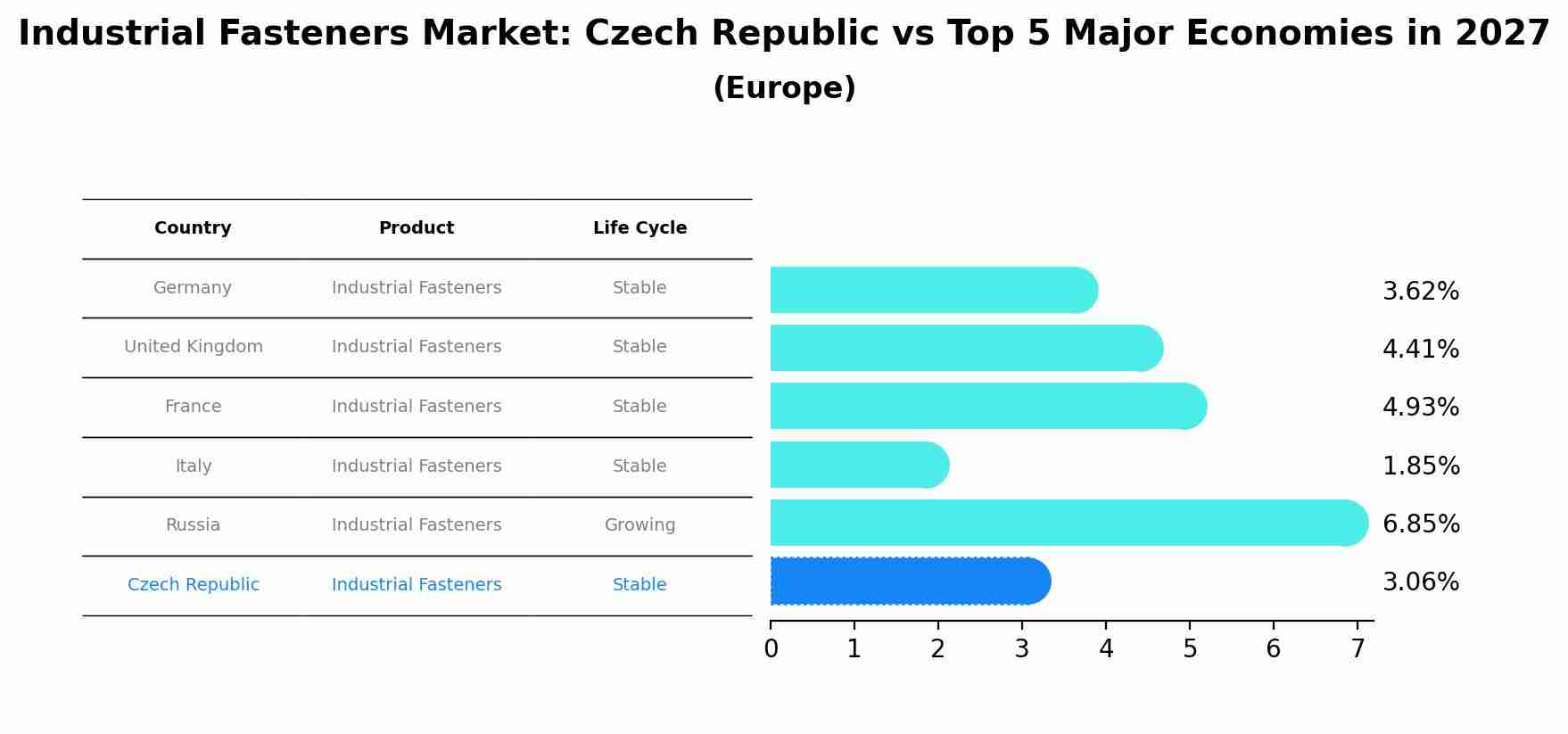
The Industrial Fasteners market in Czech Republic is projected to grow at a stable growth rate of 3.06% by 2027, within the Europe region led by Germany, along with other countries like United Kingdom, France, Italy and Russia, collectively shaping a dynamic and evolving market environment driven by innovation and increasing adoption of emerging technologies.
Czech Republic Industrial Fasteners Market Overview
The industrial fasteners market is essential for construction, automotive, and manufacturing industries. The demand for high-strength and durable fasteners is increasing, driven by industrial growth and infrastructure projects.
Drivers of the market
The industrial fasteners market benefits from the rising demand for reliable and durable fastening solutions across various industries, including automotive, construction, and manufacturing. As industries prioritize safety and quality in their products, the adoption of high-performance fasteners becomes essential. Additionally, the growing trend towards automation and advanced manufacturing processes drives the demand for innovative fastening solutions.
Challenges of the market
The industrial fasteners market is challenged by fluctuating raw material prices, which can affect production costs and pricing strategies. Additionally, the increasing demand for customized fasteners can complicate inventory management and supply chain logistics.
Government Policy of the market
The industrial fasteners market in the Czech Republic is expanding as demand for durable and reliable fastening solutions increases across various sectors. Government regulations promoting product quality and safety standards drive manufacturers to innovate and enhance their offerings. As industries prioritize efficiency and reliability, investments in advanced fastening technologies continue to rise.
Key Highlights of the Report:
- Czech Republic Industrial Fasteners Market Outlook
- Market Size of Czech Republic Industrial Fasteners Market, 2024
- Forecast of Czech Republic Industrial Fasteners Market, 2031
- Historical Data and Forecast of Czech Republic Industrial Fasteners Revenues & Volume for the Period 2018 - 2031
- Czech Republic Industrial Fasteners Market Trend Evolution
- Czech Republic Industrial Fasteners Market Drivers and Challenges
- Czech Republic Industrial Fasteners Price Trends
- Czech Republic Industrial Fasteners Porter's Five Forces
- Czech Republic Industrial Fasteners Industry Life Cycle
- Historical Data and Forecast of Czech Republic Industrial Fasteners Market Revenues & Volume By Raw Material for the Period 2018 - 2031
- Historical Data and Forecast of Czech Republic Industrial Fasteners Market Revenues & Volume By Plastic for the Period 2018 - 2031
- Historical Data and Forecast of Czech Republic Industrial Fasteners Market Revenues & Volume By Metal for the Period 2018 - 2031
- Historical Data and Forecast of Czech Republic Industrial Fasteners Market Revenues & Volume By Product for the Period 2018 - 2031
- Historical Data and Forecast of Czech Republic Industrial Fasteners Market Revenues & Volume By Externally Threaded for the Period 2018 - 2031
- Historical Data and Forecast of Czech Republic Industrial Fasteners Market Revenues & Volume By Internally Threaded for the Period 2018 - 2031
- Historical Data and Forecast of Czech Republic Industrial Fasteners Market Revenues & Volume By Non-threaded for the Period 2018 - 2031
- Historical Data and Forecast of Czech Republic Industrial Fasteners Market Revenues & Volume By Aerospace Grade for the Period 2018 - 2031
- Historical Data and Forecast of Czech Republic Industrial Fasteners Market Revenues & Volume By Application for the Period 2018 - 2031
- Historical Data and Forecast of Czech Republic Industrial Fasteners Market Revenues & Volume By Automotive for the Period 2018 - 2031
- Historical Data and Forecast of Czech Republic Industrial Fasteners Market Revenues & Volume By Aerospace for the Period 2018 - 2031
- Historical Data and Forecast of Czech Republic Industrial Fasteners Market Revenues & Volume By Building & Construction for the Period 2018 - 2031
- Historical Data and Forecast of Czech Republic Industrial Fasteners Market Revenues & Volume By Industrial Machinery for the Period 2018 - 2031
- Historical Data and Forecast of Czech Republic Industrial Fasteners Market Revenues & Volume By Lawn and Garden for the Period 2018 - 2031
- Historical Data and Forecast of Czech Republic Industrial Fasteners Market Revenues & Volume By Plumbing Products for the Period 2018 - 2031
- Historical Data and Forecast of Czech Republic Industrial Fasteners Market Revenues & Volume By Others for the Period 2018 - 2031
- Czech Republic Industrial Fasteners Import Export Trade Statistics
- Market Opportunity Assessment By Raw Material
- Market Opportunity Assessment By Product
- Market Opportunity Assessment By Application
- Czech Republic Industrial Fasteners Top Companies Market Share
- Czech Republic Industrial Fasteners Competitive Benchmarking By Technical and Operational Parameters
- Czech Republic Industrial Fasteners Company Profiles
- Czech Republic Industrial Fasteners Key Strategic Recommendations






































