Czech Republic Industrial Machinery Market Size, Share & Growth Rate
The Czech Republic Industrial Machinery Market was estimated at USD 234 Million in 2025 and is projected to reach USD 256 Million by 2032, growing at a CAGR of 1.3% from 2026 to 2032. This modest growth is primarily fueled by the increasing demand for advanced machinery solutions across various sectors such as construction, manufacturing, and agriculture. As companies strive to enhance operational efficiency through automation and cutting-edge technology, investment in sophisticated industrial machinery becomes a critical strategy for maintaining competitiveness.
Czech Republic Industrial Machinery Market Year-wise Growth Rate and Key Drivers
This graph highlights how the Czech Republic Industrial Machinery Market has steadily grown over the years, supported by major growth factors.
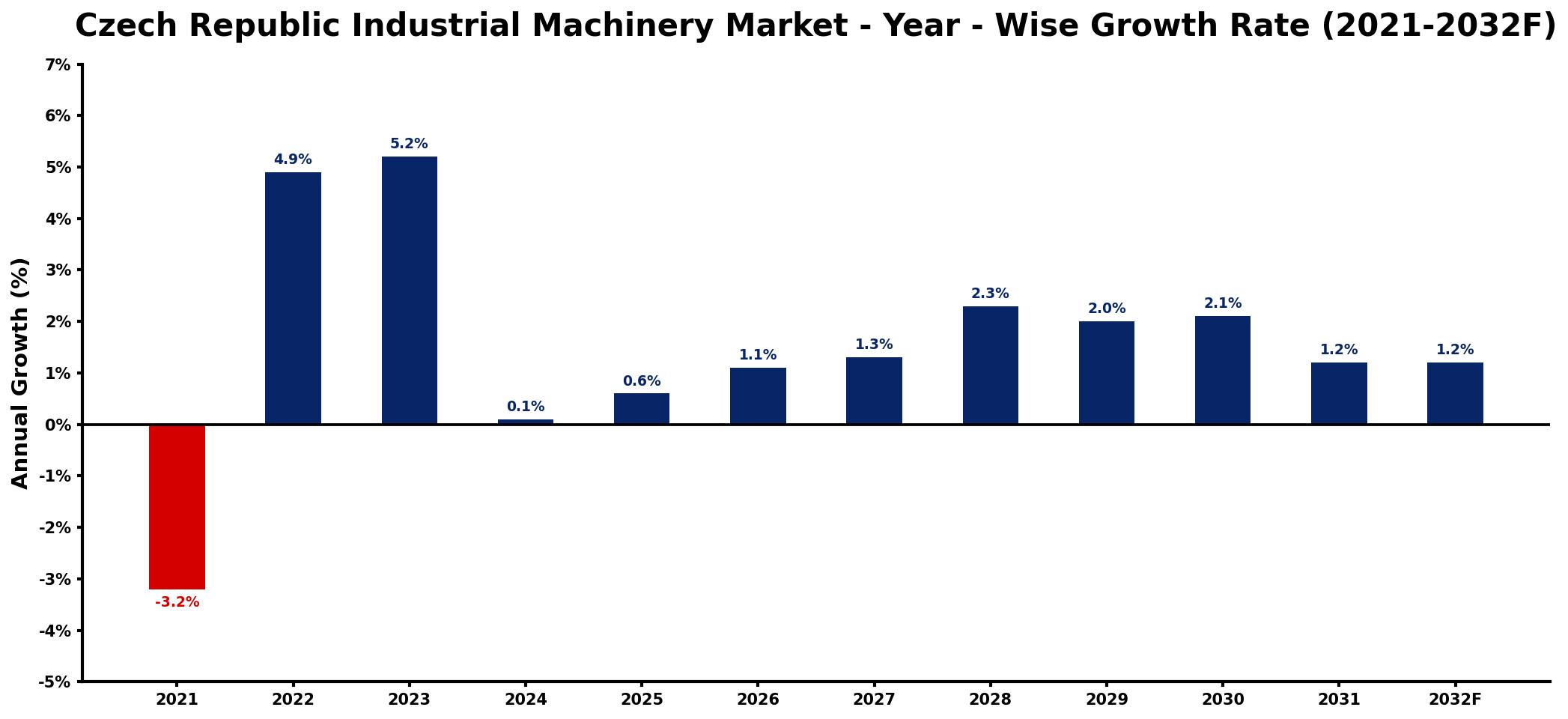
The table below presents the year‑wise growth rates along with the key drivers influencing the market
| Year | Growth Rate | Major Drivers |
| 2021 | -3.2% | decrease in new project investments |
| 2022 | 4.9% | surge in automation adoption rates |
| 2023 | 5.2% | expansion of renewable energy projects |
| 2024 | 0.1% | increased demand for robotics solutions |
| 2025 | 0.6% | growth in manufacturing sector output |
| 2026 | 1.1% | higher investment in infrastructure development |
| 2027 | 1.3% | rising interest in sustainable technologies |
| 2028 | 2.3% | rising end-use demand growth |
| 2029 | 2.0% | enhanced focus on digital transformation |
| 2030 | 2.1% | growing need for efficient production |
| 2031 | 1.2% | increased collaboration with tech startups |
| 2032 | 1.2% | rising infrastructure development spending |
Note: Market size estimations and growth projections presented in this report are based on 6Wresearch's proprietary forecasting methodology, utilizing the latest available industry data, government publications, and primary research inputs.
Czech Republic Industrial Machinery Market Synopsis
The industrial machinery sector in the Czech Republic is currently experiencing a transformation, characterized by a strong push towards automation and modernization. This shift is not only pivotal for enhancing productivity but also crucial for meeting the evolving demands of various industries, particularly in heavy engineering and automotive sectors.
As companies recognize the importance of efficient production processes, the market is witnessing significant investments in innovative machinery technologies. This trend is supported by a favorable regulatory environment that encourages investment in advanced manufacturing capabilities.
Czech Republic Industrial Machinery Market Key Takeaways
- Technological advancements are a key driver in the growth of the market, enabling industries to automate and increase efficiency.
- The focus on sustainability and green technologies is becoming increasingly important in industrial machinery investments.
- Government policies promoting innovation and industrial competitiveness are enhancing market conditions.
- Despite stable growth, market volatility due to fluctuating demand across sectors remains a concern.
- Investment in modernization and automation will play a significant role in shaping the future landscape of the market.
Evaluation of Restraints in Czech Republic Industrial Machinery Market
While the Czech Republic Industrial Machinery Market is poised for growth, several restraints could impact its trajectory. One of the most pressing concerns is the continuous demand for technological advancement. Companies must regularly update their machinery to meet the increasing expectations for efficiency and automation, which can be a financial burden. Additionally, the cyclical nature of industrial demand can create fluctuations that lead to market volatility, making it difficult for manufacturers to maintain steady production and investment levels.
Czech Republic Industrial Machinery Market Trends
A notable trend within the Czech Republic Industrial Machinery Market is the integration of smart technologies and the implementation of Industry 4.0 practices. Companies are increasingly focusing on IoT-enabled machinery to enhance data collection and process automation. This trend not only improves efficiency but also allows for more tailored solutions for specific industrial applications.
Moreover, there is a growing emphasis on sustainable manufacturing practices, as businesses seek to minimize their environmental impact. This shift toward greener technologies is expected to reshape investment priorities in the sector, fostering innovation while aligning with global sustainability goals.
Czech Republic Industrial Machinery Market Opportunities
Opportunities for growth in the Czech Republic Industrial Machinery Market are plentiful, particularly in sectors that prioritize automation and sustainability. As industries move towards more efficient production methods, there is a burgeoning demand for machinery that incorporates advanced analytics and machine learning. Additionally, the government's support for innovation paves the way for manufacturers to explore new technologies, such as robotics and AI-driven solutions.
Government Initiatives in the Czech Republic Industrial Machinery Market
The Czech government has actively implemented initiatives aimed at enhancing the country's industrial competitiveness. Policies that promote research and development, along with financial incentives for adopting modern technologies, have created a conducive environment for investment in industrial machinery. Such initiatives not only support the modernization of existing facilities but also stimulate new projects in line with Industry 4.0 objectives.
Future Insights of the Czech Republic Industrial Machinery Market
Looking forward to the period between 2026 and 2032, the Czech Republic Industrial Machinery Market is expected to evolve significantly. The continued emphasis on automation and technological integration will likely drive further investments, particularly as companies adapt to changing market dynamics. Moreover, a deeper commitment to sustainability will push manufacturers to innovate, offering new product solutions that meet both efficiency and environmental standards. Overall, the future outlook remains cautiously optimistic as the market positions itself to address emerging challenges and opportunities.
Czech Republic Industrial Machinery Market Latest Developments (2025 - 2026)
Recent developments within the Czech Republic Industrial Machinery Market highlight a growing trend toward the adoption of intelligent manufacturing solutions. Companies are increasingly investing in technologies that facilitate real-time data analysis and machine learning capabilities. Additionally, collaborative projects between the public and private sectors aim to accelerate innovation in industrial practices, paving the way for enhanced productivity across multiple industries.
Czech Republic Industrial Machinery Market - Key Attractiveness of the Report
- 10 Years of Market Numbers
- Historical Data Starting from 2022 to 2025
- Base Year: 2025
- Forecast Data until 2032
- Key Performance Indicators Impacting the Market
- Major Upcoming Developments and Projects
Key Highlights of the Report:
- Czech Republic Industrial Machinery Market Outlook
- Market Size of Czech Republic Industrial Machinery Market, 2025
- Forecast of Czech Republic Industrial Machinery Market, 2032
- Historical Data and Forecast of Czech Republic Industrial Machinery Revenues & Volume for the Period 2022-2032F
- Czech Republic Industrial Machinery Market Trend Evolution
- Czech Republic Industrial Machinery Market Drivers and Challenges
- Czech Republic Industrial Machinery Price Trends
- Czech Republic Industrial Machinery Porter's Five Forces
- Czech Republic Industrial Machinery Industry Life Cycle
- Historical Data and Forecast of Czech Republic Industrial Machinery Market Revenues & Volume By Application for the Period 2022-2032F
- Historical Data and Forecast of Czech Republic Industrial Machinery Market Revenues & Volume By Agriculture for the Period 2022-2032F
- Historical Data and Forecast of Czech Republic Industrial Machinery Market Revenues & Volume By Construction for the Period 2022-2032F
- Historical Data and Forecast of Czech Republic Industrial Machinery Market Revenues & Volume By Packaging for the Period 2022-2032F
- Historical Data and Forecast of Czech Republic Industrial Machinery Market Revenues & Volume By Food Processing for the Period 2022-2032F
- Historical Data and Forecast of Czech Republic Industrial Machinery Market Revenues & Volume By Mining for the Period 2022-2032F
- Historical Data and Forecast of Czech Republic Industrial Machinery Market Revenues & Volume By Semiconductor Manufacturing for the Period 2022-2032F
- Czech Republic Industrial Machinery Import Export Trade Statistics
- Market Opportunity Assessment By Application
- Czech Republic Industrial Machinery Top Companies Market Share
- Czech Republic Industrial Machinery Competitive Benchmarking By Technical and Operational Parameters
- Czech Republic Industrial Machinery Company Profiles
- Czech Republic Industrial Machinery Key Strategic Recommendations






































