Czech Republic Inorganic Chemicals Market Size (2020-2030)
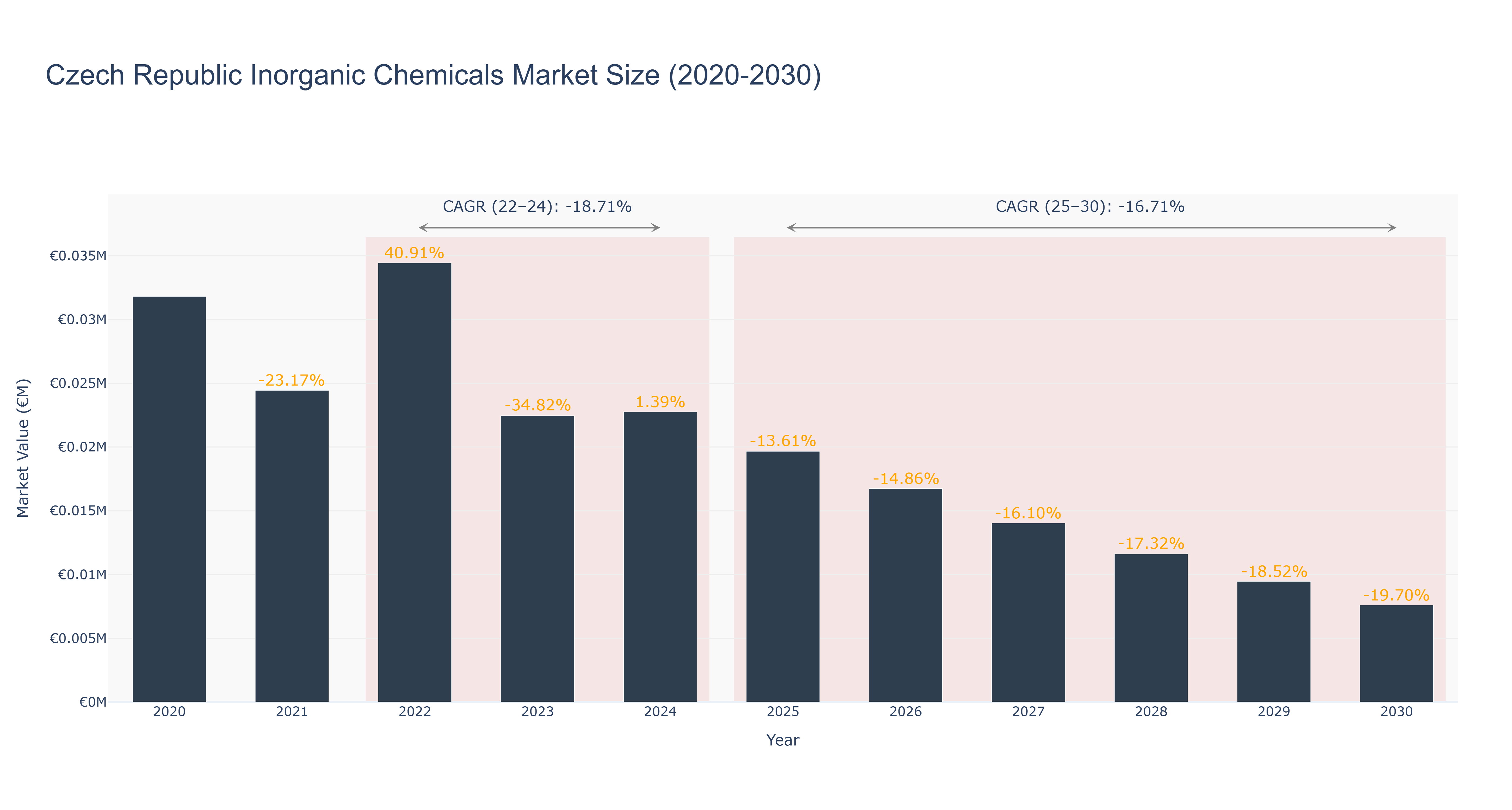
The Czech Republic Inorganic Chemicals Market experienced significant fluctuations from 2020 to 2024, with a peak market size of €34.44 thousand in 2022, followed by a sharp decline to €22.45 thousand in 2023, resulting in an overall CAGR of -18.71% during this actual period. The market has been influenced by various factors, including supply chain disruptions and shifting demand due to global economic conditions. Moving into the forecasted period from 2025 to 2030, the outlook remains challenging, with projected market sizes decreasing from €19.66 thousand in 2025 to €7.60 thousand by 2030, reflecting a CAGR of -16.71%. This continued decline may be attributed to increasing competition, regulatory pressures, and a potential shift toward sustainable alternatives. Without significant new investments or technological advancements, the market is likely to face ongoing contraction in the coming years.
Czech Republic Inorganic Chemicals Market: Production & Trade Performance (2019-2025)
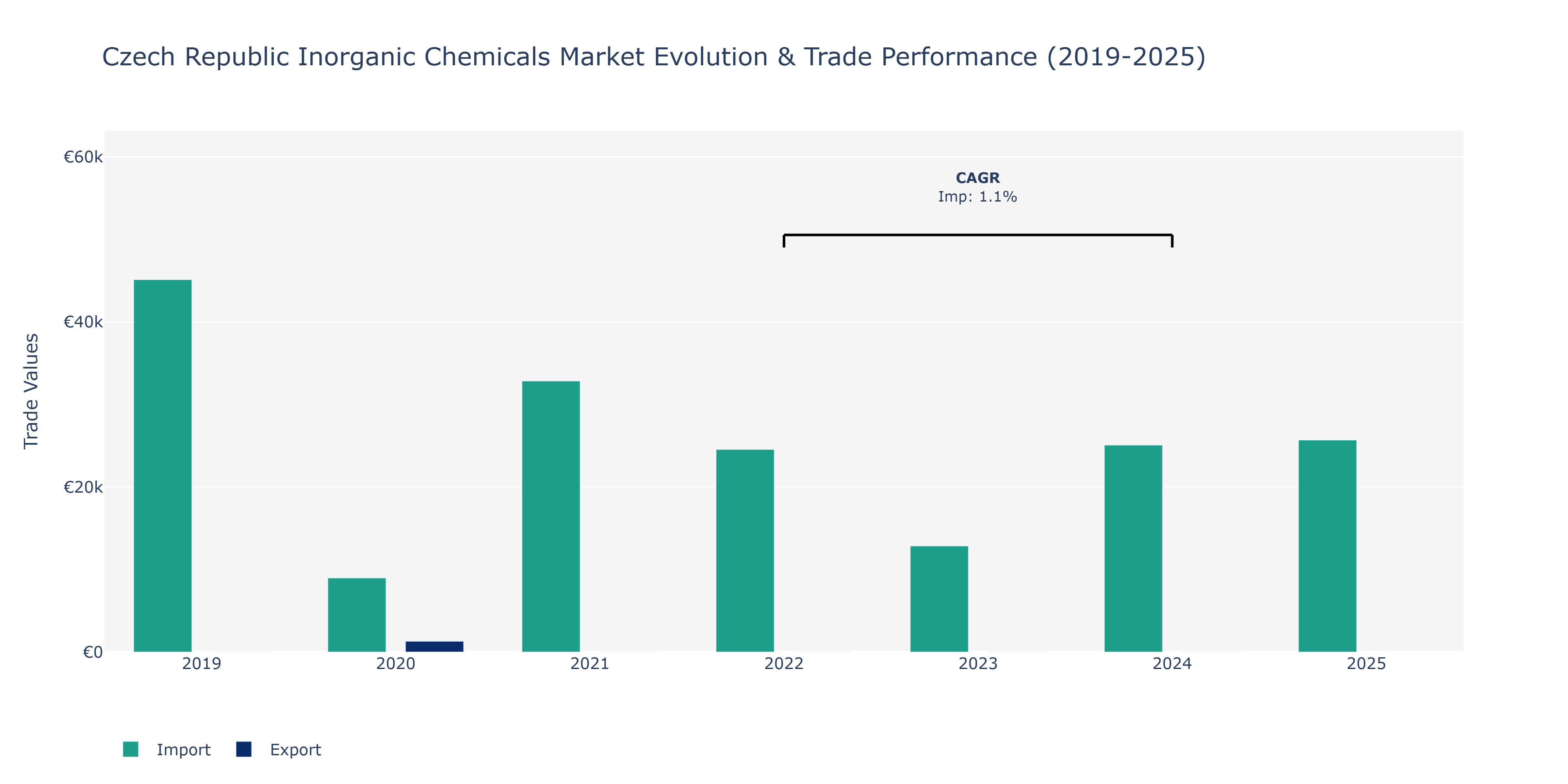
Between 2019 and 2025, the Czech Republic Inorganic Chemicals Market witnessed notable fluctuations in imports. In 2019, imports stood at €45.13 thousand, marking the highest point during the period. Subsequently, there was a substantial decline in 2020 to €8.98 thousand. However, imports demonstrated a recovery in the following years but remained below the 2019 peak. Notably, in 2025, imports amounted to approximately €25.69 thousand, showing an upward trend compared to the previous years. These fluctuations can be attributed to various factors, including global economic conditions, shifts in demand for inorganic chemicals, and changes in trade policies. The drop in imports in 2020 could be linked to disruptions caused by the COVID-19 pandemic, while the subsequent recovery and growth might reflect the market's resilience and adaptation to evolving market dynamics. Going forward, monitoring global economic trends and regulatory developments will be crucial for the Czech Republic Inorganic Chemicals Market to navigate uncertainties and capitalize on emerging opportunities.
Key Highlights of the Report:
- Czech Republic Inorganic Chemicals Market Outlook
- Market Size of Czech Republic Inorganic Chemicals Market, 2025
- Forecast of Czech Republic Inorganic Chemicals Market, 2032
- Historical Data and Forecast of Czech Republic Inorganic Chemicals Revenues & Volume for the Period 2022-2032F
- Czech Republic Inorganic Chemicals Market Trend Evolution
- Czech Republic Inorganic Chemicals Market Drivers and Challenges
- Czech Republic Inorganic Chemicals Price Trends
- Czech Republic Inorganic Chemicals Porter's Five Forces
- Czech Republic Inorganic Chemicals Industry Life Cycle
- Historical Data and Forecast of Czech Republic Inorganic Chemicals Market Revenues & Volume By Type for the Period 2022-2032F
- Historical Data and Forecast of Czech Republic Inorganic Chemicals Market Revenues & Volume By Ammonia for the Period 2022-2032F
- Historical Data and Forecast of Czech Republic Inorganic Chemicals Market Revenues & Volume By Chlor alkali for the Period 2022-2032F
- Historical Data and Forecast of Czech Republic Inorganic Chemicals Market Revenues & Volume By Ammonium nitrate for the Period 2022-2032F
- Historical Data and Forecast of Czech Republic Inorganic Chemicals Market Revenues & Volume By Ammonium sulfate for the Period 2022-2032F
- Historical Data and Forecast of Czech Republic Inorganic Chemicals Market Revenues & Volume By Inorganic acid for the Period 2022-2032F
- Historical Data and Forecast of Czech Republic Inorganic Chemicals Market Revenues & Volume By Sodium hydroxide for the Period 2022-2032F
- Historical Data and Forecast of Czech Republic Inorganic Chemicals Market Revenues & Volume By Hydrogen peroxide for the Period 2022-2032F
- Historical Data and Forecast of Czech Republic Ammonia Inorganic Chemicals Market Revenues & Volume By Oxygen for the Period 2022-2032F
- Czech Republic Inorganic Chemicals Import Export Trade Statistics
- Market Opportunity Assessment By Type
- Czech Republic Inorganic Chemicals Top Companies Market Share
- Czech Republic Inorganic Chemicals Competitive Benchmarking By Technical and Operational Parameters
- Czech Republic Inorganic Chemicals Company Profiles
- Czech Republic Inorganic Chemicals Key Strategic Recommendations






































