Czech Republic Livestock Market Size, Share & Growth Rate
The Czech Republic Livestock Market was estimated at USD 230 Million in 2025 and is projected to reach USD 318 Million by 2032, growing at a CAGR of 4.7% from 2026 to 2032. This growth is driven by increasing domestic consumption of high-quality meat products and the rising demand for ethically produced and locally sourced food. As consumers become more health-conscious, the trend toward sustainable farming practices is further encouraging market expansion.
Czech Republic Livestock Market Year-wise Growth Rate and Key Drivers
This graph highlights how the Czech Republic Livestock Market has steadily grown over the years, supported by major growth factors.
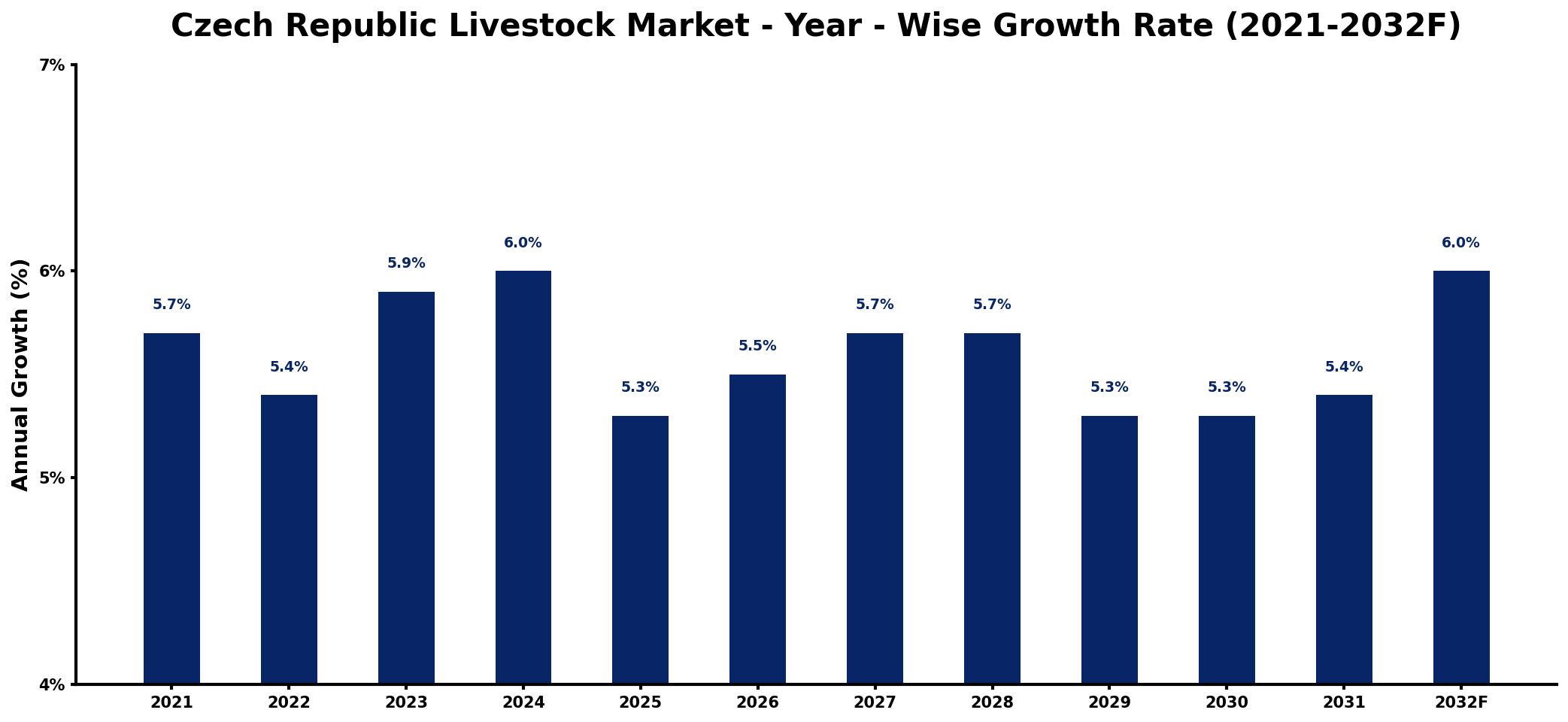
The table below presents the year‑wise growth rates along with the key drivers influencing the market
| Year | Growth Rate | Major Drivers |
| 2021 | 5.7% | Rising consumer health consciousness |
| 2022 | 5.4% | growing automotive sector requirements |
| 2023 | 5.9% | Expansion of export markets |
| 2024 | 6.0% | Technological advancements in farming |
| 2025 | 5.3% | Growth in organic farming sector |
| 2026 | 5.5% | Higher demand for protein sources |
| 2027 | 5.7% | Investment in sustainable practices |
| 2028 | 5.7% | Improved supply chain efficiency |
| 2029 | 5.3% | Strengthened local production initiatives |
| 2030 | 5.3% | Growing interest in agritech solutions |
| 2031 | 5.4% | Enhanced animal welfare standards |
| 2032 | 6.0% | Surge in alternative protein interest |
Note: Market size estimations and growth projections presented in this report are based on 6Wresearch's proprietary forecasting methodology, utilizing the latest available industry data, government publications, and primary research inputs.
Czech Republic Livestock Market Synopsis
The Czech Republic's livestock market is an essential pillar of the agricultural landscape, showcasing an impressive commitment to quality and animal welfare. With a dominant presence of cattle, pigs, poultry, and sheep, producers are continuously adapting to meet both domestic and international demands.
Cattle farming is particularly noteworthy, with both beef and dairy cattle significantly contributing to local consumption and exports. Meanwhile, pork remains a staple in Czech diets, and poultry farming, focusing on chicken and turkey, shows strong growth potential due to shifting consumer preferences towards lean meats.
Czech Republic Livestock Market Key Takeaways
- The market emphasizes high-quality production standards, with a strong focus on animal welfare.
- Sustainable and ethical farming practices are becoming increasingly prevalent among producers.
- Technology is enhancing productivity through data analytics and automation.
- Government policies actively support livestock farmers, aiming to boost sustainability and animal health.
- Investment opportunities abound, particularly in livestock farming and processing facilities.
Evaluation of Restraints in Czech Republic Livestock Market
Despite its strengths, the Czech Republic livestock market faces significant restraints that could hinder its potential. Fluctuating feed prices create uncertainty for farmers, impacting production costs and profitability. Moreover, increasing competition from imported products poses a challenge, as does the necessity for compliance with strict animal welfare and food safety regulations. Disease outbreaks, like African swine fever and avian influenza, threaten to disrupt production, making resilience crucial for stakeholders in this evolving landscape.
Czech Republic Livestock Market Trends
Current trends within the Czech Republic livestock market reflect a notable shift towards sustainability and transparency. Farmers are increasingly adopting environmentally friendly practices, including reduced antibiotic usage and improved waste management. Additionally, consumer demand for traceable meat products drives producers to focus on quality over quantity. The integration of technology within farming practices enhances operational efficiency and productivity, catering to a market that increasingly values both ethical and sustainable sourcing.
Czech Republic Livestock Market Opportunities
Investment prospects in the Czech Republic livestock market are promising, buoyed by a strong agricultural framework and a rise in high-quality meat demand. The strategic location of the Czech Republic within the EU facilitates export opportunities, further enhancing the attractiveness for investors. Entering the market through livestock farming or establishing processing facilities can yield substantial returns, especially when aligning operations with the growing consumer emphasis on sustainability and quality.
Government Initiatives in the Czech Republic Livestock Market
The Czech government actively supports the livestock market through various initiatives aimed at ensuring high standards in animal welfare and food safety. These include financial assistance programs that promote sustainable farming practices, as well as stringent regulations that ensure product quality for consumers. Monitoring systems to control livestock diseases are also in place, reflecting a commitment to both consumer health and environmental sustainability within the agricultural sector.
Future Insights of the Czech Republic Livestock Market
Looking ahead to 2026-2032, the Czech Republic livestock market is poised for steady growth, driven by a robust agricultural tradition and investment in modern farming technologies. The increasing global demand for ethically produced meat products aligns well with the market's focus on sustainability and quality. However, stakeholders must navigate challenges such as fluctuating feed prices and market competition. Overall, with the right strategies in place, the sector is set to thrive in an evolving consumer landscape.
Czech Republic Livestock Market Latest Developments (2025 - 2026)
Recent developments in the Czech Republic livestock market indicate a strong shift toward adopting innovative farming techniques and technology integration. Producers are increasingly leveraging data analytics to enhance operational efficiency and improve meat traceability. Concurrently, the government is enhancing its support systems to foster sustainable practices, aligning policies with the evolving needs of the market. The focus on ethical farming is also expected to drive consumer interest and demand in the upcoming years.
Czech Republic Livestock Market - Key Attractiveness of the Report
- 10 Years of Market Numbers
- Historical Data Starting from 2022 to 2025
- Base Year: 2025
- Forecast Data until 2032
- Key Performance Indicators Impacting the Market
- Major Upcoming Developments and Projects
Key Highlights of the Report:
- Czech Republic Livestock Market Outlook
- Market Size of Czech Republic Livestock Market, 2025
- Forecast of Czech Republic Livestock Market, 2032
- Historical Data and Forecast of Czech Republic Livestock Revenues & Volume for the Period 2022-2032F
- Czech Republic Livestock Market Trend Evolution
- Czech Republic Livestock Market Drivers and Challenges
- Czech Republic Livestock Price Trends
- Czech Republic Livestock Porter's Five Forces
- Czech Republic Livestock Industry Life Cycle
- Historical Data and Forecast of Czech Republic Livestock Market Revenues & Volume By Animal Type for the Period 2022-2032F
- Historical Data and Forecast of Czech Republic Livestock Market Revenues & Volume By Ruminants for the Period 2022-2032F
- Historical Data and Forecast of Czech Republic Livestock Market Revenues & Volume By Poultry for the Period 2022-2032F
- Historical Data and Forecast of Czech Republic Livestock Market Revenues & Volume By Swine for the Period 2022-2032F
- Historical Data and Forecast of Czech Republic Livestock Market Revenues & Volume By Aquaculture for the Period 2022-2032F
- Czech Republic Livestock Import Export Trade Statistics
- Market Opportunity Assessment By Animal Type
- Czech Republic Livestock Top Companies Market Share
- Czech Republic Livestock Competitive Benchmarking By Technical and Operational Parameters
- Czech Republic Livestock Company Profiles
- Czech Republic Livestock Key Strategic Recommendations






































