Czech Republic Portland Cement Market Size (2020-2030)
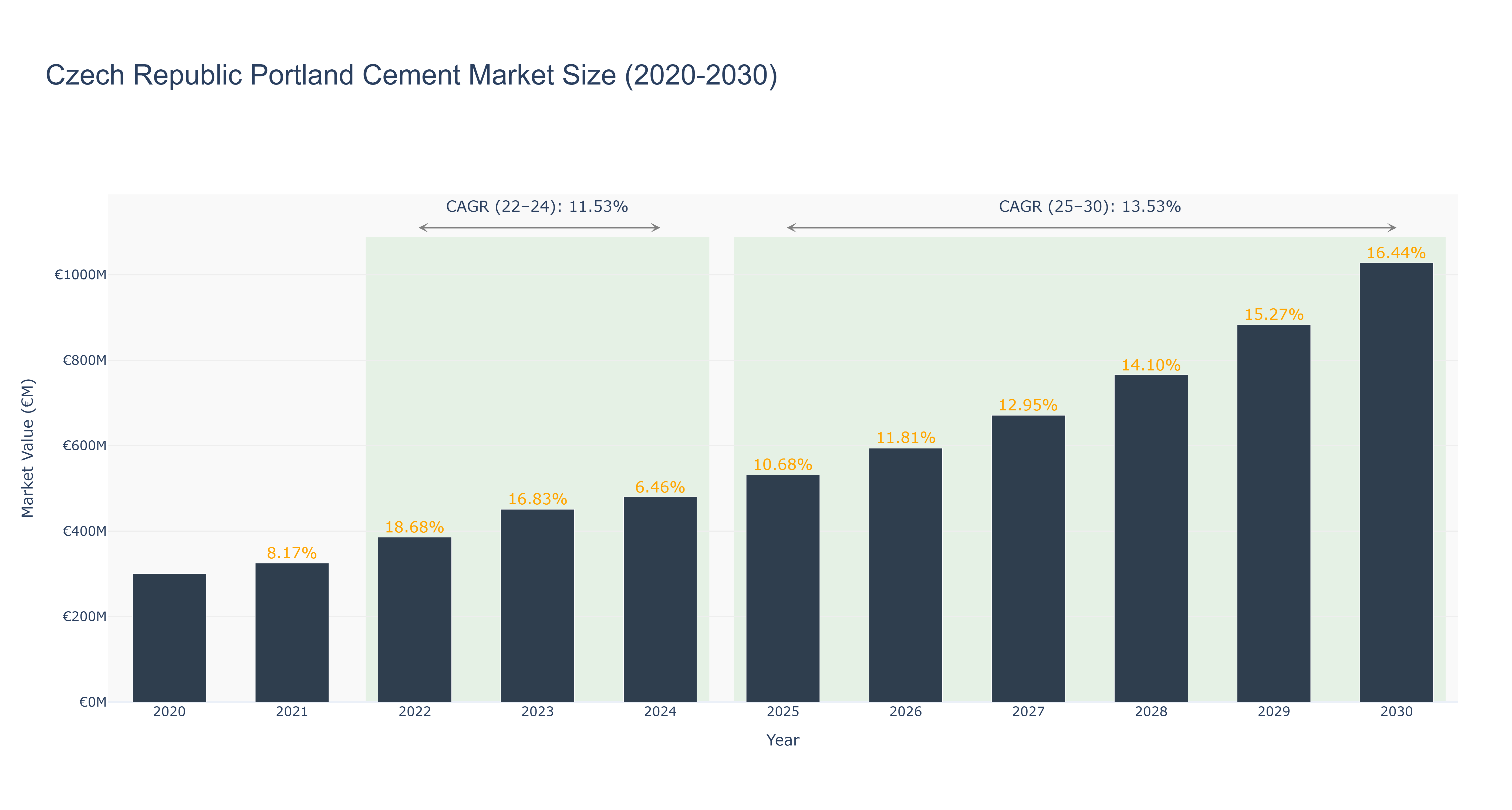
The Czech Republic Portland Cement Market has demonstrated significant growth over the past few years, with an actual market size peaking at €450.95 million in 2023, reflecting a robust growth rate of 16.83% from the previous year. The actual CAGR from 2022 to 2024 stands at 11.53%, driven by increased infrastructure investments and a revival in construction activity post-pandemic. As we look ahead to the forecasted period from 2025 to 2030, the market is expected to expand further, with projected market sizes reaching €1.03 billion by 2030, supported by a CAGR of 13.53%. Key macro drivers include ongoing government initiatives aimed at enhancing infrastructure and sustainable building practices, alongside rising demand in the residential sector. These factors are anticipated to sustain momentum, positioning the Czech Portland cement market for continued growth amid evolving industry dynamics.
Czech Republic Portland Cement Market: Production & Trade Performance (2019-2025)
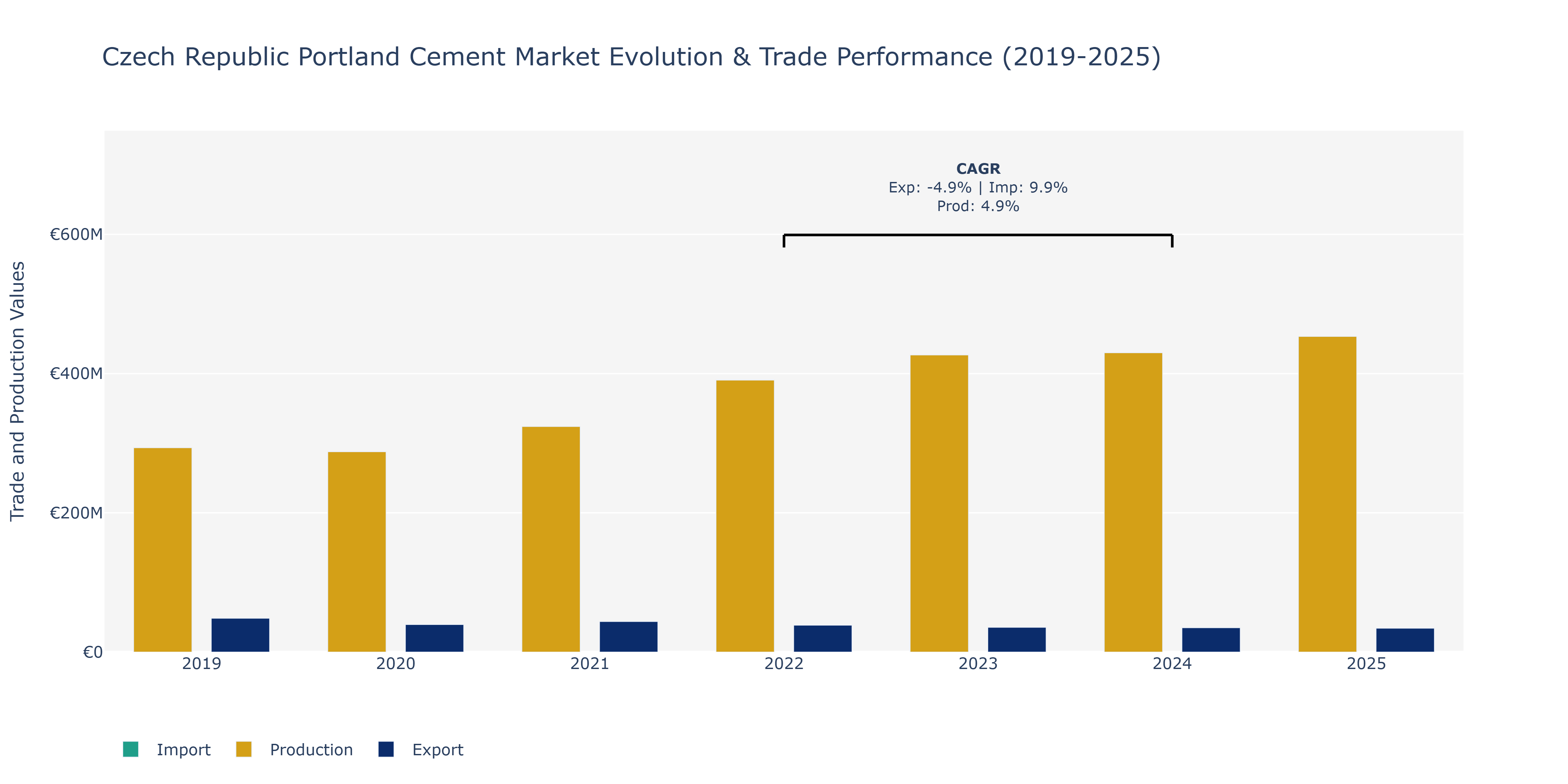
The Czech Republic Portland Cement Market witnessed fluctuations in exports, imports, and production from 2019 to 2025. Exports experienced a gradual decline from €48.48 million in 2019 to €34.09 million in 2025, possibly influenced by global economic uncertainties impacting demand. In contrast, imports showed an increasing trend, rising from €43.11 million in 2019 to €81.62 million in 2025, indicating a growing reliance on external sources. Production displayed a steady growth trajectory, reaching €453.39 million in 2025, reflecting the domestic market's capacity expansion to meet rising demand. The market's dynamics were further shaped by infrastructure development projects and construction activities in the Czech Republic, aligning with the cement industry's performance. The contrasting trends between exports and imports suggest evolving market competitiveness and trade dynamics within the cement sector, emphasizing the market's responsiveness to both domestic and international factors.
Czech Republic Portland Cement Market Synopsis
The Czech Republic Portland Cement market is characterized by steady growth driven by the country`s robust construction sector. The demand for Portland cement in the Czech Republic is primarily fueled by infrastructure projects, residential construction, and commercial development. Key players in the market include major cement manufacturers such as Äeskomoravský cement, Lafarge Cement, and Holcim. Sustainability and eco-friendly practices are becoming increasingly important in the market, with a growing emphasis on reducing carbon emissions and implementing energy-efficient production processes. The market is also witnessing a trend towards the use of alternative materials in cement production to minimize environmental impact. Overall, the Czech Republic Portland Cement market is poised for continued growth, supported by ongoing infrastructure projects and a strong construction industry.
Czech Republic Portland Cement Market Trends
In the Czech Republic Portland Cement Market, some current trends include a growing demand for sustainable and eco-friendly building materials, leading to an increased interest in low-carbon and high-performance cements. Additionally, there is a shift towards digitalization and automation in cement production processes to improve efficiency and reduce operational costs. Infrastructure development projects in the country are driving the demand for Portland cement, particularly in the construction of roads, bridges, and residential buildings. Market players are also focusing on innovation and product differentiation to stay competitive in the market. Overall, the Czech Republic Portland Cement Market is witnessing a combination of sustainability, technological advancement, and infrastructure growth as key trends shaping the industry landscape.
Czech Republic Portland Cement Market Challenges
In the Czech Republic Portland Cement Market, challenges may include intense competition among domestic and international cement manufacturers, leading to price wars and margin pressures. Additionally, fluctuations in raw material prices, such as limestone and clay, can impact the cost of production and profitability for cement companies. Environmental regulations and sustainability concerns are also becoming increasingly important, pushing companies to invest in eco-friendly production processes and technologies. Furthermore, the market may face challenges related to infrastructure development and construction activity levels, which can directly impact the demand for cement products. Overall, navigating these challenges requires cement companies in the Czech Republic to focus on innovation, cost-efficiency, and sustainability to maintain a competitive edge in the market.
Czech Republic Portland Cement Market Investment Opportunities
The Czech Republic Portland Cement Market presents promising investment opportunities due to the country`s strong infrastructure development and construction industry. With increasing demand for cement in residential, commercial, and industrial construction projects, there is a growing need for high-quality building materials like Portland cement. Investors can consider opportunities in cement production plants, distribution networks, or even technological innovations to improve efficiency and sustainability in the industry. Additionally, the Czech Republic`s strategic location in Central Europe provides access to neighboring markets, enhancing the export potential for cement products. Overall, investing in the Czech Republic Portland Cement Market offers the potential for long-term growth and profitability in line with the country`s construction sector expansion.
Czech Republic Portland Cement Market Future Outlook
The future outlook for the Czech Republic Portland Cement Market appears positive, driven by several factors. The construction industry in the country is expected to grow steadily, supported by infrastructure projects, residential construction, and commercial developments. Additionally, the government`s focus on sustainable construction practices and the increasing demand for high-quality cement products are likely to boost the market further. Technological advancements and innovations in cement production processes are also anticipated to enhance the efficiency and environmental sustainability of the industry. Overall, with favorable market conditions and a growing construction sector, the Czech Republic Portland Cement Market is poised for gradual expansion and development in the coming years.
Key Highlights of the Report:
- Czech Republic Portland Cement Market Outlook
- Market Size of Czech Republic Portland Cement Market, 2021
- Forecast of Czech Republic Portland Cement Market, 2031
- Historical Data and Forecast of Czech Republic Portland Cement Revenues & Volume for the Period 2018 - 2031
- Czech Republic Portland Cement Market Trend Evolution
- Czech Republic Portland Cement Market Drivers and Challenges
- Czech Republic Portland Cement Price Trends
- Czech Republic Portland Cement Porter's Five Forces
- Czech Republic Portland Cement Industry Life Cycle
- Historical Data and Forecast of Czech Republic Portland Cement Market Revenues & Volume By Type for the Period 2018 - 2031
- Historical Data and Forecast of Czech Republic Portland Cement Market Revenues & Volume By Type 1 for the Period 2018 - 2031
- Historical Data and Forecast of Czech Republic Portland Cement Market Revenues & Volume By Type 2 for the Period 2018 - 2031
- Historical Data and Forecast of Czech Republic Portland Cement Market Revenues & Volume By Type 3 for the Period 2018 - 2031
- Historical Data and Forecast of Czech Republic Portland Cement Market Revenues & Volume By Type 4 for the Period 2018 - 2031
- Historical Data and Forecast of Czech Republic Portland Cement Market Revenues & Volume By Type 5 for the Period 2018 - 2031
- Historical Data and Forecast of Czech Republic Portland Cement Market Revenues & Volume By for the Period 2018 - 2031
- Historical Data and Forecast of Czech Republic Portland Cement Market Revenues & Volume By Application for the Period 2018 - 2031
- Historical Data and Forecast of Czech Republic Portland Cement Market Revenues & Volume By Residential for the Period 2018 - 2031
- Historical Data and Forecast of Czech Republic Portland Cement Market Revenues & Volume By Commercial for the Period 2018 - 2031
- Historical Data and Forecast of Czech Republic Portland Cement Market Revenues & Volume By Industrial for the Period 2018 - 2031
- Historical Data and Forecast of Czech Republic Portland Cement Market Revenues & Volume By for the Period 2018 - 2031
- Historical Data and Forecast of Czech Republic Portland Cement Market Revenues & Volume By Packing Type for the Period 2018 - 2031
- Historical Data and Forecast of Czech Republic Portland Cement Market Revenues & Volume By 10 KG for the Period 2018 - 2031
- Historical Data and Forecast of Czech Republic Portland Cement Market Revenues & Volume By 15 KG for the Period 2018 - 2031
- Historical Data and Forecast of Czech Republic Portland Cement Market Revenues & Volume By 25 KG for the Period 2018 - 2031
- Historical Data and Forecast of Czech Republic Portland Cement Market Revenues & Volume By Others for the Period 2018 - 2031
- Czech Republic Portland Cement Import Export Trade Statistics
- Market Opportunity Assessment By Type
- Market Opportunity Assessment By Application
- Market Opportunity Assessment By Packing Type
- Czech Republic Portland Cement Top Companies Market Share
- Czech Republic Portland Cement Competitive Benchmarking By Technical and Operational Parameters
- Czech Republic Portland Cement Company Profiles
- Czech Republic Portland Cement Key Strategic Recommendations






































