Czech Republic Renewable Chemicals Market Size, Share & Growth Rate
The Czech Republic Renewable Chemicals Market was estimated at USD 314 Million in 2025 and is projected to reach USD 411 Million by 2032, growing at a CAGR of 3.9% from 2026 to 2032. This growth trajectory is significantly influenced by the increasing shift towards sustainable chemical alternatives, driven by both consumer demand and regulatory frameworks. Moreover, advancements in production technologies are enhancing the viability and cost-effectiveness of renewable chemicals, enabling wider adoption in various applications.
Czech Republic Renewable Chemicals Market Year-wise Growth Rate and Key Drivers
This graph highlights how the Czech Republic Renewable Chemicals Market has steadily grown over the years, supported by major growth factors.
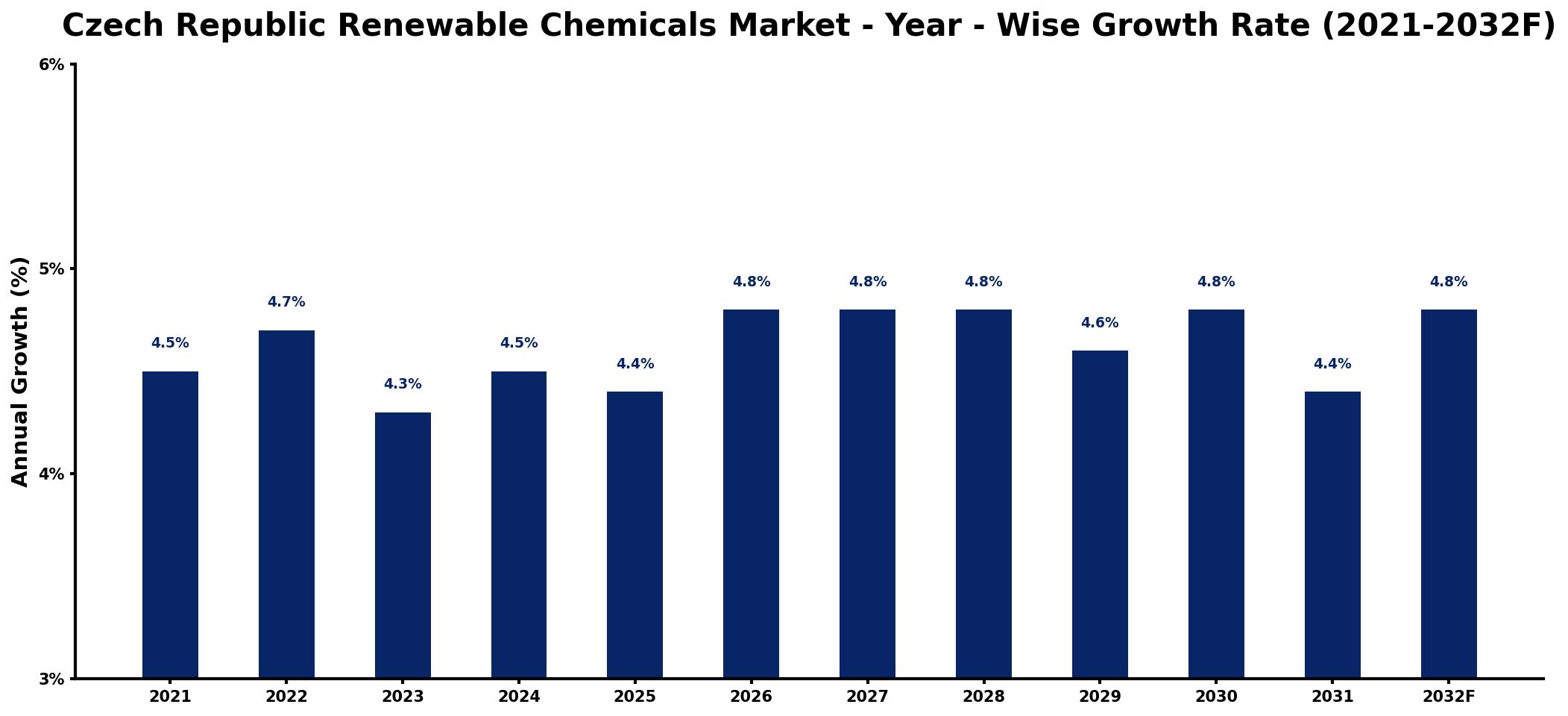
The table below presents the year‑wise growth rates along with the key drivers influencing the market
| Year | Growth Rate | Major Drivers |
| 2021 | 4.5% | Rising demand for sustainable materials |
| 2022 | 4.7% | Increased investments in green technologies |
| 2023 | 4.3% | Growing consumer preference for eco-friendly |
| 2024 | 4.5% | Expansion of bio-based product applications |
| 2025 | 4.4% | Strengthening regulatory support for sustainability |
| 2026 | 4.8% | Advancements in production efficiency techniques |
| 2027 | 4.8% | Emerging markets adopting sustainable practices |
| 2028 | 4.8% | Collaborations between industries for innovation |
| 2029 | 4.6% | growing downstream application demand |
| 2030 | 4.8% | Growing interest from venture capital |
| 2031 | 4.4% | Strengthened partnerships with research institutions |
| 2032 | 4.8% | Increased public awareness of sustainability |
Note: Market size estimations and growth projections presented in this report are based on 6Wresearch's proprietary forecasting methodology, utilizing the latest available industry data, government publications, and primary research inputs.
Czech Republic Renewable Chemicals Market Synopsis
The Czech Republic renewable chemicals market has recently gained momentum, reflecting a strong commitment to sustainability. As companies embrace green chemistry practices, the market is evolving rapidly, highlighting a transition from traditional petrochemical dependency toward renewable solutions. Despite this positive trajectory, there are critical areas that require attention, particularly in the adoption of innovative technologies and regulatory support.
Looking ahead, the renewable chemicals market is set to expand further, fuelled by rising consumer awareness regarding environmental issues. As awareness grows, more businesses are expected to invest in renewable chemical alternatives, seeking to align themselves with circular economy principles. The forthcoming years will be pivotal in establishing a robust regulatory framework that can bolster innovation and investment in this sector.
Czech Republic Renewable Chemicals Market Key Takeaways
- The market is anticipated to grow significantly due to enhanced governmental policies and consumer awareness.
- Technological innovations are making renewable chemicals increasingly cost-competitive.
- The circular economy model is driving material recycling and repurposing, impacting market dynamics positively.
- High production costs and limited consumer awareness remain key challenges for market participants.
- Government incentives are crucial for encouraging investment and R&D in renewable chemical technologies.
Evaluation of Restraints in Czech Republic Renewable Chemicals Market
Despite its growth potential, the Czech Republic renewable chemicals market faces notable constraints. The primary barrier remains the high production costs when compared to conventional chemical processes. This situation is exacerbated by fluctuating raw material prices and a limited supply chain for sustainable inputs. Additionally, while government incentives exist, they are often perceived as insufficient to drive the widespread adoption of innovative green technologies. The current lack of a comprehensive regulatory framework also limits scalability and hampers investments in this critical sector.
Czech Republic Renewable Chemicals Market Trends
Several current trends are shaping the landscape of the renewable chemicals market in the Czech Republic. A significant shift is the adoption of bioplastics, particularly in consumer goods and packaging, as companies strive to meet increasing eco-friendly expectations. Furthermore, advancements in biotechnology are leading to novel bio-based solvents and fuels, which present competitive alternatives to traditional petrochemical products. As the industry evolves, collaborations between startups and established chemical firms are becoming more common, facilitating innovation and market entry.
Czech Republic Renewable Chemicals Market Opportunities
The landscape for growth and investment in the Czech Republic renewable chemicals market is particularly bright in the realms of bioplastics and biofuels. Companies are encouraged to explore partnerships that focus on R&D for new bio-based applications. Furthermore, as the demand for sustainable products continues to rise, there is a unique opportunity to develop new business models centered around circular economy practices. By focusing on waste-to-resource initiatives, stakeholders can unlock significant value while contributing to sustainability goals.
Government Initiatives in the Czech Republic Renewable Chemicals Market
The Czech government has actively pursued initiatives aimed at fostering the renewable chemicals market, in alignment with broader EU directives aimed at carbon reduction. Various incentives, including tax breaks for companies investing in renewable technologies and grants for research and development, have been established to stimulate innovation. Additionally, the government is focusing on creating a more cohesive regulatory framework to support the integration of renewable chemicals into the national economy.
Future Insights of the Czech Republic Renewable Chemicals Market
As we look towards 2026-2032, the Czech Republic renewable chemicals market is poised for dynamic growth, propelled by increased environmental regulations and an urgent need for sustainable alternatives. Industry stakeholders that capitalize on emerging technologies and enhance consumer awareness will likely thrive. Furthermore, anticipated improvements in the regulatory landscape should enable faster adoption of innovative renewable products, further solidifying the market's foundation for long-term success.
Czech Republic Renewable Chemicals Market Latest Developments (2025 - 2026)
Recent developments within the renewable chemicals market in the Czech Republic highlight a growing commitment from various sectors towards sustainability. Numerous companies have started pilot projects focusing on the production of bioplastics and bio-based chemicals, showcasing the potential for large-scale adoption. Additionally, industry conferences and networking events have been pivotal in fostering collaboration, leading to a more interconnected ecosystem that supports innovation and growth.
Czech Republic Renewable Chemicals Market - Key Attractiveness of the Report
- 10 Years of Market Numbers
- Historical Data Starting from 2022 to 2025
- Base Year: 2025
- Forecast Data until 2032
- Key Performance Indicators Impacting the Market
- Major Upcoming Developments and Projects
Key Highlights of the Report:
- Czech Republic Renewable Chemicals Market Outlook
- Market Size of Czech Republic Renewable Chemicals Market, 2025
- Forecast of Czech Republic Renewable Chemicals Market, 2032
- Historical Data and Forecast of Czech Republic Renewable Chemicals Revenues & Volume for the Period 2022-2032F
- Czech Republic Renewable Chemicals Market Trend Evolution
- Czech Republic Renewable Chemicals Market Drivers and Challenges
- Czech Republic Renewable Chemicals Price Trends
- Czech Republic Renewable Chemicals Porter's Five Forces
- Czech Republic Renewable Chemicals Industry Life Cycle
- Historical Data and Forecast of Czech Republic Renewable Chemicals Market Revenues & Volume By Product Type for the Period 2022-2032F
- Historical Data and Forecast of Czech Republic Renewable Chemicals Market Revenues & Volume By Alcohols for the Period 2022-2032F
- Historical Data and Forecast of Czech Republic Renewable Chemicals Market Revenues & Volume By Organic Acids for the Period 2022-2032F
- Historical Data and Forecast of Czech Republic Renewable Chemicals Market Revenues & Volume By Ketones for the Period 2022-2032F
- Historical Data and Forecast of Czech Republic Renewable Chemicals Market Revenues & Volume By Platform Chemicals for the Period 2022-2032F
- Historical Data and Forecast of Czech Republic Renewable Chemicals Market Revenues & Volume By Biopolymers for the Period 2022-2032F
- Historical Data and Forecast of Czech Republic Renewable Chemicals Market Revenues & Volume By Others for the Period 2022-2032F
- Historical Data and Forecast of Czech Republic Renewable Chemicals Market Revenues & Volume By Applications for the Period 2022-2032F
- Historical Data and Forecast of Czech Republic Renewable Chemicals Market Revenues & Volume By Transportation for the Period 2022-2032F
- Historical Data and Forecast of Czech Republic Renewable Chemicals Market Revenues & Volume By Textiles for the Period 2022-2032F
- Historical Data and Forecast of Czech Republic Renewable Chemicals Market Revenues & Volume By Food safety for the Period 2022-2032F
- Historical Data and Forecast of Czech Republic Renewable Chemicals Market Revenues & Volume By Environment for the Period 2022-2032F
- Historical Data and Forecast of Czech Republic Renewable Chemicals Market Revenues & Volume By Communication for the Period 2022-2032F
- Historical Data and Forecast of Czech Republic Renewable Chemicals Market Revenues & Volume By Housing for the Period 2022-2032F
- Historical Data and Forecast of Czech Republic Renewable Chemicals Market Revenues & Volume By Recreation for the Period 2022-2032F
- Historical Data and Forecast of Czech Republic Renewable Chemicals Market Revenues & Volume By Other Applications for the Period 2022-2032F
- Czech Republic Renewable Chemicals Import Export Trade Statistics
- Market Opportunity Assessment By Product Type
- Market Opportunity Assessment By Applications
- Czech Republic Renewable Chemicals Top Companies Market Share
- Czech Republic Renewable Chemicals Competitive Benchmarking By Technical and Operational Parameters
- Czech Republic Renewable Chemicals Company Profiles
- Czech Republic Renewable Chemicals Key Strategic Recommendations






































