Czech Republic Retail And Wholesale Market Size, Share & Growth Rate
The Czech Republic Retail And Wholesale Market was estimated at USD 844 Million in 2025 and is projected to reach USD 1462 Million by 2032, growing at a CAGR of 8.2% from 2026 to 2032. This remarkable growth trajectory is primarily driven by the increasing internet penetration and a tech-savvy population that is rapidly embracing online shopping. Furthermore, a growing preference for high-quality, sustainable products is reshaping consumer spending habits, contributing to the overall market expansion.
Czech Republic Retail And Wholesale Market Year-wise Growth Rate and Key Drivers
This graph highlights how the Czech Republic Retail And Wholesale Market has steadily grown over the years, supported by major growth factors.
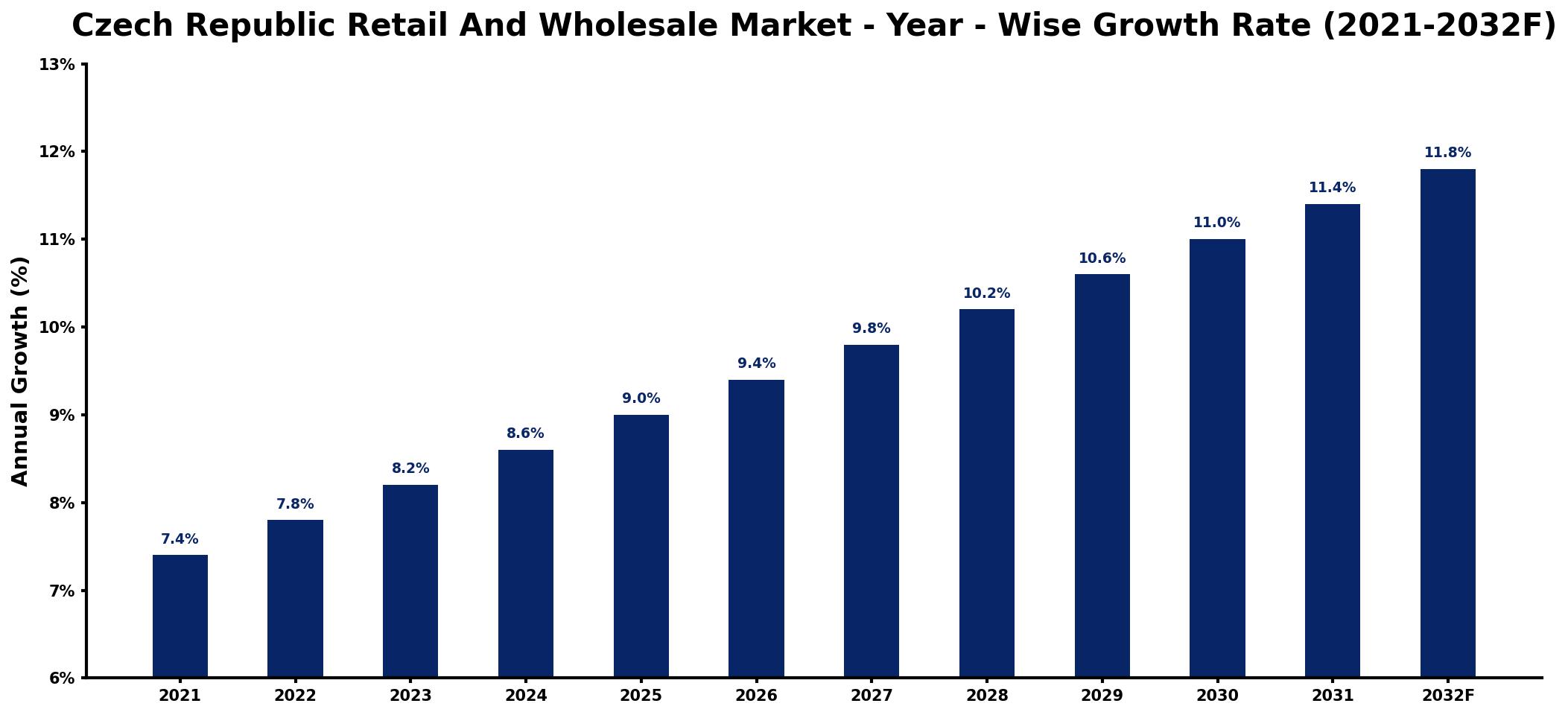
The table below presents the year‑wise growth rates along with the key drivers influencing the market
| Year | Growth Rate | Major Drivers |
| 2021 | 7.4% | E-commerce adoption accelerates rapidly |
| 2022 | 7.8% | Consumer spending increases significantly |
| 2023 | 8.2% | Technological innovations enhance efficiency |
| 2024 | 8.6% | Sustainability initiatives gain traction |
| 2025 | 9.0% | Digital payment systems expand widely |
| 2026 | 9.4% | Urbanization drives shopping preferences |
| 2027 | 9.8% | Logistics improvements enhance distribution |
| 2028 | 10.2% | Omnichannel strategies attract customers |
| 2029 | 10.6% | Product diversification meets demands |
| 2030 | 11.0% | Health and wellness trends rise |
| 2031 | 11.4% | Personalization in services increases |
| 2032 | 11.8% | Global partnerships strengthen market presence |
Note: Market size estimations and growth projections presented in this report are based on 6Wresearch's proprietary forecasting methodology, utilizing the latest available industry data, government publications, and primary research inputs.
Czech Republic Retail And Wholesale Market Synopsis
A noteworthy aspect of the Czech Republic Retail and Wholesale Market is the rising demand for locally sourced and sustainable products. Consumers are becoming more conscientious about their purchasing choices, leading retailers to adapt their offerings accordingly. This trend is pushing businesses towards eco-friendly practices and promoting local production.
Simultaneously, the competitive landscape is evolving, with international chains establishing a strong presence alongside local businesses. The ability to provide a seamless shopping experience—whether in-store or online—has become crucial for capturing consumer loyalty in an increasingly crowded market.
Czech Republic Retail And Wholesale Market Key Takeaways
- The market shows significant potential, driven by a blend of traditional and online retail channels.
- Consumer preferences are shifting towards sustainability and local sourcing.
- International competition is intensifying, creating both challenges and opportunities.
- The rapid adoption of e-commerce is fundamentally changing shopping behaviors.
- Strategic investments in technology and customer experience are vital for market success.
Evaluation of Restraints in Czech Republic Retail And Wholesale Market
Despite the promising growth prospects, the market faces certain restraints. One significant limitation is the mounting pressure from international retailers who can often leverage economies of scale to offer competitive prices. This intensifies the need for local businesses to clearly distinguish themselves through unique value propositions. Additionally, fluctuating economic conditions and regulatory changes introduce uncertainties that can hinder stability and growth within the sector. Retailers must also navigate the complexities of supply chain management and ensure their inventory aligns with shifting consumer demands to maintain competitiveness.
Czech Republic Retail And Wholesale Market Trends
Several trends are shaping the Czech Republic Retail and Wholesale Market today. The surge in online shopping continues to dominate, driven by convenience and a broad product selection. Retailers are increasingly utilizing innovative technologies like augmented reality to enhance in-store experiences, while personalized recommendations are becoming commonplace in online retail. Furthermore, sustainability is not just a trend but a necessity, as consumers are prioritizing brands that demonstrate a commitment to environmentally friendly practices.
Czech Republic Retail And Wholesale Market Opportunities
The landscape of investment opportunities in the Czech Republic's Retail and Wholesale Market is both diverse and promising. With a growing economy and rising disposable incomes, sectors such as food and beverages, fashion, and electronics are poised for significant growth. E-commerce continues to emerge as a lucrative area, driven by evolving consumer preferences. Businesses that align their strategies with sustainability initiatives will find themselves well-positioned to capture a loyal customer base increasingly concerned about ethical consumption.
Government Initiatives in the Czech Republic Retail And Wholesale Market
Government policies play a pivotal role in the Retail and Wholesale Market by fostering fair competition and protecting consumer interests. Key regulations, including the Competition Act and Consumer Protection Act, work to ensure a transparent market environment. Additionally, the government offers support for small and medium-sized enterprises (SMEs) through various programs aimed at facilitating access to financing and promoting growth within the sector. These initiatives contribute to a healthy market ecosystem that benefits both consumers and businesses.
Future Insights of the Czech Republic Retail And Wholesale Market
Looking ahead to the period of 2026-2032, the Czech Republic Retail and Wholesale Market is expected to maintain a positive growth trajectory. As disposable incomes continue to rise, consumer confidence is likely to bolster spending across various sectors. E-commerce will play an increasingly significant role, with more individuals opting for the convenience it offers. The trend towards sustainability will further shape market dynamics, compelling retailers to innovate and align their offerings with consumers' evolving values.
Czech Republic Retail And Wholesale Market Latest Developments (2025 - 2026)
In recent months, the Czech Republic's Retail and Wholesale Market has witnessed significant shifts in industry direction. The surge in e-commerce has prompted traditional retailers to invest in enhancing their online platforms, focusing on improved user experiences and faster delivery options. Simultaneously, there is an increasing emphasis on sustainable practices, with several businesses adopting eco-friendly sourcing and packaging solutions. This shift reflects broader consumer trends prioritizing environmental responsibility, suggesting an enduring change in the market landscape.
Czech Republic Retail And Wholesale Market - Key Attractiveness of the Report
- 10 Years of Market Numbers
- Historical Data Starting from 2022 to 2025
- Base Year: 2025
- Forecast Data until 2032
- Key Performance Indicators Impacting the Market
- Major Upcoming Developments and Projects
Key Highlights of the Report:
- Czech Republic Retail And Wholesale Market Outlook
- Market Size of Czech Republic Retail And Wholesale Market, 2025
- Forecast of Czech Republic Retail And Wholesale Market, 2032
- Historical Data and Forecast of Czech Republic Retail And Wholesale Revenues & Volume for the Period 2022-2032F
- Czech Republic Retail And Wholesale Market Trend Evolution
- Czech Republic Retail And Wholesale Market Drivers and Challenges
- Czech Republic Retail And Wholesale Price Trends
- Czech Republic Retail And Wholesale Porter's Five Forces
- Czech Republic Retail And Wholesale Industry Life Cycle
- Historical Data and Forecast of Czech Republic Retail And Wholesale Market Revenues & Volume By Type for the Period 2022-2032F
- Historical Data and Forecast of Czech Republic Retail And Wholesale Market Revenues & Volume By Retail for the Period 2022-2032F
- Historical Data and Forecast of Czech Republic Retail And Wholesale Market Revenues & Volume By Wholesale for the Period 2022-2032F
- Historical Data and Forecast of Czech Republic Retail And Wholesale Market Revenues & Volume By Ownership for the Period 2022-2032F
- Historical Data and Forecast of Czech Republic Retail And Wholesale Market Revenues & Volume By Retail Chain/Wholesale Chain for the Period 2022-2032F
- Historical Data and Forecast of Czech Republic Retail And Wholesale Market Revenues & Volume By Independent Retailer/Independent Wholesalers for the Period 2022-2032F
- Historical Data and Forecast of Czech Republic Retail And Wholesale Market Revenues & Volume By Price Range for the Period 2022-2032F
- Historical Data and Forecast of Czech Republic Retail And Wholesale Market Revenues & Volume By Premium for the Period 2022-2032F
- Historical Data and Forecast of Czech Republic Retail And Wholesale Market Revenues & Volume By Mid-Range for the Period 2022-2032F
- Historical Data and Forecast of Czech Republic Retail And Wholesale Market Revenues & Volume By Economy for the Period 2022-2032F
- Historical Data and Forecast of Czech Republic Retail And Wholesale Market Revenues & Volume By Distribution Channel for the Period 2022-2032F
- Historical Data and Forecast of Czech Republic Retail And Wholesale Market Revenues & Volume By Supermarkets/Hypermarkets for the Period 2022-2032F
- Historical Data and Forecast of Czech Republic Retail And Wholesale Market Revenues & Volume By Convenience Stores for the Period 2022-2032F
- Historical Data and Forecast of Czech Republic Retail And Wholesale Market Revenues & Volume By Department Stores for the Period 2022-2032F
- Historical Data and Forecast of Czech Republic Retail And Wholesale Market Revenues & Volume By Specialty Stores for the Period 2022-2032F
- Czech Republic Retail And Wholesale Import Export Trade Statistics
- Market Opportunity Assessment By Type
- Market Opportunity Assessment By Ownership
- Market Opportunity Assessment By Price Range
- Market Opportunity Assessment By Distribution Channel
- Czech Republic Retail And Wholesale Top Companies Market Share
- Czech Republic Retail And Wholesale Competitive Benchmarking By Technical and Operational Parameters
- Czech Republic Retail And Wholesale Company Profiles
- Czech Republic Retail And Wholesale Key Strategic Recommendations






































