Denmark Diesel Engine Market Size (2020-2030)
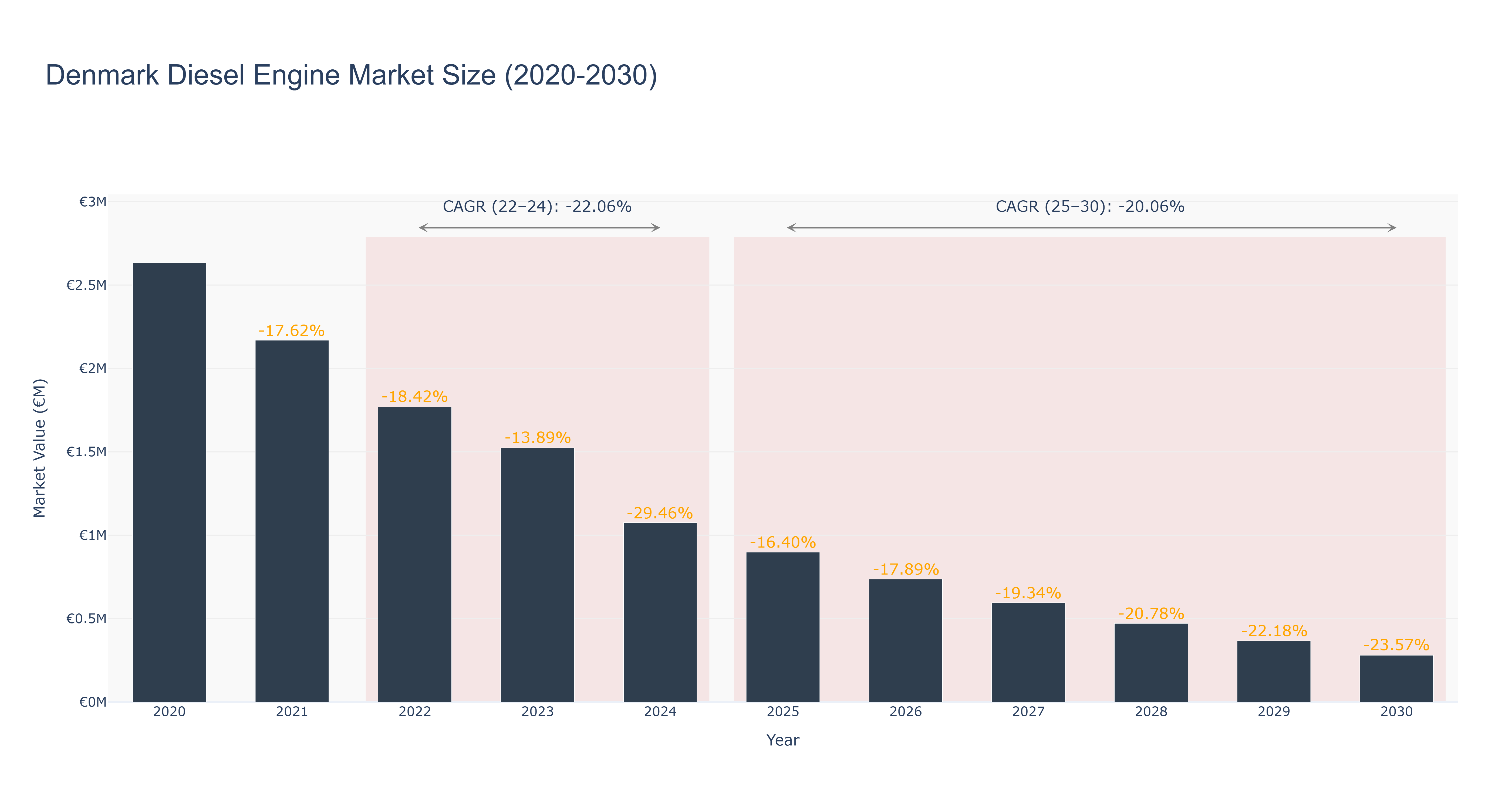
The Denmark Diesel Engine Market has experienced a significant decline in market size over the past decade. The peak market size of €2.63 million was recorded in 2020, followed by a steady decrease to €0.28 million in 2030. The actual market size from 2020 to 2024 saw a substantial drop, attributed to a combination of factors such as technological advancements in alternative energy sources and shifting consumer preferences towards greener solutions. The forecasted market size from 2025 to 2030 indicates a continued downward trend, with a CAGR of -20.06%. Despite the challenging market conditions, recent developments in Denmark, such as government initiatives to promote sustainable energy solutions and investments in renewable technologies, are expected to drive future growth in the diesel engine market. Industry drivers include environmental regulations, energy efficiency requirements, and evolving customer demands for eco-friendly products.
Denmark Diesel Engine Market: Production & Trade Performance (2019-2025)
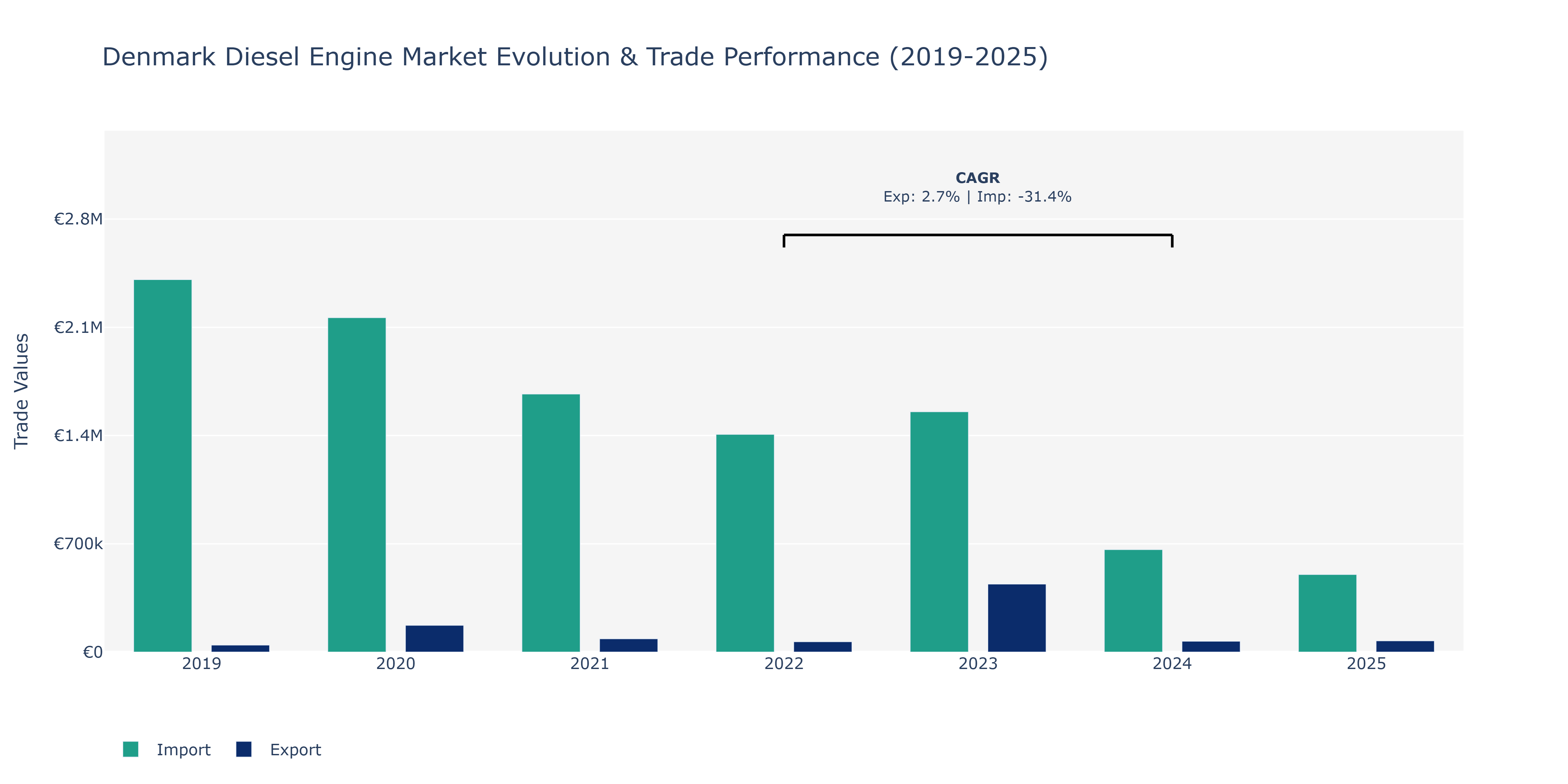
The Denmark Diesel Engine Market witnessed notable fluctuations in both Exports and Imports from 2019 to 2025. In 2019, Imports stood at €2.41 million, significantly higher than Exports at €45.14 thousand. However, in 2020, Exports surged to €172.66 thousand, narrowing the gap with Imports at €2.16 million. The following year, both Exports and Imports experienced a decline, with Exports dropping to €85.6 thousand and Imports decreasing to €1.67 million. A similar trend continued in 2022, reflecting reduced demand for diesel engines. Interestingly, in 2023, Exports spiked to €439.57 thousand, potentially due to increased international demand or new market entries. Meanwhile, Imports decreased to €1.55 million, a potential sign of domestic manufacturing capabilities meeting local demand. By 2025, Exports and Imports had stabilized around €72.59 thousand and €501.38 thousand, respectively, reflecting a more balanced market. These fluctuations can be attributed to changing global trade dynamics, evolving environmental regulations favoring alternative energy sources, and technological advancements in diesel engine efficiency, influencing both domestic production and international trade patterns in the Danish diesel engine market.
Denmark Diesel Engine Market Overview
The Denmark Diesel Engine Market is witnessing a shift towards cleaner and more efficient diesel technologies in response to environmental regulations and sustainability goals. The demand for diesel engines remains strong in transportation and industrial sectors due to their durability and fuel efficiency. However, the market is also influenced by the growing adoption of alternative fuels and hybrid technologies as companies seek to reduce emissions. Manufacturers are focusing on developing advanced diesel engines that comply with stringent emission standards while delivering high performance.
Drivers of the market
The diesel engine market in Denmark is primarily driven by the need for efficient and reliable power solutions in transportation, agriculture, and construction sectors. The increasing focus on fuel efficiency and low emissions has led to advancements in diesel engine technology, enhancing performance and sustainability. Additionally, the growth of logistics and freight transportation requires robust diesel engines to support heavy-duty applications. Government regulations aimed at reducing carbon footprints further drive the adoption of advanced diesel engine solutions.
Challenges of the market
The Denmark Diesel Engine Market faces increasing pressure to comply with stringent emissions regulations aimed at reducing environmental impact. Manufacturers must invest in technologies to meet these regulations, which can lead to higher production costs. Additionally, the growing popularity of alternative fuels and electric vehicles poses a threat to traditional diesel engine sales. The market is also characterized by intense competition, requiring companies to innovate continually and offer improved efficiency and performance.
Government Policy of the market
In the diesel engine market, the Danish government is committed to reducing carbon emissions and promoting cleaner technologies. Regulations governing emissions standards are strictly enforced, pushing manufacturers to innovate and develop more efficient diesel engines. The government also invests in alternative fuels and hybrid technologies to encourage a transition towards sustainable transportation solutions. Public awareness campaigns promote the benefits of cleaner diesel engines, supporting their acceptance in the market.
Key Highlights of the Report:
- Denmark Diesel Engine Market Outlook
- Market Size of Denmark Diesel Engine Market, 2024
- Forecast of Denmark Diesel Engine Market, 2031
- Historical Data and Forecast of Denmark Diesel Engine Revenues & Volume for the Period 2021-2031
- Denmark Diesel Engine Market Trend Evolution
- Denmark Diesel Engine Market Drivers and Challenges
- Denmark Diesel Engine Price Trends
- Denmark Diesel Engine Porter`s Five Forces
- Denmark Diesel Engine Industry Life Cycle
- Historical Data and Forecast of Denmark Diesel Engine Market Revenues & Volume By Power Rating for the Period 2021-2031
- Historical Data and Forecast of Denmark Diesel Engine Market Revenues & Volume By 0.5 MW 1 MW for the Period 2021-2031
- Historical Data and Forecast of Denmark Diesel Engine Market Revenues & Volume By Up to 0.5 MW for the Period 2021-2031
- Historical Data and Forecast of Denmark Diesel Engine Market Revenues & Volume By 2 MW 5 MW for the Period 2021-2031
- Historical Data and Forecast of Denmark Diesel Engine Market Revenues & Volume By 1 MW 2 MW for the Period 2021-2031
- Historical Data and Forecast of Denmark Diesel Engine Market Revenues & Volume By Above 5 MW for the Period 2021-2031
- Historical Data and Forecast of Denmark Diesel Engine Market Revenues & Volume By for the Period 2021-2031
- Historical Data and Forecast of Denmark Diesel Engine Market Revenues & Volume By End User for the Period 2021-2031
- Historical Data and Forecast of Denmark Diesel Engine Market Revenues & Volume By Automotive for the Period 2021-2031
- Historical Data and Forecast of Denmark Diesel Engine Market Revenues & Volume By Non-Automotive for the Period 2021-2031
- Denmark Diesel Engine Import Export Trade Statistics
- Market Opportunity Assessment By Power Rating
- Market Opportunity Assessment By End User
- Denmark Diesel Engine Top Companies Market Share
- Denmark Diesel Engine Competitive Benchmarking By Technical and Operational Parameters
- Denmark Diesel Engine Company Profiles
- Denmark Diesel Engine Key Strategic Recommendations






































