Denmark Fruit Pulp Market Top 5 Importing Countries and Market Competition (HHI) Analysis
In 2024, Denmark import of fruit pulp continued to see strong growth with a CAGR of 18.69% from 2020 to 2024. Top exporting countries to Denmark included Germany, Poland, Sweden, Metropolitan France, and Italy. Despite the increasing import volume, the market remained competitive with low concentration as indicated by the Herfindahl-Hirschman Index (HHI). The growth rate in 2024 was also notable at 4.74%, reflecting the ongoing demand for fruit pulp in Denmark.
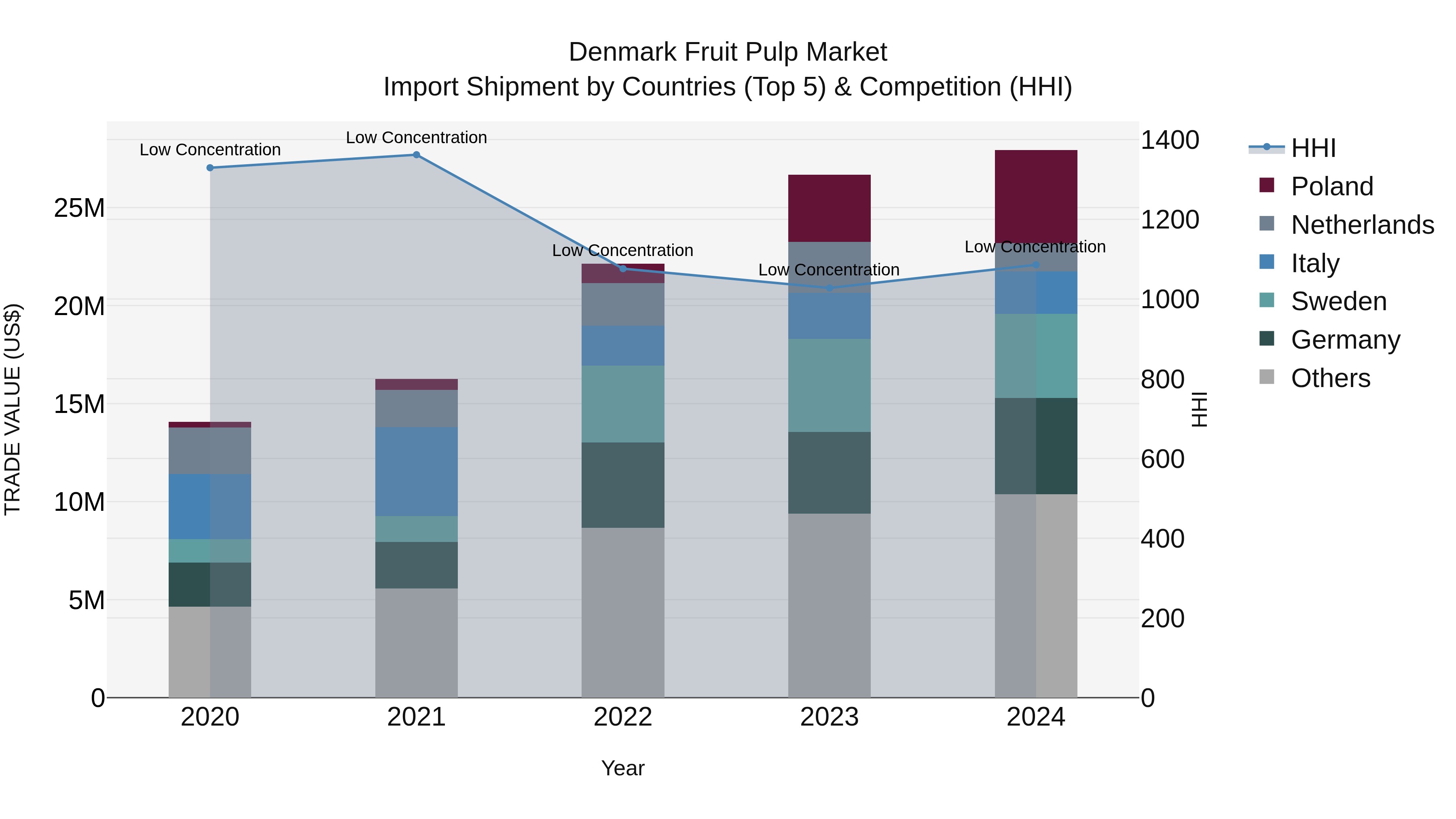
Denmark Fruit Pulp Market Overview
The Denmark Fruit Pulp Market is experiencing growth as consumers increasingly seek natural and healthy food options. Fruit pulp is widely used in the production of beverages, desserts, and baked goods, driven by the trend towards clean-label products. The demand for organic and sustainably sourced fruit pulp is also on the rise, reflecting consumer preferences for high-quality ingredients. Innovations in processing technologies are enhancing the quality and shelf life of fruit pulp, further supporting market growth. The market is expected to benefit from the expanding food and beverage industry, particularly in the health and wellness segment.
Drivers of the market
The Denmark fruit pulp market is propelled by the growing consumer preference for natural and healthy food products. As consumers seek convenient options for incorporating fruits into their diets, fruit pulp serves as a versatile ingredient for various applications, including beverages, desserts, and bakery products. Additionally, the increasing popularity of smoothies and fruit-based snacks drives demand for fruit pulp as a key ingredient. The trend towards clean-label products is also influencing manufacturers to use natural fruit pulp instead of artificial flavors, further boosting the market. Innovations in processing techniques to enhance product quality and shelf life are also contributing to market growth.
Challenges of the market
In the Denmark Fruit Pulp Market, challenges include competition from imported fruit pulp products, which can be less expensive due to lower production costs in other countries. Domestic producers must focus on quality and differentiation to compete effectively. Additionally, fluctuations in fruit availability due to seasonal changes and climate impacts can create supply chain instability. Ensuring consistent quality while adhering to food safety regulations also poses ongoing challenges for manufacturers.
Government Policy of the market
The fruit pulp market in Denmark is shaped by government policies that encourage local fruit production and processing. The Danish Agriculture and Food Council collaborates with producers to ensure compliance with quality standards and promote the use of domestic fruits in processed products. Additionally, the government supports initiatives aimed at reducing food waste and enhancing sustainability in the fruit supply chain, fostering a more resilient and environmentally friendly market.
Key Highlights of the Report:
- Denmark Fruit Pulp Market Outlook
- Market Size of Denmark Fruit Pulp Market, 2024
- Forecast of Denmark Fruit Pulp Market, 2031
- Historical Data and Forecast of Denmark Fruit Pulp Revenues & Volume for the Period 2021-2031
- Denmark Fruit Pulp Market Trend Evolution
- Denmark Fruit Pulp Market Drivers and Challenges
- Denmark Fruit Pulp Price Trends
- Denmark Fruit Pulp Porter`s Five Forces
- Denmark Fruit Pulp Industry Life Cycle
- Historical Data and Forecast of Denmark Fruit Pulp Market Revenues & Volume By Fruit Type for the Period 2021-2031
- Historical Data and Forecast of Denmark Fruit Pulp Market Revenues & Volume By Mango for the Period 2021-2031
- Historical Data and Forecast of Denmark Fruit Pulp Market Revenues & Volume By Strawberry for the Period 2021-2031
- Historical Data and Forecast of Denmark Fruit Pulp Market Revenues & Volume By Apple for the Period 2021-2031
- Historical Data and Forecast of Denmark Fruit Pulp Market Revenues & Volume By Guava for the Period 2021-2031
- Historical Data and Forecast of Denmark Fruit Pulp Market Revenues & Volume By Berries for the Period 2021-2031
- Historical Data and Forecast of Denmark Fruit Pulp Market Revenues & Volume By Citrus Fruits for the Period 2021-2031
- Historical Data and Forecast of Denmark Fruit Pulp Market Revenues & Volume By Others for the Period 2021-2031
- Historical Data and Forecast of Denmark Fruit Pulp Market Revenues & Volume By Form for the Period 2021-2031
- Historical Data and Forecast of Denmark Fruit Pulp Market Revenues & Volume By Liquid for the Period 2021-2031
- Historical Data and Forecast of Denmark Fruit Pulp Market Revenues & Volume By Powder for the Period 2021-2031
- Historical Data and Forecast of Denmark Fruit Pulp Market Revenues & Volume By Application for the Period 2021-2031
- Historical Data and Forecast of Denmark Fruit Pulp Market Revenues & Volume By Food and Beverages for the Period 2021-2031
- Historical Data and Forecast of Denmark Fruit Pulp Market Revenues & Volume By Distribution for the Period 2021-2031
- Historical Data and Forecast of Denmark Fruit Pulp Market Revenues & Volume By E-Commerce for the Period 2021-2031
- Historical Data and Forecast of Denmark Fruit Pulp Market Revenues & Volume By Convenience Stores for the Period 2021-2031
- Historical Data and Forecast of Denmark Fruit Pulp Market Revenues & Volume By Supermarkets/Hypermarkets for the Period 2021-2031
- Historical Data and Forecast of Denmark Fruit Pulp Market Revenues & Volume By Specialty Stores for the Period 2021-2031
- Historical Data and Forecast of Denmark Fruit Pulp Market Revenues & Volume By Others for the Period 2021-2031
- Denmark Fruit Pulp Import Export Trade Statistics
- Market Opportunity Assessment By Fruit Type
- Market Opportunity Assessment By Form
- Market Opportunity Assessment By Application
- Market Opportunity Assessment By Distribution
- Denmark Fruit Pulp Top Companies Market Share
- Denmark Fruit Pulp Competitive Benchmarking By Technical and Operational Parameters
- Denmark Fruit Pulp Company Profiles
- Denmark Fruit Pulp Key Strategic Recommendations






































