Denmark Geosynthetics Market Top 5 Importing Countries and Market Competition (HHI) Analysis
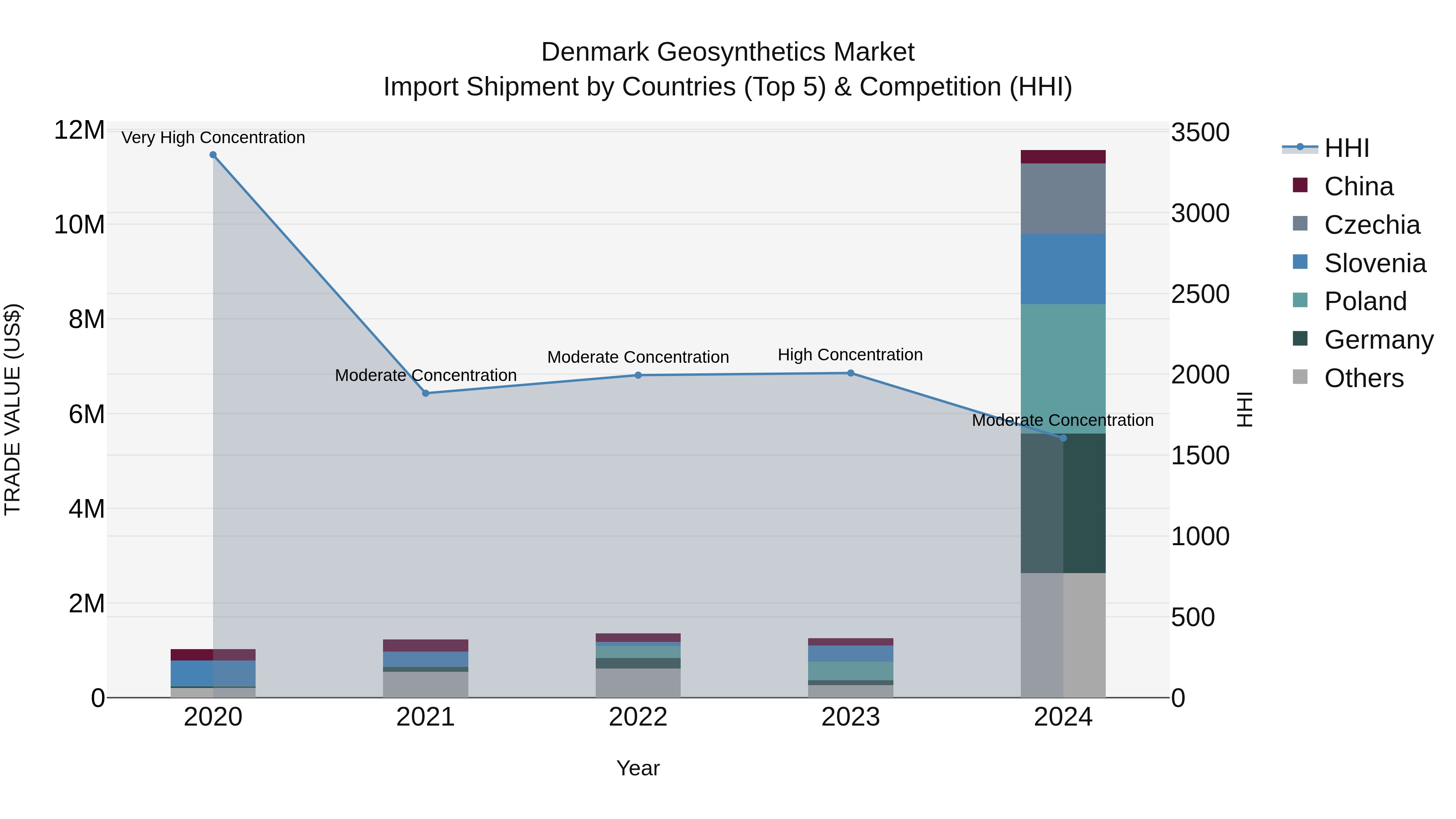
Denmark geosynthetics import market saw a significant increase in diversity in 2024, with top exporting countries including Germany, Poland, Slovenia, Czechia, and Hungary. The market experienced a transition from high concentration in 2023 to moderate concentration in 2024, indicating a more balanced distribution of imports. The impressive compound annual growth rate (CAGR) of 83.42% from 2020 to 2024 highlights the rapid expansion of the market. Moreover, the exceptional growth rate of 822.99% from 2023 to 2024 underscores the dynamic nature of the geosynthetics import industry in Denmark.
Denmark Geosynthetics Market Overview
The Denmark geosynthetics market is witnessing significant growth due to the increasing demand for sustainable construction practices. Geosynthetics are used in various applications, including road construction, drainage systems, and soil stabilization. With Denmarks focus on environmental protection and efficient resource management, geosynthetics offer effective solutions for reducing soil erosion and enhancing the longevity of infrastructure projects. Government initiatives and regulations promoting sustainable development further drive the adoption of geosynthetic materials in civil engineering and environmental applications.
Drivers of the market
The Denmark geosynthetics market is primarily driven by the growing demand for sustainable infrastructure solutions. With increasing concerns over soil erosion and water management, geosynthetics are being used in various applications such as landfills, drainage systems, and road construction. Furthermore, the emphasis on environmentally friendly materials has led to innovations in the production of geosynthetic products, enhancing their appeal to both public and private sector projects. Government initiatives promoting sustainable construction practices also bolster market growth by encouraging the use of geosynthetics.
Challenges of the market
The Denmark geosynthetics market faces challenges such as environmental regulations that require adherence to sustainability practices in the manufacturing and disposal of geosynthetic products. Additionally, competition from traditional construction materials can hinder market growth, as customers may prefer more established options despite the advantages offered by geosynthetics. Furthermore, the lack of awareness among end-users regarding the benefits of geosynthetics can limit adoption rates in various applications, including civil engineering and environmental protection.
Government Policy of the market
The Danish government supports the geosynthetics market through various environmental policies aimed at promoting sustainable construction practices. Regulations encouraging the use of geosynthetic materials in infrastructure projects are prevalent, driven by the need for effective soil stabilization, drainage solutions, and erosion control. Initiatives such as the Green Construction Program incentivize the use of geosynthetics in public works to enhance durability and reduce environmental impacts.
Key Highlights of the Report:
- Denmark Geosynthetics Market Outlook
- Market Size of Denmark Geosynthetics Market, 2024
- Forecast of Denmark Geosynthetics Market, 2031
- Historical Data and Forecast of Denmark Geosynthetics Revenues & Volume for the Period 2021-2031
- Denmark Geosynthetics Market Trend Evolution
- Denmark Geosynthetics Market Drivers and Challenges
- Denmark Geosynthetics Price Trends
- Denmark Geosynthetics Porter`s Five Forces
- Denmark Geosynthetics Industry Life Cycle
- Historical Data and Forecast of Denmark Geosynthetics Market Revenues & Volume By Type for the Period 2021-2031
- Historical Data and Forecast of Denmark Geosynthetics Market Revenues & Volume By Geotextile for the Period 2021-2031
- Historical Data and Forecast of Denmark Geosynthetics Market Revenues & Volume By Geomembranes for the Period 2021-2031
- Historical Data and Forecast of Denmark Geosynthetics Market Revenues & Volume By Geogrids for the Period 2021-2031
- Historical Data and Forecast of Denmark Geosynthetics Market Revenues & Volume By Geofoams for the Period 2021-2031
- Historical Data and Forecast of Denmark Geosynthetics Market Revenues & Volume By Geonets for the Period 2021-2031
- Historical Data and Forecast of Denmark Geosynthetics Market Revenues & Volume By Application for the Period 2021-2031
- Historical Data and Forecast of Denmark Geosynthetics Market Revenues & Volume By Waste Management for the Period 2021-2031
- Historical Data and Forecast of Denmark Geosynthetics Market Revenues & Volume By Water Management for the Period 2021-2031
- Historical Data and Forecast of Denmark Geosynthetics Market Revenues & Volume By Transportation Infrastructure for the Period 2021-2031
- Historical Data and Forecast of Denmark Geosynthetics Market Revenues & Volume By Civil Construction for the Period 2021-2031
- Denmark Geosynthetics Import Export Trade Statistics
- Market Opportunity Assessment By Type
- Market Opportunity Assessment By Application
- Denmark Geosynthetics Top Companies Market Share
- Denmark Geosynthetics Competitive Benchmarking By Technical and Operational Parameters
- Denmark Geosynthetics Company Profiles
- Denmark Geosynthetics Key Strategic Recommendations






































