Topics Covered in Australia Geosynthetics Market Report
Australia Geosynthetics Market Report thoroughly covers the market by type and application. Australia Geosynthetics Market Outlook report provides an unbiased and detailed analysis of the ongoing Australia Geosynthetics Market trends, opportunities/high growth areas, and market drivers. This would help stakeholders devise and align their market strategies according to the current and future market dynamics.
Australia Geosynthetics Market Synopsis
The Australia geosynthetics market experienced fluctuations between 2021 and 2024, driven by shifting infrastructure activity and supply dynamics. Growth was initially strong, fueled by government investments in major projects such as Inland Rail, Sydney and Melbourne airport upgrades, and initiatives such as the National Water Grid Fund, boosting demand in soil stabilization, drainage, and erosion control. The market grew significantly in 2022, supported by increased infrastructure spending and sustainability regulations, but declined in 2023 and then again a bit in 2024 due to reduced imports linked to global supply disruptions and higher interest rates slowing construction.
Key projects such as WestConnex, M80 Ring Road Upgrade, and Western Sydney Infrastructure Plan, alongside the Sydney Metro and Darwin Water Supply Program, kept baseline demand intact. Although challenges persisted, resumption of projects such as the Macalister Irrigation District Phase 2 upgrade helped the market regain momentum toward the end of 2024.
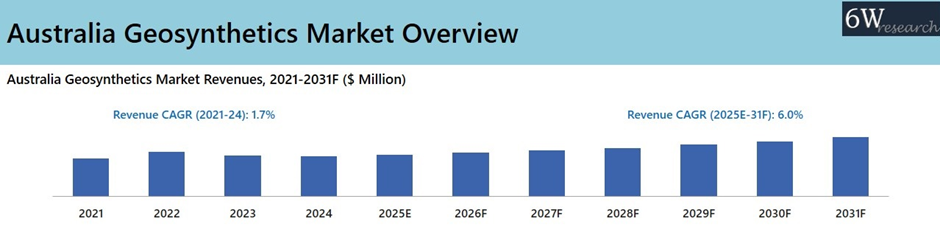
According to 6Wresearch, Australia geosynthetics market size is projected to grow at a CAGR of 6.0% in terms of revenue during 2025-2031, driven by sustained public and private sector investments in infrastructure development. A major growth catalyst is the rising number of residential and commercial construction projects, as Australia’s housing stock is expected to increase, creating significant demand for construction materials, including geosynthetics used in soil stabilization, drainage, and erosion control. Key commercial developments such as the Central Place Sydney project, set for completion in 2026, highlight this trend, integrating advanced civil engineering practices where geosynthetics play a critical role.
Moreover, the 2025–26 Budget allocation of under the “Infrastructure Investment Program” reflects a continued national focus on upgrading core transport networks. This includes significant investments such as for Bruce Highway safety upgrades, for key infrastructure developments in Western Sydney, and to preserve the corridor for the South West Sydney Rail Extension, all of which are expected to heavily utilize geosynthetic solutions for improved structural integrity, longevity, and environmental performance. Additionally, Australia's increasing emphasis on sustainable construction practices and climate resilience is further promoting the use of geosynthetics across transportation, water management, and landfill sectors, ensuring strong market expansion over the forecast period.
Market Segmentation By Type
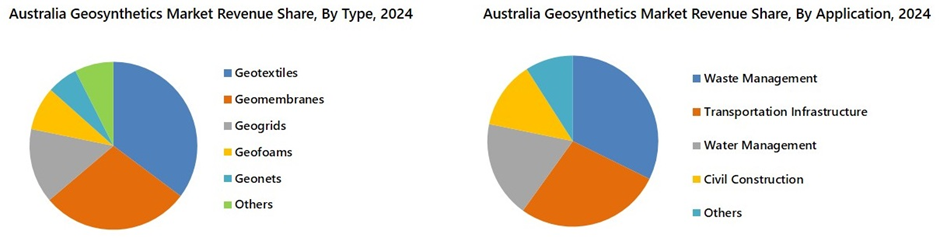
Geotextiles would continue to dominate Australia’s geosynthetics market by revenue size in 2031, driven by their widespread application across a variety of infrastructure and environmental projects. As Australia increasingly invests in water security, road construction, coastal protection, and landfill management, geotextiles offer versatile and cost-effective solutions for filtration, separation, reinforcement, and erosion control.
However, geomembranes are expected to witness the fastest growth during 2025 to 2031, as the country intensifies efforts under the National Water Grid Fund in water conservation and waste management. Geomembranes would be essential for applications such as lining landfills, tailings dams, wastewater lagoons, and water reservoirs. Additionally, large-scale projects such as the Alkimos Seawater Desalination Plant (ASDP) in Perth would drive demand for geomembranes for effective seepage control and containment.
Market Segmentation By Application
In 2031, waste management is projected to remain the dominant segment in Australia's geosynthetics market, driven by the country's growing need for sustainable waste handling solutions. Australia has been actively focusing on improving its waste management practices, with increased investments in recycling infrastructure, landfill management, and waste-to-energy projects. Additionally, the ongoing push toward circular economy practices and waste diversion from landfills further reinforces the role of geosynthetics in shaping the future of waste management in Australia.
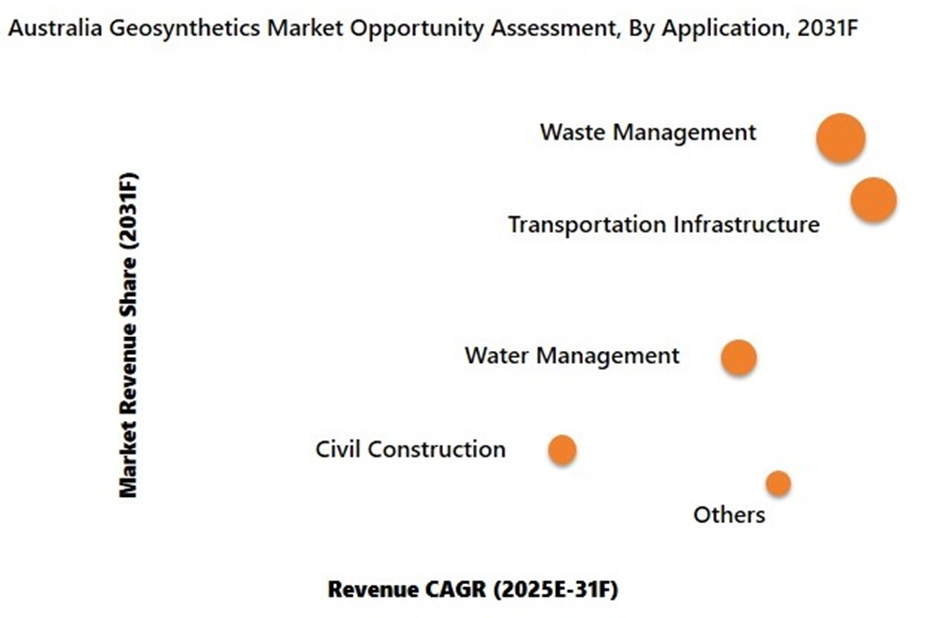
However, during 2025-2031, transport infrastructure would witness the highest growth rate due to the substantial demand for geosynthetics in road, railway, and airport construction and maintenance. The Australian government's ongoing investment in transportation projects, such as the expansion of highways, urban transit systems, and regional connectivity, relies heavily on geosynthetics for various applications.
Key Attractiveness of the Report
- 10 Years Market Numbers.
- Historical Data Starting from 2021 to 2024
- Base Year: 2024
- Forecast Data until 2031
- Key Performance Indicators Impacting the Market.
- Major Upcoming Developments and Projects.
Key Highlights of the Report:
- Australia Geosynthetics Market Overview
- Australia Geosynthetics Market Outlook
- Australia Geosynthetics Market Forecast
- Historical Data and Forecast of Australia Geosynthetics Market Revenues for the Period 2021-2031F
- Historical Data and Forecast of Market Revenues, By Type, for the Period 2021-2031F
- Historical Data and Forecast of Market Revenues, By Application, for the Period 2021-2031F
- Australia Geosynthetics Market Drivers and Restraints
- Industry Life Cycle
- Porter’s Five Force Analysis
- Australia Geosynthetics Market Trends & Evolution
- Market Opportunity Assessment
- Australia Geosynthetics Market Revenue Ranking, By Top 3 Companies
- Competitive Benchmarking
- Company Profiles
- Key Strategic Recommendations
Market Scope and Segmentation
Thereportprovides a detailed analysis of the following market segments:
By Type
- Geotextiles
- Geomembranes
- Geogrids
- Geofoams
- Geonets
- Others
By Application
- Waste Management
- Water Management
- Transportation Infrastructure
- Civil Construction
- Others






































