Denmark Household Cleaning Products Market Top 5 Importing Countries and Market Competition (HHI) Analysis
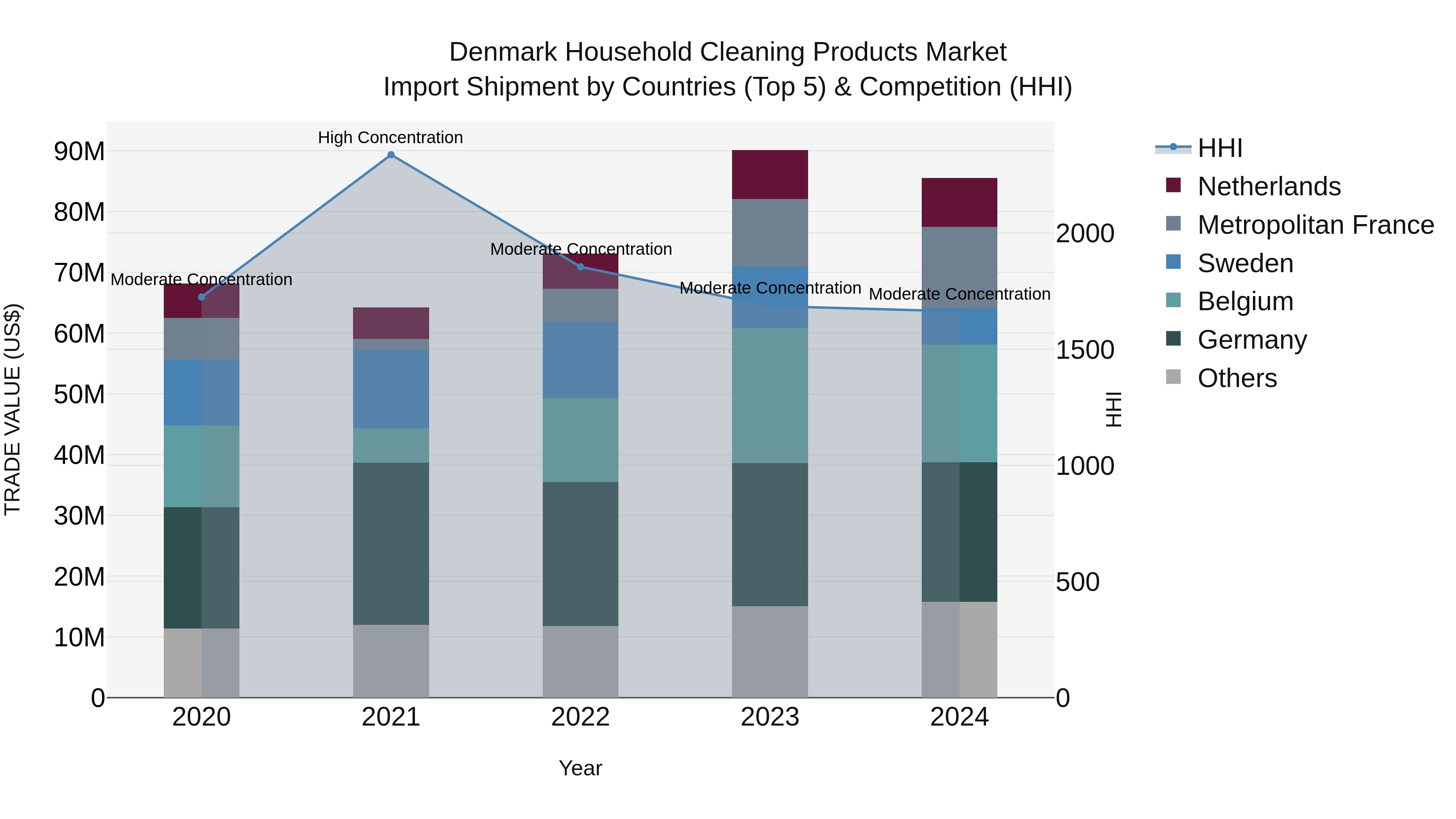
In 2024, Denmark continued to import household cleaning products primarily from top exporters Germany, Belgium, Metropolitan France, Netherlands, and Sweden. The market concentration, as measured by the Herfindahl-Hirschman Index (HHI), remained at a moderate level. Despite a slight decline in growth rate from 2023 to 2024, the compound annual growth rate (CAGR) over the period 2020-24 stood strong at 5.85%. This indicates a steady demand for household cleaning products in Denmark, with key suppliers maintaining their presence in the market.
Household Cleaning Products Market: Denmark vs Top 5 Major Economies in 2027 (Europe)
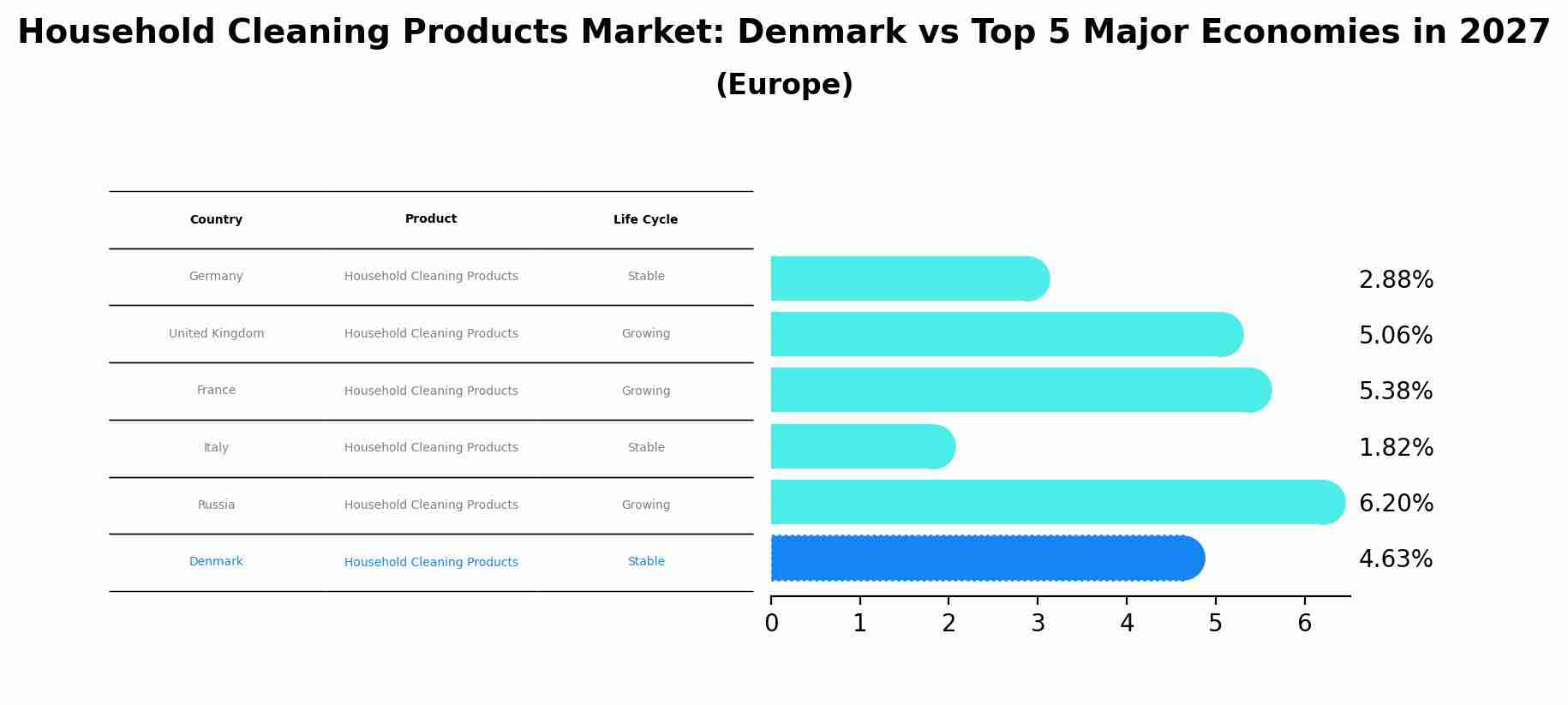
In the Europe region, the Household Cleaning Products market in Denmark is projected to expand at a stable growth rate of 4.63% by 2027. The largest economy is Germany, followed by United Kingdom, France, Italy and Russia.
Denmark Household Cleaning Products Market Overview
The household cleaning products market in Denmark is shaped by consumer preferences for effective and eco-friendly cleaning solutions. As awareness of environmental issues grows, many consumers are opting for biodegradable and non-toxic cleaning products. This trend is driving innovation within the industry, as companies develop sustainable formulations that meet consumer demands. The market also benefits from the rise of online shopping, making a wide range of cleaning products readily available to consumers. Additionally, the focus on hygiene, particularly in the wake of the COVID-19 pandemic, has further stimulated demand for cleaning solutions.
Drivers of the market
The household cleaning products market in Denmark is propelled by growing awareness of hygiene and cleanliness, particularly in the wake of the COVID-19 pandemic. Consumers are increasingly seeking effective and environmentally friendly cleaning solutions. Additionally, innovations in cleaning product formulations and packaging contribute to market growth by enhancing convenience and usability.
Challenges of the market
The household cleaning products market in Denmark faces challenges associated with regulatory compliance and shifting consumer preferences. Stricter regulations regarding chemical ingredients and environmental impact are forcing manufacturers to reformulate products, which can be costly and complex. Furthermore, there is a growing trend towards natural and eco-friendly cleaning solutions, prompting companies to innovate and adapt their offerings. Consumer skepticism towards traditional cleaning products also poses a challenge, as brands must work to build trust and demonstrate efficacy.
Government Policy of the market
Government policies in Denmark regulate the household cleaning products market through strict environmental and safety standards. The Danish Environmental Protection Agency promotes the use of biodegradable and non-toxic ingredients in cleaning products, driving the shift towards sustainable formulations. Public campaigns raising awareness about chemical safety contribute to informed consumer choices. Additionally, incentives for companies producing eco-friendly cleaning solutions foster innovation and competitiveness in the market.
Key Highlights of the Report:
- Denmark Household Cleaning Products Market Outlook
- Market Size of Denmark Household Cleaning Products Market, 2024
- Forecast of Denmark Household Cleaning Products Market, 2031
- Historical Data and Forecast of Denmark Household Cleaning Products Revenues & Volume for the Period 2021-2031
- Denmark Household Cleaning Products Market Trend Evolution
- Denmark Household Cleaning Products Market Drivers and Challenges
- Denmark Household Cleaning Products Price Trends
- Denmark Household Cleaning Products Porter`s Five Forces
- Denmark Household Cleaning Products Industry Life Cycle
- Historical Data and Forecast of Denmark Household Cleaning Products Market Revenues & Volume By Product Type for the Period 2021-2031
- Historical Data and Forecast of Denmark Household Cleaning Products Market Revenues & Volume By Laundry Detergents for the Period 2021-2031
- Historical Data and Forecast of Denmark Household Cleaning Products Market Revenues & Volume By Surface Cleaners for the Period 2021-2031
- Historical Data and Forecast of Denmark Household Cleaning Products Market Revenues & Volume By Dishwashing Products for the Period 2021-2031
- Historical Data and Forecast of Denmark Household Cleaning Products Market Revenues & Volume By Toilet Cleaners for the Period 2021-2031
- Historical Data and Forecast of Denmark Household Cleaning Products Market Revenues & Volume By Others for the Period 2021-2031
- Denmark Household Cleaning Products Import Export Trade Statistics
- Market Opportunity Assessment By Product Type
- Denmark Household Cleaning Products Top Companies Market Share
- Denmark Household Cleaning Products Competitive Benchmarking By Technical and Operational Parameters
- Denmark Household Cleaning Products Company Profiles
- Denmark Household Cleaning Products Key Strategic Recommendations






































