Denmark Packaged Water Market Top 5 Importing Countries and Market Competition (HHI) Analysis
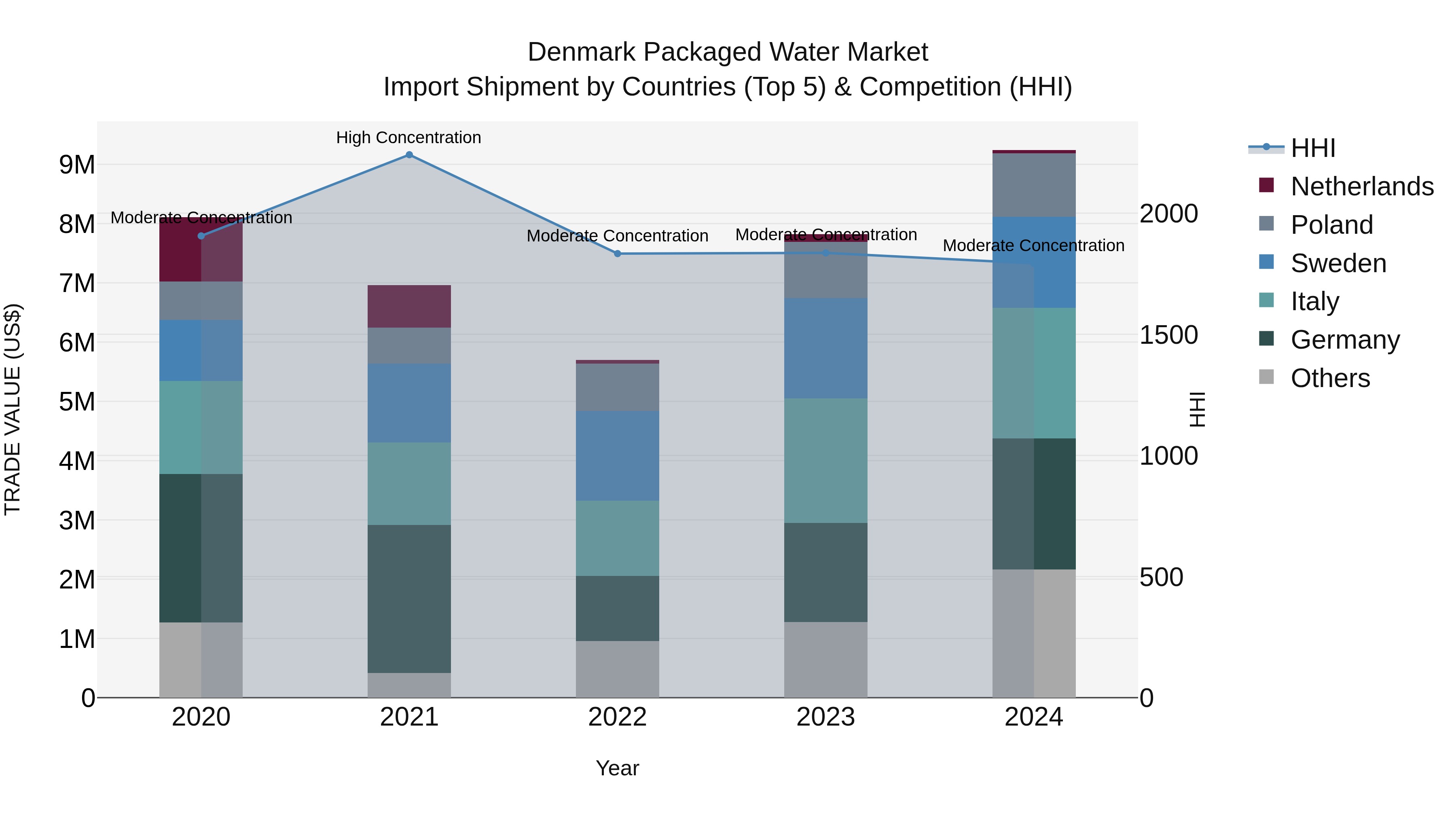
In 2024, Denmark packaged water import market continued to see a steady growth trajectory with a CAGR of 3.33% from 2020 to 2024. The top exporting countries to Denmark in 2024 were Germany, Italy, Sweden, Spain, and Poland, indicating a diverse supply chain. Despite this, market concentration, as measured by the Herfindahl-Hirschman Index (HHI), remained at a moderate level. The impressive growth rate of 18.09% from 2023 to 2024 suggests a promising outlook for the packaged water import market in Denmark.
Denmark Packaged water Market Overview
The Denmark packaged water market is experiencing steady growth driven by consumer preferences for healthier beverage options and increasing concerns about water quality. The market is characterized by a high level of competition among key players such as Danone, Nestle, and Coca-Cola, who offer a wide range of products including still, sparkling, flavored, and functional waters. The trend towards sustainability and environmental consciousness is also shaping the market, with a growing demand for eco-friendly packaging solutions. Convenience and on-the-go consumption habits are further propelling the market growth, especially among urban populations. As health and wellness continue to be a key focus for consumers, the packaged water market in Denmark is expected to expand further, with innovations in product offerings and packaging formats driving the market forward.
Denmark Packaged water Market Trends and Opportunities
The Denmark Packaged water market is experiencing a shift towards healthier hydration options, with increasing demand for flavored and functional waters. Consumers are seeking products with added vitamins, minerals, and natural ingredients to enhance their overall well-being. Sustainable packaging solutions are also gaining importance, as eco-conscious consumers look for products that minimize environmental impact. Opportunities exist for companies to innovate with unique flavor profiles, functional benefits, and eco-friendly packaging to cater to evolving consumer preferences. Additionally, partnerships with retailers and e-commerce platforms can help expand distribution channels and reach a wider audience. Overall, the market is ripe for growth and innovation, with a focus on health, sustainability, and convenience driving consumer purchasing decisions.
Denmark Packaged water Market Challenges
In the Denmark Packaged water market, one of the key challenges faced is increasing competition from other beverage options such as flavored water, sports drinks, and energy drinks. Consumers are becoming more health-conscious and seeking alternatives to traditional packaged water, leading to a fragmented market with various choices for hydration. Additionally, environmental concerns surrounding single-use plastic bottles have raised sustainability issues, prompting consumers to opt for more eco-friendly packaging solutions. This shift towards sustainability has forced packaged water companies to explore innovative packaging materials and recycling programs to address these concerns and maintain consumer trust. Adapting to changing consumer preferences while also meeting sustainability goals presents a significant challenge for companies operating in the Denmark Packaged water market.
Denmark Packaged water Market Drivers
The Denmark Packaged water market is primarily driven by increasing health consciousness among consumers, leading to a shift towards healthier beverage choices. The convenience and portability of packaged water also contribute to its popularity, especially among on-the-go consumers. Additionally, concerns about water quality and safety further boost the demand for packaged water as a reliable alternative to tap water. The growing trend of sustainability and eco-friendliness is prompting companies to offer eco-friendly packaging options, attracting environmentally conscious consumers. Furthermore, the influence of marketing and branding strategies, as well as the availability of innovative flavored and functional water products, are also driving the growth of the Packaged water market in Denmark.
Denmark Packaged water Market Government Policy
In Denmark, packaged water market is influenced by government policies focused on promoting sustainability and reducing plastic waste. The government has implemented a deposit-refund system for plastic bottles to encourage recycling, with consumers receiving a refund when returning empty bottles. Additionally, there are regulations in place to ensure the quality and safety of packaged water, including limits on contaminants and strict labeling requirements. The government also supports initiatives to promote tap water as a more environmentally friendly and cost-effective alternative to packaged water. Overall, the Danish government`s policies aim to balance consumer demand for convenience with environmental concerns, driving the packaged water market towards more sustainable practices.
Denmark Packaged water Market Future Outlook
The Denmark packaged water market is expected to witness steady growth in the coming years due to increasing health consciousness among consumers and a shift towards healthier beverage options. The rising awareness about the importance of hydration, convenience, and the growing preference for on-the-go consumption are driving the demand for packaged water in Denmark. Additionally, the emphasis on sustainability and environmental concerns is likely to shape the market dynamics, leading to a surge in demand for eco-friendly packaging solutions. With innovative product offerings, such as functional and flavored water variants, market players are poised to cater to evolving consumer preferences and drive further market expansion. Overall, the Denmark packaged water market is anticipated to experience positive growth trends and opportunities for market players to capitalize on in the foreseeable future.
Key Highlights of the Report:
- Denmark Packaged water Market Outlook
- Market Size of Denmark Packaged water Market, 2024
- Forecast of Denmark Packaged water Market, 2031
- Historical Data and Forecast of Denmark Packaged water Revenues & Volume for the Period 2021- 2031
- Denmark Packaged water Market Trend Evolution
- Denmark Packaged water Market Drivers and Challenges
- Denmark Packaged water Price Trends
- Denmark Packaged water Porter's Five Forces
- Denmark Packaged water Industry Life Cycle
- Historical Data and Forecast of Denmark Packaged water Market Revenues & Volume By Product for the Period 2021- 2031
- Historical Data and Forecast of Denmark Packaged water Market Revenues & Volume By Still for the Period 2021- 2031
- Historical Data and Forecast of Denmark Packaged water Market Revenues & Volume By Carbonated for the Period 2021- 2031
- Historical Data and Forecast of Denmark Packaged water Market Revenues & Volume By Flavored for the Period 2021- 2031
- Historical Data and Forecast of Denmark Packaged water Market Revenues & Volume By Functional for the Period 2021- 2031
- Denmark Packaged water Import Export Trade Statistics
- Market Opportunity Assessment By Product
- Denmark Packaged water Top Companies Market Share
- Denmark Packaged water Competitive Benchmarking By Technical and Operational Parameters
- Denmark Packaged water Company Profiles
- Denmark Packaged water Key Strategic Recommendations






































