Denmark Vending Machines Market Top 5 Importing Countries and Market Competition (HHI) Analysis
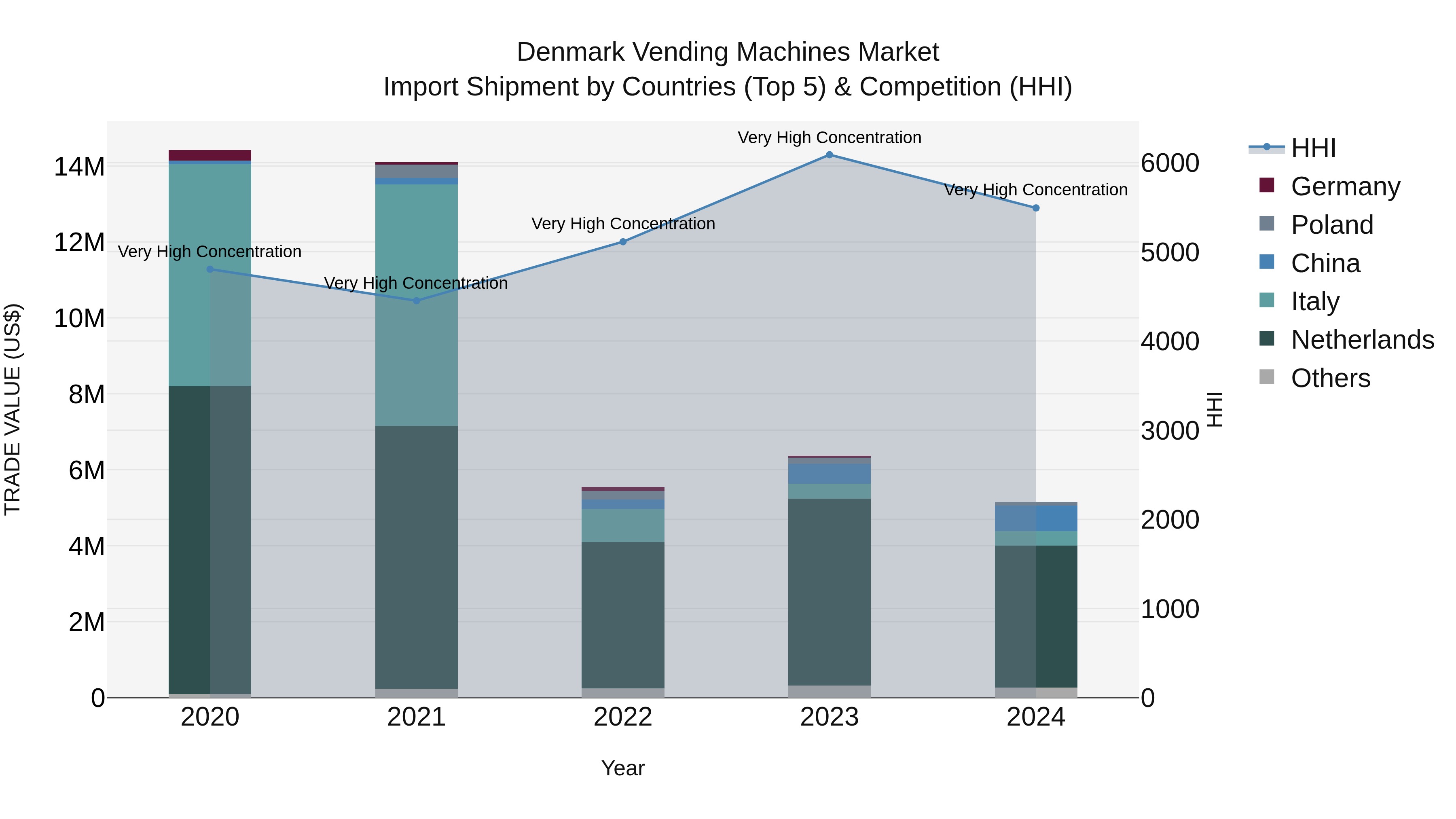
Despite the challenging growth rates in the vending machine import market in Denmark, the top exporting countries such as Netherlands, China, and Italy continue to dominate the market in 2024. The high Herfindahl-Hirschman Index (HHI) indicates a concentrated market landscape. However, the negative compound annual growth rate (CAGR) and growth rate for the year 2024 suggest a declining trend, possibly influenced by various factors such as economic conditions or shifting consumer preferences. Stakeholders in the industry may need to adapt their strategies to navigate these challenging market conditions effectively.
Denmark Vending machines Market Overview
The vending machines market in Denmark is evolving as consumer preferences shift toward contactless, convenient purchasing options. Innovations such as cashless payment systems, IoT-enabled machines, and the availability of healthier snack options are driving market growth. Businesses are investing in smart vending machines that can track inventory in real-time and offer personalized product recommendations.
Drivers of the market
The Vending Machines Market in Denmark is primarily driven by the growing demand for convenient and quick access to food and beverages. As consumer lifestyles become busier, vending machines offer a practical solution for on-the-go snacking and beverage consumption. Additionally, the trend towards healthier options in vending machines is gaining traction, as consumers increasingly seek nutritious alternatives. Technological advancements, such as cashless payment systems and smart vending machines equipped with IoT connectivity, are also contributing to market growth by enhancing user experience and operational efficiency.
Challenges of the market
The Denmark vending machines market experiences challenges related to high operational and maintenance costs. Vandalism and theft also present recurring issues, especially in unattended locations. Additionally, ensuring machine reliability in varying environmental conditions can be difficult, and the rising demand for healthier food options is putting pressure on operators to adapt product offerings, which may require costly modifications to existing machines.
Government Policy of the market
The vending machines market in Denmark is affected by government regulations concerning food safety, consumer health, and environmental sustainability. The Danish Food Authority mandates strict hygiene standards for food vending machines, ensuring that they provide safe and healthy options for consumers. Additionally, policies promoting sustainable practices, such as recycling and reducing plastic waste, influence the types of products offered in vending machines. The government`s support for innovative vending solutions, such as contactless payment systems, also contributes to the market`s growth.
Key Highlights of the Report:
- Denmark Vending machines Market Outlook
- Market Size of Denmark Vending machines Market, 2024
- Forecast of Denmark Vending machines Market, 2031
- Historical Data and Forecast of Denmark Vending machines Revenues & Volume for the Period 2021-2031
- Denmark Vending machines Market Trend Evolution
- Denmark Vending machines Market Drivers and Challenges
- Denmark Vending machines Price Trends
- Denmark Vending machines Porter`s Five Forces
- Denmark Vending machines Industry Life Cycle
- Historical Data and Forecast of Denmark Vending machines Market Revenues & Volume By Applications for the Period 2021-2031
- Historical Data and Forecast of Denmark Vending machines Market Revenues & Volume By Commercial Places for the Period 2021-2031
- Historical Data and Forecast of Denmark Vending machines Market Revenues & Volume By Offices for the Period 2021-2031
- Historical Data and Forecast of Denmark Vending machines Market Revenues & Volume By Public Places for the Period 2021-2031
- Historical Data and Forecast of Denmark Vending machines Market Revenues & Volume By Others for the Period 2021-2031
- Historical Data and Forecast of Denmark Vending machines Market Revenues & Volume By Payment Mode for the Period 2021-2031
- Historical Data and Forecast of Denmark Vending machines Market Revenues & Volume By Cash for the Period 2021-2031
- Historical Data and Forecast of Denmark Vending machines Market Revenues & Volume By Cashless for the Period 2021-2031
- Denmark Vending machines Import Export Trade Statistics
- Market Opportunity Assessment By Applications
- Market Opportunity Assessment By Payment Mode
- Denmark Vending machines Top Companies Market Share
- Denmark Vending machines Competitive Benchmarking By Technical and Operational Parameters
- Denmark Vending machines Company Profiles
- Denmark Vending machines Key Strategic Recommendations






































