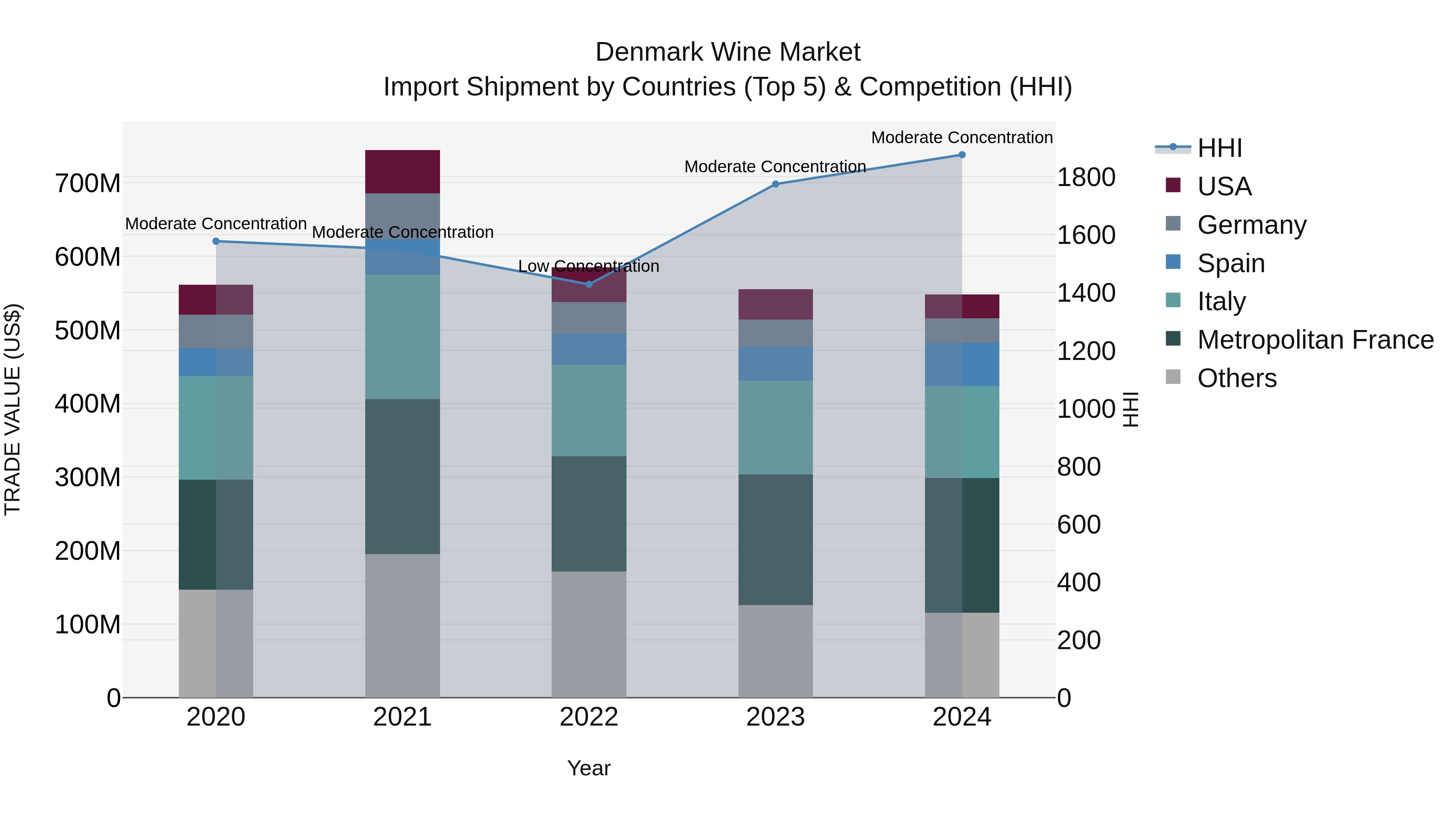
Denmark Wine Market Top 5 Importing Countries and Market Competition (HHI) Analysis
Despite a slightly declining CAGR and negative growth rate in 2024, Denmark wine import market continues to be dominated by key exporters such as Metropolitan France, Italy, Spain, Germany, and the USA. The moderate concentration indicated by the HHI suggests a balanced market share among these top exporting countries. It will be interesting to monitor how these trends evolve in the coming years and what strategies the exporters employ to maintain their positions in the Danish market.
Denmark Wine Market Growth Rate
According to 6Wresearch internal database and industry insights, the Denmark Wine Market is projected to grow at a compound annual growth rate (CAGR) of 5.5% during the forecast period (2026–2032).
Five-Years Growth Trajectory of the Denmark Wine Market with Core Drivers
Below is the evaluation of the year-wise growth rate along with key drivers:
| Years | Estimated Annual Growth (%) | Growth Drivers |
| 2021 | 3.5 | Growing interest in premium wines, especially among younger consumers, and higher imports from key wine regions. |
| 2022 | 4 | Increase in wine tourism and events, raises awareness and usage. |
| 2023 | 4.2 | Surge in online wine sales, providing convenient purchasing options. |
| 2024 | 4.6 | Heavy demand for organic and biodynamic wines, pushed by health-conscious trends. |
| 2025 | 5 | Popularity of wine pairings in dining, boosting overall consumption. |
Topics Covered in the Denmark Wine Market Report
The Denmark Wine Market report thoroughly covers the market by Product Types, Colors, and Distribution Channels. The report provides an unbiased and detailed analysis of ongoing market trends, opportunities/high-growth areas, and market drivers that will help stakeholders devise and align strategies according to current and future market dynamics.
Denmark Wine Market Highlights
| Report Name | Denmark Wine Market |
| Forecast Period | 2026–2032 |
| CAGR | 5.5% |
| Growing Sector | Food and Beverage |
Denmark Wine Market Synopsis
Denmark Wine Industry is likely to experience stable development as a result of the growing need for luxury wines, particularly the organic and biodynamic ones, and also the boost in wine tourism. The online wine market is another factor that is propelling growth as rising number of consumers are opting for the convenience of wine buying. Denmark's long-standing wine culture, along with its broadening curiosity in foreign wines, additionally provides the market with a favorable condition for growth.
Evaluation of Growth Drivers in the Denmark Wine Market
Below are some prominent drivers and their influence on the Denmark Wine Market dynamics:
| Drivers | Primary Segments Affected | Why it Matters |
| Rising interest in premium wines | By Product Types | Millennials are choosing premium wines, boosting sales. |
| Growth of wine tourism and events | By Distribution Channel | Wine tourism and events increase awareness and consumption. |
| Expansion of online wine sales | By Distribution Channel | Online wine shopping is growing, offering more variety. |
| Demand for organic and biodynamic wines | By Product Types | Health-conscious consumers are driving demand for organic and biodynamic wines. |
The Denmark Wine Market Size is projected to grow at a CAGR of 5.5% during the forecast period (2026–2032). The market growth is significantly influenced by the demand for premium wines, especially organic and biodynamic ones. Moreover, the online wine sales gaining popularity and the wine tourism development are also contributing to the market growth. Denmark, being a major importer of wines, is playing an important role in the market dynamics and providing the consumers with a wide variety of choices. This together with the changing consumer tastes towards eco-friendly, high-grade wines is enlarging Denmark Wine Market Growth potential.
Evaluation of Restraints in the Denmark Wine Market
Below are some major restraints and their influence on the Denmark Wine Market dynamics:
| Restraints | Primary Segments Affected | What this Means |
| Price sensitivity for premium wines | By Product Types | High prices for premium wines may limit demand from budget-conscious consumers. |
| Limited awareness of wine categories | By Product Types | Limited awareness of organic or biodynamic wines may slow growth. |
| Import dependencies | By Product Types | Heavy reliance on imports can create supply chain challenges, especially with changing trade regulations. |
| Weather-related disruptions in wine production | By Product Types | Climate changes can disrupt wine production, causing supply issues and price fluctuations. |
Denmark Wine Market Challenges
Denmark Wine Market faces challenges like price sensitivity as price plays a big role in curtailing the growth among the top-end categories. Limited consumer knowledge of organic or biodynamic wines slows down their acceptance. Heavy dependency on imports is another reason the market is being affected, and the changing trade regulations causes supply problems. Besides all that, the weather-related disruptions further complicate supply consistency, making it harder to meet demand.
Denmark Wine Market Trends
Several key trends are shaping the growth of the Denmark Wine Market:
- Shift to premium wines: Premium wines like still and sparkling wines are increasingly in preference, as consumers are spending more on high-quality wines.
- Wine tourism and events: Wine events are raising awareness and increasing consumption in the country.
- Expansion of online wine sales: Consumers get easy access for more variety due to the online shopping option. It also offers convenience.
- Rising demand for organic wines: Health trends are increasing demand for organic and biodynamic wines as sustainable options.
Investment Opportunities in the Denmark Wine Market
Some notable investment opportunities include:
- Expand online wine retail: To meet increasing consumers demand for wines online, investment in commerce platforms is being done.
- Develop organic wine offerings: Increase organic and biodynamic wine options to attract health-conscious and eco-friendly consumers.
- Invest in wine tourism and events: The Consumption rate is increasing day by day due to building wine tourism infrastructure and hosting events in the country.
- Improve wine distribution logistics: Enhance logistics and cold chain services to improve storage, reduce spoilage, and ensure consistent supply year-round.
Top 5 Leading Players in the Denmark Wine Market
Some leading players operating in the Denmark Wine Market include:
1. Viking Wine Import
| Company Name | Viking Wine Import |
| Headquarters | Denmark |
| Established | 1985 |
| Website | Click Here |
Viking Wine Import is a major distributor of both domestic and international wines, offering a range of premium wines, including organic varieties.
2. Carlsberg Group
| Company Name | Carlsberg Group |
| Headquarters | Copenhagen, Denmark |
| Established | 1847 |
| Website | Click Here |
Carlsberg Group, a global brewing company, has a strong presence in Denmark’s wine market through its acquisition of various wine brands, focusing on premium and organic wines.
3. Skål Wines
| Company Name | Skål Wines |
| Headquarters | Denmark |
| Established | 2003 |
| Website | Click Here |
Skål Wines specializes in high-quality wine imports, including organic and biodynamic wines, with a focus on sustainability and environmental practices.
4. SuperBest
| Company Name | SuperBest |
| Headquarters | Denmark |
| Established | 1967 |
| Website | Click Here |
SuperBest is a leading grocery chain in Denmark, offering a wide range of wines, including organic and premium wines, for retail customers.
5. Dansk Vinimport
| Company Name | Dansk Vinimport |
| Headquarters | Denmark |
| Established | 1970 |
| Website | Click Here |
Dansk VinImport is one of Denmark’s largest wine distributors, specializing in both local and international wine brands, with a focus on premium wines.
Government Regulations Introduced in the Denmark Wine Market
According to Danish Government data, several regulations impact the wine industry, including the Danish Food Agency (FDA), which enforces strict labeling and quality control standards for all wines sold in Denmark. The European Union also offers financial support to organic wine producers, which has been done to promote sustainable production practices. Additionally, the Danish Ministry of Agriculture offers incentives for modernizing wine production and implementing sustainable farming practices.
Future Insights of the Denmark Wine Market
Growth in Denmark Wine Market Share will be steady and supported by the increasing demand for premium, organic, and biodynamic wines. Besides, the online sales of wine, wine tourism, and increased consumer interest in wine tasting will help the market growth. Moreover, the increasing preference for health-conscious and environment-friendly wines will not only magnify the market size but also strengthen the position of Denmark in the global wine trade as a major player.
Market Segmentation Analysis
The report offers a comprehensive study of the following market segments and their leading categories:
By Product Types – Still Wine to Lead the Market
According to Mansi, Senior Research Analyst, 6Wresearch, still wines are expected to dominate the Denmark Wine Market, due to their widespread consumption across households, restaurants, and foodservice establishments. Their consistency and versatility make still wines the most popular wine category.
By Colors – Red Wine to Lead the Market
Red wines are likely to dominate the market, this is owing to their ability to pair well with a variety of foods, particularly in dining and foodservice sectors. Their broad appeal ensures their dominance in the market.
By Distribution Channel – Offline to Lead the Market
Offline channels segment is estimated to lead the market in the coming years, this is due to the in-person shopping experience. Although online wine sales are growing, offline channels remain the primary way consumers purchase wine in Denmark.
Key Attractiveness of the Report
- 10 Years of Market Numbers
- Historical Data Starting from 2022 to 2025
- Base Year: 2025
- Forecast Data until 2032
- Key Performance Indicators Impacting the Market
- Major Upcoming Developments and Projects
Key Highlights of the Report:
- Denmark Wine Market Outlook
- Market Size of Denmark Wine Market, 2025
- Forecast of Denmark Wine Market, 2032
- Historical Data and Forecast of Denmark Wine Revenues & Volume for the Period 2022-2032
- Denmark Wine Market Trend Evolution
- Denmark Wine Market Drivers and Challenges
- Denmark Wine Price Trends
- Denmark Wine Porter`s Five Forces
- Denmark Wine Industry Life Cycle
- Historical Data and Forecast of Denmark Wine Market Revenues & Volume By Product Types for the Period 2022-2032
- Historical Data and Forecast of Denmark Wine Market Revenues & Volume By Still Wine for the Period 2022-2032
- Historical Data and Forecast of Denmark Wine Market Revenues & Volume By Sparkling Wine for the Period 2022-2032
- Historical Data and Forecast of Denmark Wine Market Revenues & Volume By Dessert Wine for the Period 2022-2032
- Historical Data and Forecast of Denmark Wine Market Revenues & Volume By Fortified Wine for the Period 2022-2032
- Historical Data and Forecast of Denmark Wine Market Revenues & Volume By Colors for the Period 2022-2032
- Historical Data and Forecast of Denmark Wine Market Revenues & Volume By Red Wine for the Period 2022-2032
- Historical Data and Forecast of Denmark Wine Market Revenues & Volume By Rose Wine for the Period 2022-2032
- Historical Data and Forecast of Denmark Wine Market Revenues & Volume By White Wine for the Period 2022-2032
- Historical Data and Forecast of Denmark Wine Market Revenues & Volume By Other Colors for the Period 2022-2032
- Historical Data and Forecast of Denmark Wine Market Revenues & Volume By Distribution Channel for the Period 2022-2032
- Historical Data and Forecast of Denmark Wine Market Revenues & Volume By Offline for the Period 2022-2032
- Historical Data and Forecast of Denmark Wine Market Revenues & Volume By Online for the Period 2022-2032
- Denmark Wine Import Export Trade Statistics
- Market Opportunity Assessment By Product Types
- Market Opportunity Assessment By Colors
- Market Opportunity Assessment By Distribution Channel
- Denmark Wine Top Companies Market Share
- Denmark Wine Competitive Benchmarking By Technical and Operational Parameters
- Denmark Wine Company Profiles
- Denmark Wine Key Strategic Recommendations
Markets Covered
The report offers a comprehensive study of the following market segments:
By Product Types
- Still Wine
- Sparkling Wine
- Dessert Wine
- Fortified Wine
By Colors
- Red Wine
- Rose Wine
- White Wine
- Other Colors
By Distribution Channel
- Offline
- Online






































