Ecuador Cellulose Fiber Market Top 5 Importing Countries and Market Competition (HHI) Analysis
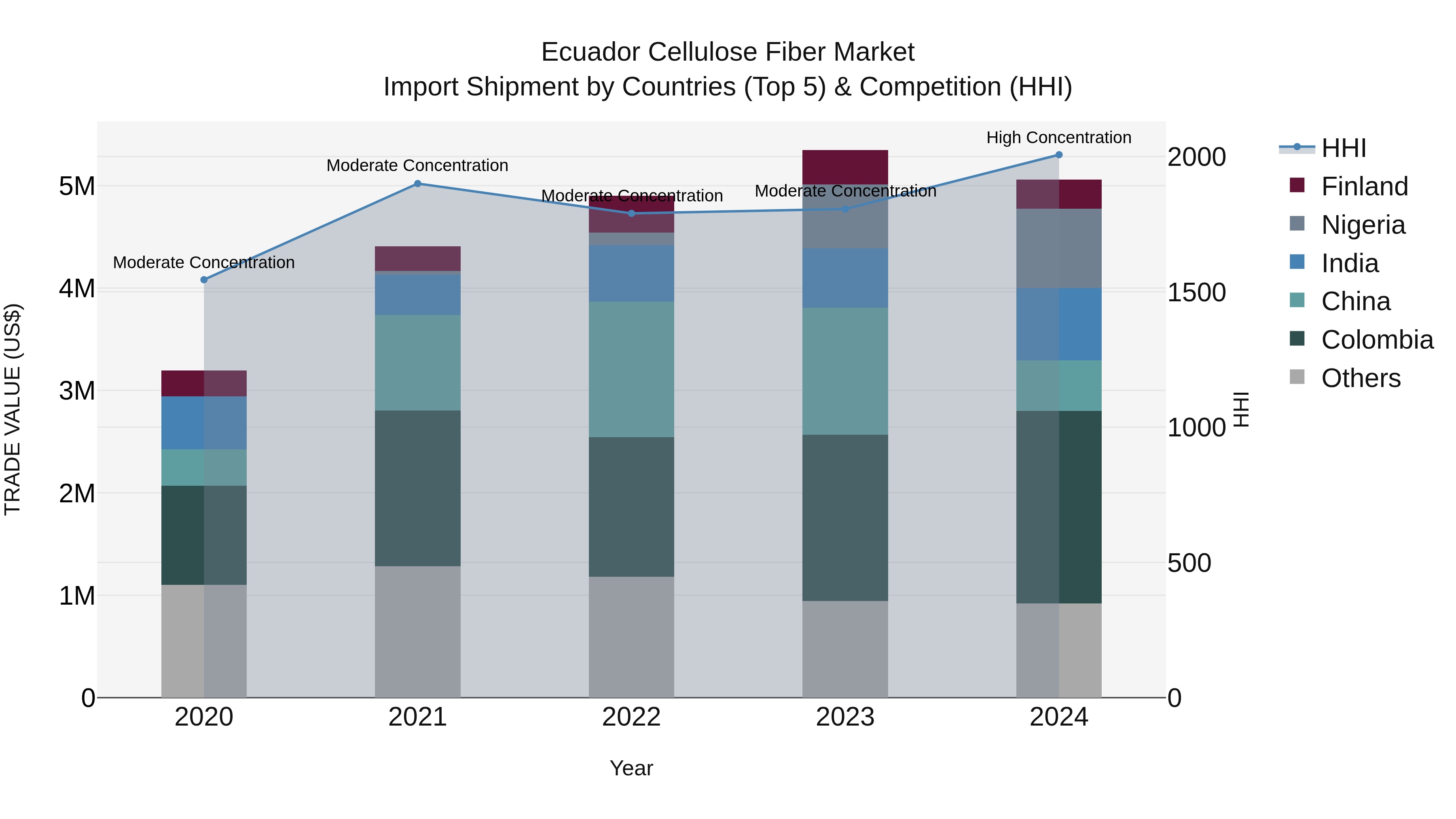
In 2024, Ecuador`s import shipments of cellulose fiber saw a shift in concentration, with top exporting countries being Colombia, Nigeria, India, China, and the USA. The Herfindahl-Hirschman Index (HHI) indicated a transition from moderate to high concentration, reflecting Market Top 5 Importing Countries and Market Competition (HHI) Analysis dynamics. Despite a slight decline in growth rate from 2023 to 2024, the compound annual growth rate (CAGR) from 2020 to 2024 remained robust at 12.19%. This data suggests a competitive Market Top 5 Importing Countries and Market Competition (HHI) Analysis landscape with notable changes in key suppliers, potentially impacting pricing and supply chain strategies for stakeholders in the cellulose fiber industry.
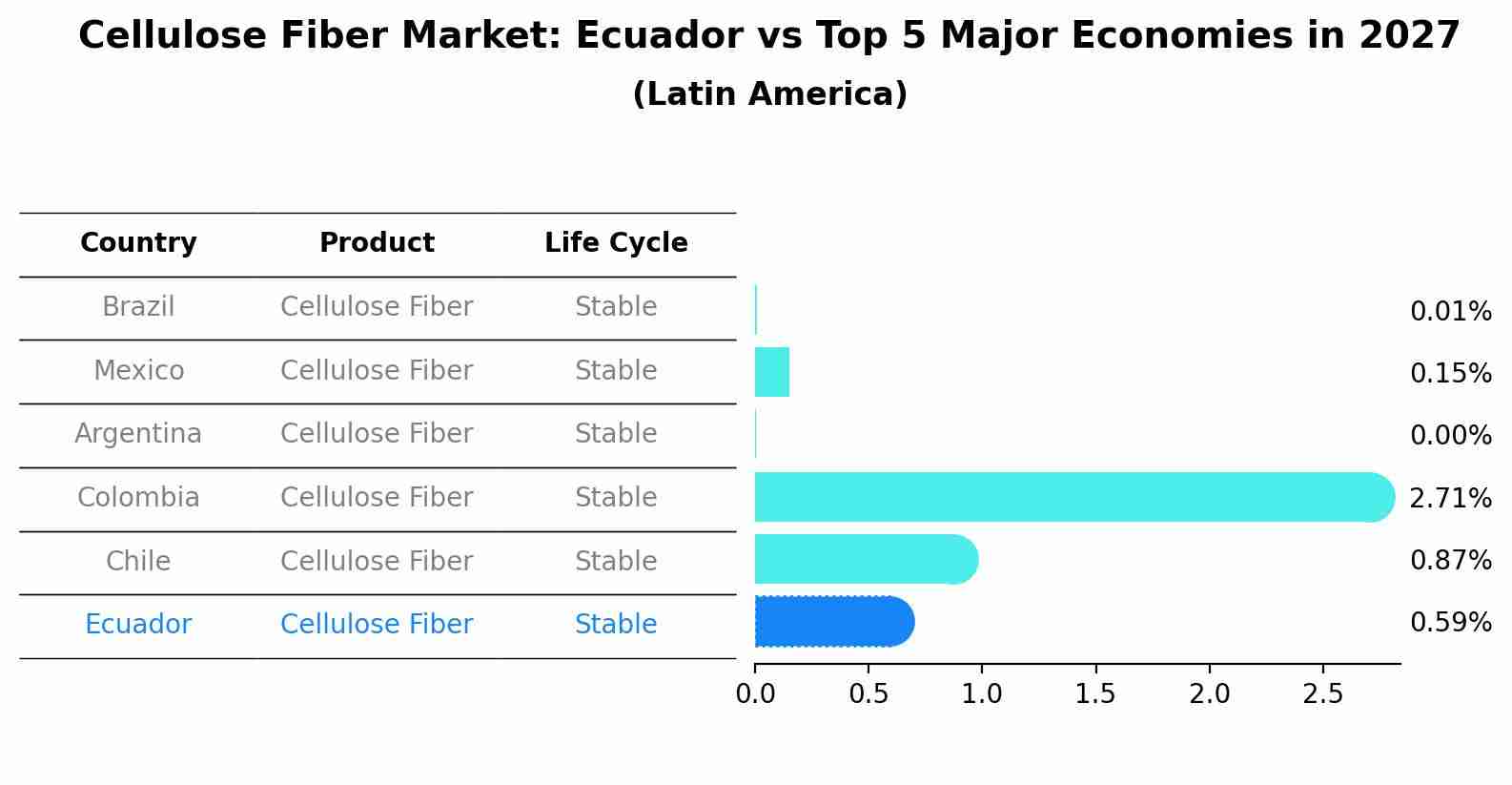
Cellulose Fiber Market: Ecuador vs Top 5 Major Economies in 2027 (Latin America)
In the Latin America region, the Cellulose Fiber market in Ecuador is projected to expand at a stable growth rate of 0.59% by 2027. The largest economy is Brazil, followed by Mexico, Argentina, Colombia and Chile.
Ecuador Cellulose Fiber Market Overview
The cellulose fiber market in Ecuador is expanding, driven by the growing interest in sustainable and natural fibers in the textile industry. Cellulose fibers, derived from plants, are increasingly favored for their biodegradability and comfort. The rising trend towards eco-friendly fashion and sustainable materials is propelling the demand for cellulose fibers in various applications, from clothing to home textiles.
Drivers of the market
The cellulose fiber market is driven by the increasing demand for sustainable and eco-friendly textile materials. As consumers become more environmentally conscious, the adoption of cellulose fibers, such as lyocell and modal, is rising. Moreover, the growing fashion industrys interest in sustainable sourcing is promoting the use of cellulose fibers in garment production.
Challenges of the market
The cellulose fiber market in Ecuador encounters difficulties due to limited awareness of the benefits of cellulose fibers in various applications, including textiles and composites. High production costs and competition from synthetic fibers limit market penetration. Additionally, reliance on imported raw materials creates vulnerabilities in the supply chain, impacting pricing and availability.
Government Policy of the market
Ecuador is advancing its commitment to sustainable materials by promoting the cellulose fiber market. Policies support the textile and packaging industries through tax incentives for cellulose fiber production, aiming to reduce plastic use and enhance eco-friendly product offerings.
Key Highlights of the Report:
- Ecuador Cellulose Fiber Market Outlook
- Market Size of Ecuador Cellulose Fiber Market, 2024
- Forecast of Ecuador Cellulose Fiber Market, 2031
- Historical Data and Forecast of Ecuador Cellulose Fiber Revenues & Volume for the Period 2021-2031
- Ecuador Cellulose Fiber Market Trend Evolution
- Ecuador Cellulose Fiber Market Drivers and Challenges
- Ecuador Cellulose Fiber Price Trends
- Ecuador Cellulose Fiber Porter`s Five Forces
- Ecuador Cellulose Fiber Industry Life Cycle
- Historical Data and Forecast of Ecuador Cellulose Fiber Market Revenues & Volume By Fiber Type for the Period 2021-2031
- Historical Data and Forecast of Ecuador Cellulose Fiber Market Revenues & Volume By Introduction for the Period 2021-2031
- Historical Data and Forecast of Ecuador Cellulose Fiber Market Revenues & Volume By Natural Cellulose Fibers for the Period 2021-2031
- Historical Data and Forecast of Ecuador Cellulose Fiber Market Revenues & Volume By Man-made Cellulose Fibers for the Period 2021-2031
- Historical Data and Forecast of Ecuador Cellulose Fiber Market Revenues & Volume By Others for the Period 2021-2031
- Historical Data and Forecast of Ecuador Cellulose Fiber Market Revenues & Volume By Applications for the Period 2021-2031
- Historical Data and Forecast of Ecuador Cellulose Fiber Market Revenues & Volume By Introduction for the Period 2021-2031
- Historical Data and Forecast of Ecuador Cellulose Fiber Market Revenues & Volume By Apparel for the Period 2021-2031
- Historical Data and Forecast of Ecuador Cellulose Fiber Market Revenues & Volume By Home Textile for the Period 2021-2031
- Historical Data and Forecast of Ecuador Cellulose Fiber Market Revenues & Volume By Industrial for the Period 2021-2031
- Historical Data and Forecast of Ecuador Cellulose Fiber Market Revenues & Volume By Others for the Period 2021-2031
- Ecuador Cellulose Fiber Import Export Trade Statistics
- Market Opportunity Assessment By Fiber Type
- Market Opportunity Assessment By Applications
- Ecuador Cellulose Fiber Top Companies Market Share
- Ecuador Cellulose Fiber Competitive Benchmarking By Technical and Operational Parameters
- Ecuador Cellulose Fiber Company Profiles
- Ecuador Cellulose Fiber Key Strategic Recommendations






































