Ecuador Electric Mobility Market Top 5 Importing Countries and Market Competition (HHI) Analysis
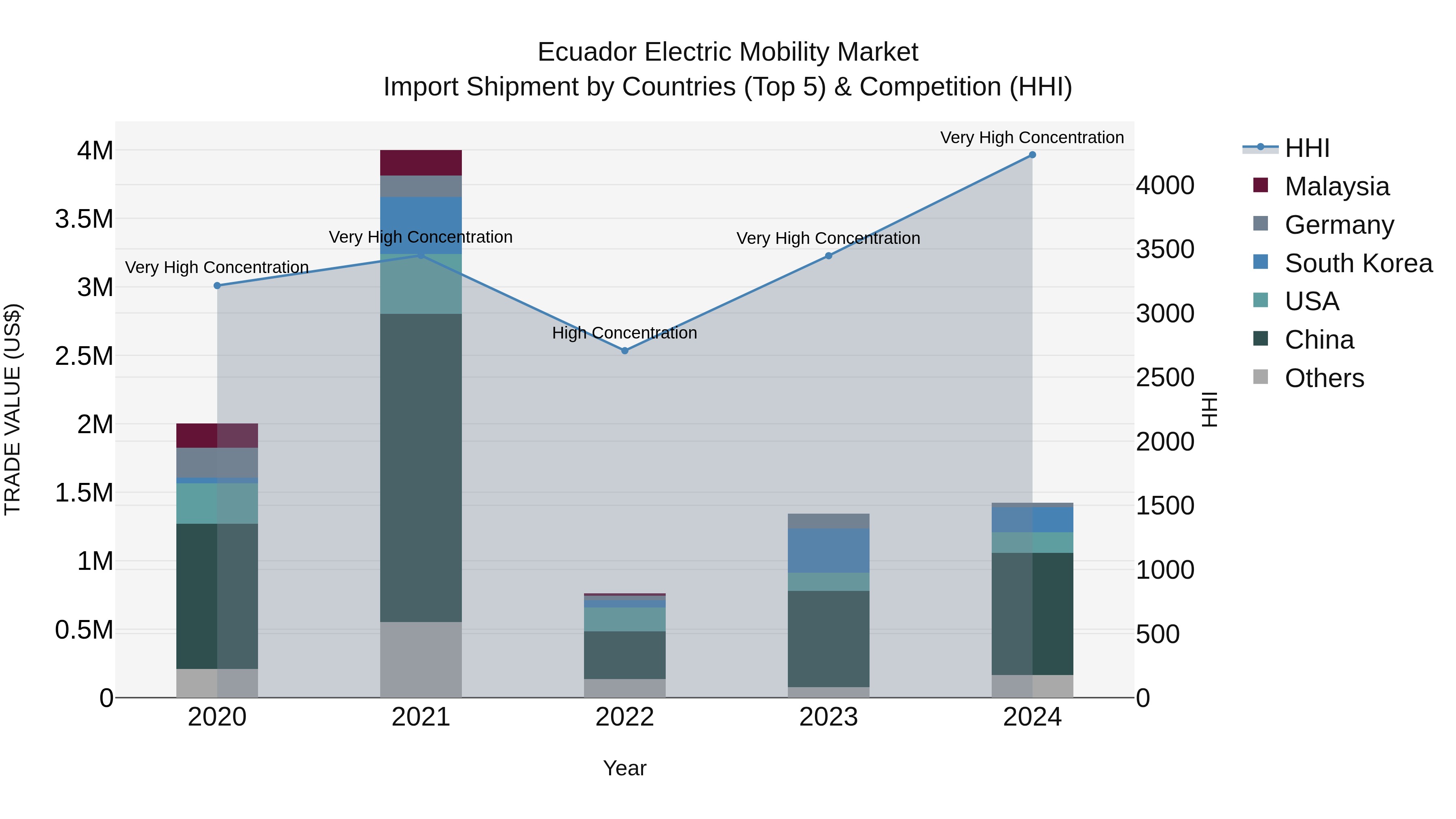
Ecuador`s electric mobility import Market Top 5 Importing Countries and Market Competition (HHI) Analysis continues to be dominated by key players such as China, South Korea, USA, Japan, and Germany in 2024. Despite a high Herfindahl-Hirschman Index (HHI) indicating Market Top 5 Importing Countries and Market Competition (HHI) Analysis concentration, the industry experienced a negative compound annual growth rate (CAGR) from 2020 to 2024. However, there was a notable uptick in growth from 2023 to 2024, showcasing a promising trend for the future of electric mobility imports in Ecuador. The diverse range of countries exporting to Ecuador highlights the global nature of the electric vehicle Market Top 5 Importing Countries and Market Competition (HHI) Analysis.
Ecuador Electric Mobility Market Overview
The electric mobility market in Ecuador is experiencing steady growth due to increasing environmental awareness and government initiatives promoting sustainable transportation. The country has seen a rising adoption of electric vehicles (EVs) and charging infrastructure development, supported by tax incentives and subsidies for EV buyers. Key players in the market include international EV manufacturers, local startups, and government entities investing in EV infrastructure. Challenges such as high upfront costs, limited charging infrastructure, and range anxiety still exist but are being addressed through public-private partnerships and awareness campaigns. With a growing focus on reducing emissions and transitioning towards cleaner transportation options, the electric mobility market in Ecuador is poised for continued expansion in the coming years.
Ecuador Electric Mobility Market Trends and Opportunities
The Ecuador Electric Mobility Market is experiencing significant growth due to various factors such as increasing government initiatives to reduce carbon emissions, rising fuel prices, and growing environmental awareness among consumers. Electric vehicles (EVs) are becoming more popular in urban areas, especially for commuting and delivery services. Additionally, the development of charging infrastructure is creating new opportunities for businesses to invest in EV charging stations. The market is also seeing a rise in electric bike and scooter sharing services, catering to the demand for sustainable transportation options. Overall, the Ecuador Electric Mobility Market is poised for continued expansion, offering opportunities for companies in the automotive, energy, and technology sectors to capitalize on the shift towards cleaner and more efficient transportation solutions.
Ecuador Electric Mobility Market Challenges
In the Ecuador Electric Mobility Market, several challenges are being faced, including limited infrastructure for charging stations, high initial costs of electric vehicles, lack of government incentives or policies to promote electric transportation, and low consumer awareness and acceptance of electric vehicles. The insufficient availability of charging infrastructure hinders the widespread adoption of electric vehicles, as consumers may be concerned about range anxiety. Additionally, the higher upfront costs of electric vehicles compared to traditional gas-powered vehicles pose a barrier to entry for many potential buyers. Without supportive government policies and incentives, such as tax breaks or subsidies, the market may struggle to grow. Overcoming these challenges will require a coordinated effort from government, industry stakeholders, and consumers to improve infrastructure, reduce costs, and increase awareness and adoption of electric vehicles in Ecuador.
Ecuador Electric Mobility Market Drivers
The Ecuador Electric Mobility Market is primarily being driven by government initiatives promoting sustainable transportation, such as tax incentives, subsidies, and infrastructure development for electric vehicles (EVs). Rising environmental concerns and the need to reduce greenhouse gas emissions are also significant drivers, leading consumers and businesses to adopt cleaner transportation options. Additionally, the increasing availability of EV models in the market, coupled with advancements in battery technology that improve range and charging capabilities, is boosting the adoption of electric vehicles in Ecuador. The growing awareness of the long-term cost savings associated with EV ownership, including lower fuel and maintenance expenses, is further fueling the demand for electric mobility solutions in the country.
Ecuador Electric Mobility Market Government Policy
The Ecuadorian government has implemented several policies to promote the adoption of electric mobility in the country. These include tax incentives for the importation and sale of electric vehicles, exemption from the value-added tax (VAT) for electric vehicles, and lower tariffs on charging equipment. Additionally, the government has launched the "Electric Mobility Strategy" to encourage the development of infrastructure such as charging stations and promote the use of electric vehicles in public transportation. The aim is to reduce greenhouse gas emissions, decrease dependency on fossil fuels, and improve air quality in urban areas. These policies demonstrate the government`s commitment to promoting sustainable transportation options and transitioning towards a more environmentally friendly transport sector.
Ecuador Electric Mobility Market Future Outlook
The future outlook for the Electric Mobility Market in Ecuador appears promising as the country is increasingly focusing on sustainability and reducing emissions. Government initiatives such as tax incentives and subsidies for electric vehicles, along with growing awareness among consumers about the environmental benefits of electric vehicles, are expected to drive market growth. Additionally, the improving infrastructure for electric vehicle charging stations and partnerships between the government and private sector for promoting electric mobility are likely to further boost the market. As global trends towards clean energy and sustainable transportation continue to rise, the Electric Mobility Market in Ecuador is poised for expansion in the coming years.
Key Highlights of the Report:
- Ecuador Electric Mobility Market Outlook
- Market Size of Ecuador Electric Mobility Market, 2024
- Forecast of Ecuador Electric Mobility Market, 2031
- Historical Data and Forecast of Ecuador Electric Mobility Revenues & Volume for the Period 2021- 2031
- Ecuador Electric Mobility Market Trend Evolution
- Ecuador Electric Mobility Market Drivers and Challenges
- Ecuador Electric Mobility Price Trends
- Ecuador Electric Mobility Porter's Five Forces
- Ecuador Electric Mobility Industry Life Cycle
- Historical Data and Forecast of Ecuador Electric Mobility Market Revenues & Volume By Product for the Period 2021- 2031
- Historical Data and Forecast of Ecuador Electric Mobility Market Revenues & Volume By Electric Bikes for the Period 2021- 2031
- Historical Data and Forecast of Ecuador Electric Mobility Market Revenues & Volume By Electric Scooters for the Period 2021- 2031
- Historical Data and Forecast of Ecuador Electric Mobility Market Revenues & Volume By Electric Motorized Scooters for the Period 2021- 2031
- Historical Data and Forecast of Ecuador Electric Mobility Market Revenues & Volume By Electric Motorcycles for the Period 2021- 2031
- Historical Data and Forecast of Ecuador Electric Mobility Market Revenues & Volume By Drive for the Period 2021- 2031
- Historical Data and Forecast of Ecuador Electric Mobility Market Revenues & Volume By Belt Drive for the Period 2021- 2031
- Historical Data and Forecast of Ecuador Electric Mobility Market Revenues & Volume By Chain Drive for the Period 2021- 2031
- Historical Data and Forecast of Ecuador Electric Mobility Market Revenues & Volume By Hub Drive for the Period 2021- 2031
- Historical Data and Forecast of Ecuador Electric Mobility Market Revenues & Volume By Battery for the Period 2021- 2031
- Historical Data and Forecast of Ecuador Electric Mobility Market Revenues & Volume By Lead Acid Battery for the Period 2021- 2031
- Historical Data and Forecast of Ecuador Electric Mobility Market Revenues & Volume By Li-Ion Battery for the Period 2021- 2031
- Historical Data and Forecast of Ecuador Electric Mobility Market Revenues & Volume By End-use for the Period 2021- 2031
- Historical Data and Forecast of Ecuador Electric Mobility Market Revenues & Volume By Personal for the Period 2021- 2031
- Historical Data and Forecast of Ecuador Electric Mobility Market Revenues & Volume By Commercial for the Period 2021- 2031
- Ecuador Electric Mobility Import Export Trade Statistics
- Market Opportunity Assessment By Product
- Market Opportunity Assessment By Drive
- Market Opportunity Assessment By Battery
- Market Opportunity Assessment By End-use
- Ecuador Electric Mobility Top Companies Market Share
- Ecuador Electric Mobility Competitive Benchmarking By Technical and Operational Parameters
- Ecuador Electric Mobility Company Profiles
- Ecuador Electric Mobility Key Strategic Recommendations






































