Egypt Asphalt Market Summary
The egypt asphalt market was estimated at USD 822 Million in 2025 and is projected to reach USD 1191 Million by 2032, growing at a CAGR of 6.5% from 2026 to 2032.
Egypt Asphalt Market Year-wise Growth Rate and Key Drivers
This graph highlights how the Egypt Asphalt Market has steadily grown over the past five years, supported by major growth factors.
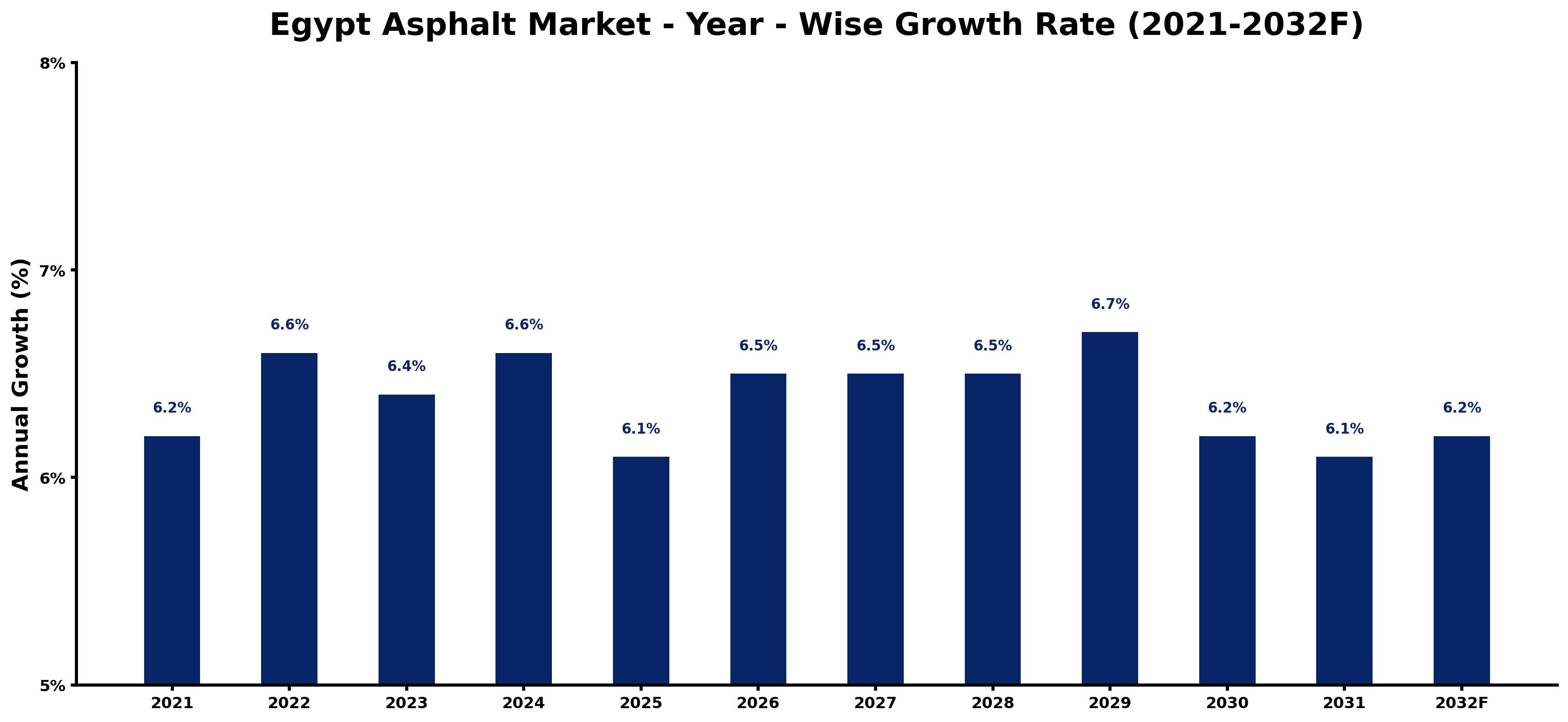
The table below presents the year wise growth rates along with the key drivers influencing the market
| Year | Growth Rate | Major Drivers |
| 2021 | 6.2% | Post-lockdown retail projects catalyzed infrastructure investments across major Egyptian cities. |
| 2022 | 6.6% | Sharp increases in construction activities highlighted the need for durable asphalt solutions. |
| 2023 | 6.4% | Enhanced transportation infrastructure initiatives aimed to support Egypt's economic diversification efforts. |
| 2024 | 6.6% | Urbanization trends prompted a surge in demand for modern roadway construction methods. |
| 2025 | 6.1% | The introduction of smart city projects created new avenues for asphalt applications. |
| 2026 | 6.5% | Rising population density necessitated enhanced urban transit systems and road expansions. |
| 2027 | 6.5% | Partnerships between local and international firms fostered innovation within the asphalt sector. |
| 2028 | 6.5% | Investment in renewable energy projects spurred demand for road infrastructure improvements. |
| 2029 | 6.7% | Adaptation to extreme weather conditions increased the need for high-performance asphalt products. |
| 2030 | 6.2% | Public-private partnerships aimed at expanding transportation networks drove market growth. |
| 2031 | 6.1% | Emerging trends in sustainable construction influenced asphalt production methodologies. |
| 2032 | 6.2% | Technological advancements in asphalt recycling opened new markets and reduced waste. |
Note - Market size estimations and growth projections presented in this report are based on 6Wresearch's advanced forecasting approach, validated with industry datasets as of June 2026.
Egypt Asphalt Market Synopsis
The Egypt Asphalt Market is projected to reach 6.5% and witness significant growth during the forecast period (2026-2032). This growth trajectory is predominantly driven by the country's ongoing infrastructural development projects, which include extensive road construction, rehabilitation, and maintenance initiatives. As urbanization accelerates, the demand for asphalt is increasingly characterized by the need for a robust transportation network capable of supporting both existing and future infrastructure demands.
Egypt Asphalt Market Growth Drivers
The continuous evolution of the Egypt Asphalt Market is primarily attributed to several critical growth drivers:
- The ambitious national infrastructure projects underway in Egypt are foundational to the expanding asphalt market. Projects such as new highways and international airports are pivotal in increasing the consumption of asphalt products.
- Urbanization trends are intensifying, with a rising population compelling the need for improved transportation facilities and urban infrastructure, further necessitating asphalt.
- Technological advances in asphalt production, including the development of warm mix asphalt and polymer-modified asphalts, enhance product durability, driving market demand.
- The focus on sustainability has led to an increasing preference for eco-friendly and recycled asphalt materials, contributing to the market's growth as environmental considerations become paramount.
- Strategic partnerships and collaborations among industry stakeholders are fostering innovations in product development, which is essential for keeping pace with market demands.
Egypt Asphalt Market Trends and Opportunities
Current trends within the Egypt Asphalt Market reflect a shift towards more sustainable practices and advanced product solutions. There are several notable trends and opportunities:
- Increased demand for eco-friendly asphalt solutions is shaping product offerings, with more manufacturers exploring recycled materials to meet sustainability goals.
- The growing focus on advanced production technologies provides opportunities for developing asphalt products that are both cost-effective and environmentally friendly.
- As the government improves the transportation network, there is potential for significant investment in high-quality asphalt products to meet enhanced regulatory standards.
- Market players are increasingly investing in research and development to innovate asphalt formulations that offer superior performance characteristics, including enhanced durability.
- Collaboration with construction and logistics firms presents opportunities for expanded distribution and influence in the supply chain, ensuring that the latest asphalt solutions reach the market effectively.
Egypt Asphalt Market Challenges and Restraints
Despite the promising growth, the Egypt Asphalt Market faces several challenges that could impede progress:
- Fluctuating oil prices often lead to volatility in raw material costs, impacting profitability for asphalt manufacturers and the overall market stability.
- Limited government investment in infrastructure projects can result in uneven demand for asphalt, complicating production planning and market strategies.
- The prevalence of counterfeit or substandard asphalt products introduces quality concerns, which could negatively affect overall market perception and consumer trust.
- Many manufacturers operate with outdated production technologies, which can hinder efficiency and the ability to deliver high-quality products in a competitive market.
- Competition from alternative materials, such as concrete, can limit market share for asphalt, especially in regions where cost considerations are paramount.
Egypt Asphalt Market Investment Opportunities
Investment opportunities within the Egypt Asphalt Market are robust, fueled by escalating infrastructure demands:
- The government's commitment to infrastructure development, particularly in roads and highways, signals a growing necessity for asphalt products, presenting numerous investment opportunities.
- Investors are increasingly looking towards establishing production facilities that focus on producing modified and specialty asphalt products to cater to evolving market needs.
- Developing distribution networks within urban areas can enhance market penetration and ensure timely delivery of asphalt products to construction sites.
- Technological advancements in asphalt production are creating avenues for investors to fund innovative projects that align with sustainability initiatives.
- Collaboration with local construction firms can provide valuable insights into market dynamics and enhance the effectiveness of investment strategies.
Egypt Asphalt Market Government Investment and Initiatives
The Egyptian government plays a crucial role in shaping the asphalt market through various investments and initiatives:
- Significant public spending on infrastructure development is directly linked to increasing demand for asphalt, as the government prioritizes upgrades and new construction projects.
- The establishment of regulatory frameworks aims to improve the quality and sustainability of asphalt production, ensuring compliance with best practices in the industry.
- Partnerships with international firms are encouraged to facilitate technology transfer, elevating local manufacturing capabilities and competitive edge.
- Price stabilization measures, including subsidies and market monitoring, have been implemented to shield manufacturers from extreme volatility and ensure steady supply.
- The government's focus on enhancing transportation networks showcases its commitment to fostering a conducive environment for the growth of the asphalt market.
Egypt Asphalt Market Latest Developments (May 2025 - June 2026)
Recent developments in the Egypt Asphalt Market from May 2025 to June 2026 suggest a dynamic landscape with several industry shifts:
- Increased collaborations between public and private sectors have resulted in accelerated project timelines for major asphalt-related infrastructure initiatives.
- Technological innovations are being actively adopted, with a rise in the use of sustainable materials in asphalt production, aligning with global environmental trends.
- There has been a marked increase in quality control measures, addressing earlier challenges related to counterfeit products and enhancing market integrity.
- New policy initiatives have emerged to incentivize investments in modern production technologies, encouraging manufacturers to upgrade facilities for better efficiency.
- Market responsiveness to urbanization trends continues to shape project planning, ensuring that asphalt solutions are aligned with contemporary demands.
Egypt Asphalt Market - Key Attractiveness of the Report
- 10 Years of Market Numbers
- Historical Data Starting from 2022 to 2025
- Base Year: 2025
- Forecast Data until 2032
- Key Performance Indicators Impacting the Market
- Major Upcoming Developments and Projects
Key Highlights of the Report:
- Egypt Asphalt Market Outlook
- Market Size of Egypt Asphalt Market, 2025
- Forecast of Egypt Asphalt Market, 2032F
- Historical Data and Forecast of Egypt Asphalt Revenues & Volume for the Period 2022-2032F
- Egypt Asphalt Market Trend Evolution
- Egypt Asphalt Market Drivers and Challenges
- Egypt Asphalt Price Trends
- Egypt Asphalt Porter's Five Forces
- Egypt Asphalt Industry Life Cycle
- Historical Data and Forecast of Egypt Asphalt Market Revenues & Volume By Type for the Period 2022-2032F
- Historical Data and Forecast of Egypt Asphalt Market Revenues & Volume By Paving Petroleum Asphalt for the Period 2022-2032F
- Historical Data and Forecast of Egypt Asphalt Market Revenues & Volume By Industrial Petroleum Asphalt for the Period 2022-2032F
- Historical Data and Forecast of Egypt Asphalt Market Revenues & Volume By Others for the Period 2022-2032F
- Historical Data and Forecast of Egypt Asphalt Market Revenues & Volume By Application for the Period 2022-2032F
- Historical Data and Forecast of Egypt Asphalt Market Revenues & Volume By Paving for the Period 2022-2032F
- Historical Data and Forecast of Egypt Asphalt Market Revenues & Volume By Roofing for the Period 2022-2032F
- Historical Data and Forecast of Egypt Asphalt Market Revenues & Volume By Others for the Period 2022-2032F
- Egypt Asphalt Import Export Trade Statistics
- Market Opportunity Assessment By Type
- Market Opportunity Assessment By Application
- Egypt Asphalt Top Companies Market Share
- Egypt Asphalt Competitive Benchmarking By Technical and Operational Parameters
- Egypt Asphalt Company Profiles
- Egypt Asphalt Key Strategic Recommendations






































