Egypt Aviation Test Equipment Market Size, Share & Growth Rate
The Egypt Aviation Test Equipment Market was estimated at USD 483 Million in 2025 and is projected to reach USD 681 Million by 2032, growing at a CAGR of 5.0% from 2026 to 2032. This growth trajectory is fueled by the increasing demand for air travel within Egypt and the broader Middle East, coupled with the modernization efforts of the aviation sector. As infrastructure expands and technology advances, the necessity for state-of-the-art testing equipment has become more pronounced, marking a significant shift in the market's landscape.
Egypt Aviation Test Equipment Market Year-wise Growth Rate and Key Drivers
This graph highlights how the Egypt Aviation Test Equipment Market has steadily grown over the years, supported by major growth factors.
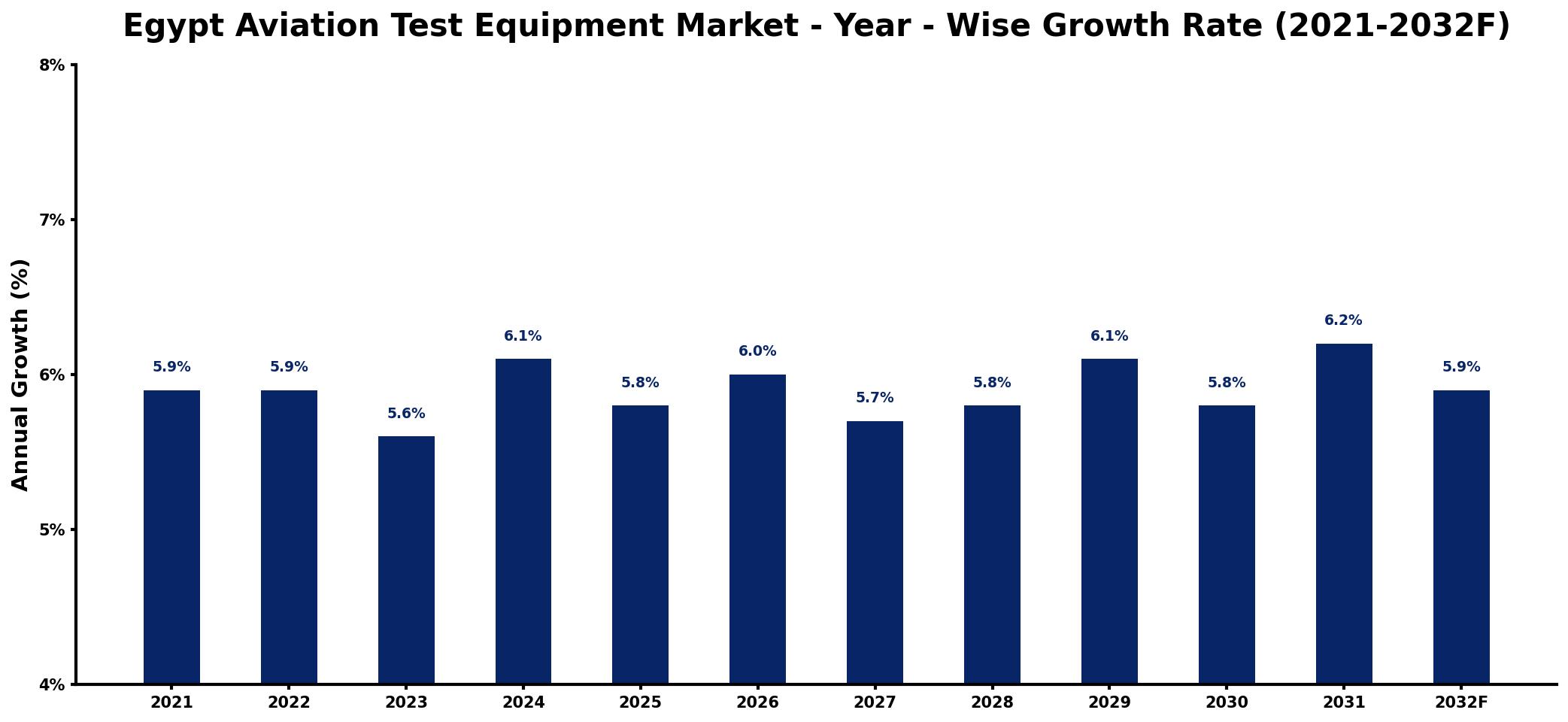
The table below presents the year‑wise growth rates along with the key drivers influencing the market
| Year | Growth Rate | Major Drivers |
| 2021 | 5.9% | Rising defense spending initiatives |
| 2022 | 5.9% | Expansion of commercial flight operations |
| 2023 | 5.6% | Increased training program investments |
| 2024 | 6.1% | Growing demand for safety standards |
| 2025 | 5.8% | Technological advancements in training |
| 2026 | 6.0% | Surge in regional air travel |
| 2027 | 5.7% | Partnerships with global suppliers |
| 2028 | 5.8% | Development of local manufacturing hubs |
| 2029 | 6.1% | Enhanced regulatory compliance measures |
| 2030 | 5.8% | Focus on sustainability practices |
| 2031 | 6.2% | Emergence of new airline entrants |
| 2032 | 5.9% | Investment in modernization projects |
Note: Market size estimations and growth projections presented in this report are based on 6Wresearch's proprietary forecasting methodology, utilizing the latest available industry data, government publications, and primary research inputs.
Egypt Aviation Test Equipment Market Synopsis
The recent momentum in the Egypt Aviation Test Equipment Market reflects a period of transformation as the aviation industry embraces modernization. However, this current growth phase is just the beginning, with expansive opportunities on the horizon for enhanced testing solutions tailored to meet evolving industry needs.
In contrast to past years, where technological advancements were incremental, the market is now set for a rapid evolution driven by automation and AI integration. These innovations not only enhance efficiency but also ensure higher safety standards, positioning the sector for sustainable growth moving forward.
Egypt Aviation Test Equipment Market Key Takeaways
- Strong growth trajectory fueled by increased air travel demand and fleet modernization.
- Emerging technologies like AI and automation are transforming testing methodologies.
- Investment opportunities abound for suppliers and manufacturers catering to MRO services.
- Government policies are shaping the market towards higher safety and compliance standards.
- Challenges remain due to costs and technological limitations, but innovation drives the market forward.
Evaluation of Restraints in Egypt Aviation Test Equipment Market
Despite the promising growth potential, the Egypt Aviation Test Equipment Market faces several restraints that can limit expansion. One of the primary issues is the limited availability of advanced testing technologies, which hampers efficiency in maintaining aviation equipment. Additionally, the high costs associated with specialized aviation test equipment pose significant barriers for smaller operators. Regulatory compliance requirements are also evolving, necessitating continuous investments in testing technologies to meet safety and quality standards. These factors compel companies to seek strategic partnerships and technological innovations to navigate the complexities of the market.
Egypt Aviation Test Equipment Market Trends
Current trends indicate a marked shift towards digital and automated testing solutions, aimed at minimizing human error and enhancing operational efficiency. The growing emphasis on portable and handheld testing equipment is also notable, allowing for greater flexibility in various maintenance environments. As the aviation sector in Egypt modernizes, there is a notable demand for sophisticated test equipment that aligns with the evolving operational needs of airlines and maintenance providers, pushing the boundaries of innovation within the industry.
Egypt Aviation Test Equipment Market Opportunities
The Egypt Aviation Test Equipment Market is ripe with investment opportunities, particularly as the country continues to develop its aviation infrastructure. The expansion of airports and the growing demand for reliable air travel services underscore the necessity for advanced testing equipment. Suppliers can capitalize on this trend by offering cutting-edge technology tailored for maintenance, repair, and overhaul services. Moreover, potential partnerships with local aviation entities and government agencies present avenues for collaborative solutions designed to address specific market needs, creating significant opportunities for growth.
Government Initiatives in the Egypt Aviation Test Equipment Market
Government policies in Egypt are pivotal in shaping the aviation test equipment landscape, with initiatives aimed at enhancing safety, quality, and efficiency. The Egyptian Civil Aviation Authority (ECAA) plays a crucial role in regulating the use of aviation test equipment to ensure compliance with international standards. Furthermore, the government is actively promoting modernization and infrastructure development through the Egypt Vision 2030 initiative, which is expected to further influence demand for advanced testing solutions in the aviation sector.
Future Insights of the Egypt Aviation Test Equipment Market
Looking ahead, the Egypt Aviation Test Equipment Market is poised for robust growth from 2026 to 2032, driven by an increasing demand for air travel and a continued commitment to modernization. Technological innovations, including IoT integration and AI advancements, are set to transform testing processes, ensuring enhanced safety and operational efficiency. Government initiatives to bolster airport infrastructure will further create a conducive environment for market expansion, establishing a forward momentum that supports sustained growth and innovation.
Egypt Aviation Test Equipment Market Latest Developments (2025 - 2026)
Recent developments within the Egypt Aviation Test Equipment Market indicate a trend towards greater collaboration between local and international firms, particularly in the realm of technology sharing. Advances in portable and automated testing solutions have garnered increased interest, as stakeholders prioritize flexibility and efficiency in operations. Furthermore, ongoing regulatory changes continue to prompt companies to enhance their compliance efforts, ensuring that their testing equipment meets the latest safety standards.
Egypt Aviation Test Equipment Market - Key Attractiveness of the Report
- 10 Years of Market Numbers
- Historical Data Starting from 2022 to 2025
- Base Year: 2025
- Forecast Data until 2032
- Key Performance Indicators Impacting the Market
- Major Upcoming Developments and Projects
Key Highlights of the Report:
- Egypt Aviation Test Equipment Market Outlook
- Market Size of Egypt Aviation Test Equipment Market, 2025
- Forecast of Egypt Aviation Test Equipment Market, 2032
- Historical Data and Forecast of Egypt Aviation Test Equipment Revenues & Volume for the Period 2022-2032F
- Egypt Aviation Test Equipment Market Trend Evolution
- Egypt Aviation Test Equipment Market Drivers and Challenges
- Egypt Aviation Test Equipment Price Trends
- Egypt Aviation Test Equipment Porter's Five Forces
- Egypt Aviation Test Equipment Industry Life Cycle
- Historical Data and Forecast of Egypt Aviation Test Equipment Market Revenues & Volume By Product for the Period 2022-2032F
- Historical Data and Forecast of Egypt Aviation Test Equipment Market Revenues & Volume By Electrical Aviation Test Equipment for the Period 2022-2032F
- Historical Data and Forecast of Egypt Aviation Test Equipment Market Revenues & Volume By Hydraulic Aviation Test Equipment for the Period 2022-2032F
- Historical Data and Forecast of Egypt Aviation Test Equipment Market Revenues & Volume By Power Aviation Test Equipment for the Period 2022-2032F
- Historical Data and Forecast of Egypt Aviation Test Equipment Market Revenues & Volume By Pneumatic Aviation Test Equipment for the Period 2022-2032F
- Historical Data and Forecast of Egypt Aviation Test Equipment Market Revenues & Volume By End User for the Period 2022-2032F
- Historical Data and Forecast of Egypt Aviation Test Equipment Market Revenues & Volume By Commercial for the Period 2022-2032F
- Historical Data and Forecast of Egypt Aviation Test Equipment Market Revenues & Volume By Defense/Military Sector for the Period 2022-2032F
- Egypt Aviation Test Equipment Import Export Trade Statistics
- Market Opportunity Assessment By Product
- Market Opportunity Assessment By End User
- Egypt Aviation Test Equipment Top Companies Market Share
- Egypt Aviation Test Equipment Competitive Benchmarking By Technical and Operational Parameters
- Egypt Aviation Test Equipment Company Profiles
- Egypt Aviation Test Equipment Key Strategic Recommendations






































