Egypt Building Construction Market Size, Share & Growth Rate
The Egypt Building Construction Market was estimated at USD 1305 Million in 2025 and is projected to reach USD 1877 Million by 2032, growing at a CAGR of 5.3% from 2026 to 2032. This growth is primarily driven by extensive government infrastructure projects aimed at improving urban and rural areas, alongside a rapidly increasing population that necessitates more housing and commercial spaces. The shift towards sustainable and energy-efficient construction practices also plays a pivotal role in shaping the market's expansion.
Egypt Building Construction Market Year-wise Growth Rate and Key Drivers
This graph highlights how the Egypt Building Construction Market has steadily grown over the years, supported by major growth factors.
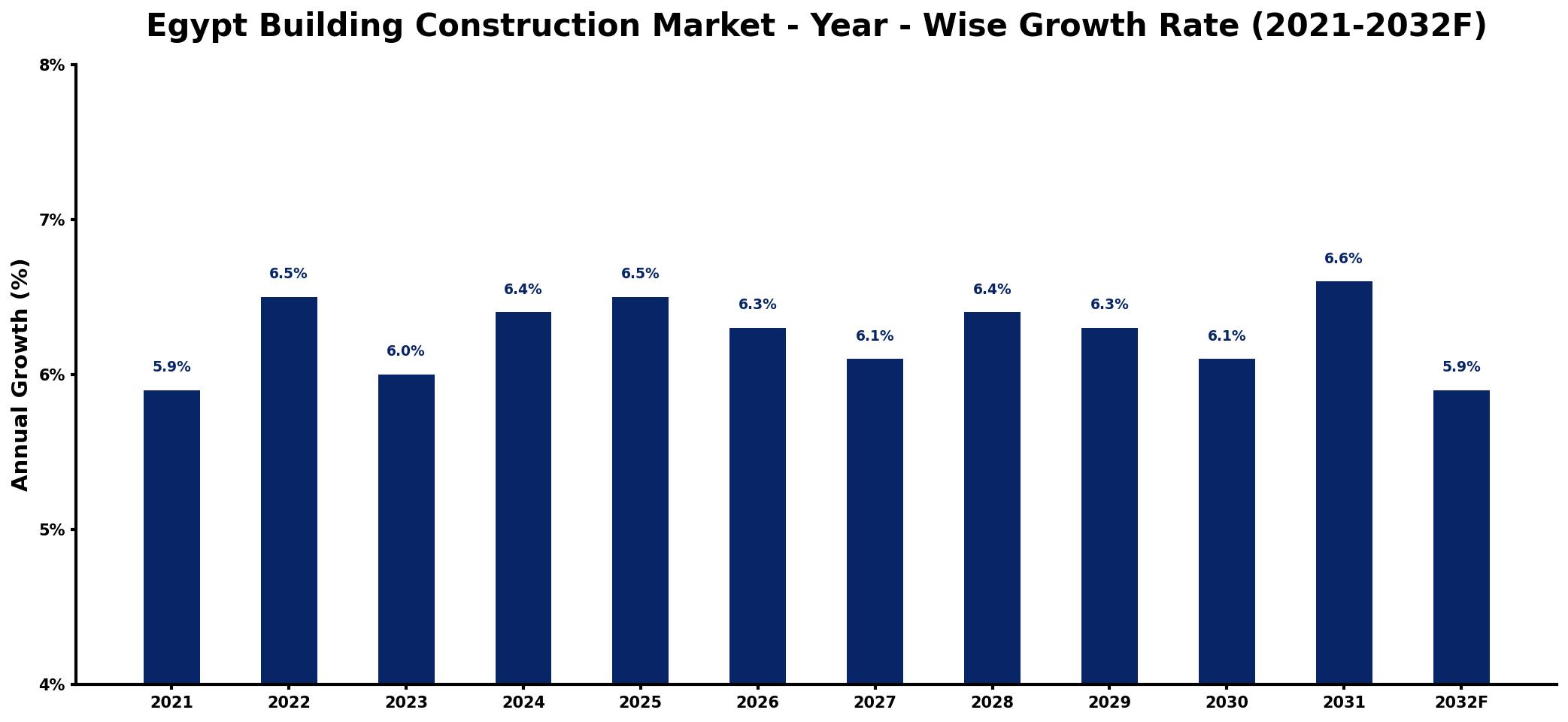
The table below presents the year‑wise growth rates along with the key drivers influencing the market
| Year | Growth Rate | Major Drivers |
| 2021 | 5.9% | increased infrastructure investment initiatives |
| 2022 | 6.5% | growing urbanization and population demands |
| 2023 | 6.0% | rising foreign direct investments influx |
| 2024 | 6.4% | expansion of renewable energy projects |
| 2025 | 6.5% | increased residential housing developments |
| 2026 | 6.3% | rising end-use demand growth |
| 2027 | 6.1% | growing tourism sector investments |
| 2028 | 6.4% | enhanced government infrastructure programs |
| 2029 | 6.3% | increased public-private partnership opportunities |
| 2030 | 6.1% | development of smart city initiatives |
| 2031 | 6.6% | growing demand for sustainable solutions |
| 2032 | 5.9% | increased pharmaceutical industry usage |
Note: Market size estimations and growth projections presented in this report are based on 6Wresearch's proprietary forecasting methodology, utilizing the latest available industry data, government publications, and primary research inputs.
Egypt Building Construction Market Synopsis
Egypt's building construction market is witnessing an unprecedented demand for residential units, fueled by urbanization and an expanding population. With a significant portion of the populace moving to urban areas, there is an urgent need for modern housing solutions that meet contemporary standards.
Additionally, the governments commitment to enhancing infrastructure is reshaping the construction landscape. Initiatives include the development of transportation networks and public utilities, creating a fertile ground for both local and international construction firms to invest and thrive.
Egypt Building Construction Market Key Takeaways
- Significant growth in residential and commercial construction driven by urban migration.
- Government investment in infrastructure is unlocking new project opportunities.
- Growing emphasis on sustainable and eco-friendly building practices is reshaping industry standards.
- Bureaucratic challenges and financing constraints remain key hurdles in project execution.
- Technological advancements, such as BIM, are increasingly being adopted in construction processes.
Evaluation of Restraints in Egypt Building Construction Market
While the Egypt building construction market presents numerous opportunities, it is not without its challenges. Bureaucratic inefficiencies and delays in securing necessary permits can significantly impede progress, resulting in escalated costs and extended timelines. Furthermore, the local currencys fluctuations contribute to unpredictability in material pricing, complicating budgeting processes. Limited access to financing avenues, coupled with high interest rates, can constrain project funding, while inconsistent enforcement of building regulations raises concerns about quality and safety standards across the sector.
Egypt Building Construction Market Trends
Current trends in the Egypt building construction market include a notable shift toward sustainable construction practices, reflecting an increased awareness of environmental issues among stakeholders. Government initiatives promoting green buildings are further propelling this trend. Additionally, the market is observing an uptick in technology adoption, with Building Information Modeling (BIM) being leveraged to enhance efficiency and project management.
Moreover, mixed-use developments are gaining traction, merging residential, commercial, and leisure spaces into cohesive urban environments. Investment in transportation and utility infrastructure is on the rise, aimed at bolstering economic growth and accommodating urban expansion, thereby creating a robust demand for innovative construction solutions.
Egypt Building Construction Market Opportunities
The Egypt building construction market presents numerous opportunities for investors and companies eager to engage in this growing sector. High demand for affordable housing solutions in urban centers, particularly in Cairo and Alexandria, creates a promising landscape for residential construction projects. Moreover, the push towards sustainable construction practices opens doors for investments in green building technologies and renewable energy solutions.
Partnerships with local construction firms or participation in public-private partnerships are viable strategies for engaging in large-scale infrastructure projects, further enhancing the market's attractiveness to foreign investors.
Government Initiatives in the Egypt Building Construction Market
The Egyptian government has implemented several policies to stimulate growth in the building construction sector. These initiatives focus on promoting sustainable housing and streamlining the permitting process to facilitate project execution. Additionally, there are measures to enhance foreign investment and ensure compliance with stringent building codes and safety standards. The government is also investing in programs aimed at supporting local construction companies, thereby fostering a more competitive environment that encourages innovation and investment.
Future Insights of the Egypt Building Construction Market
Looking ahead to 2026-2032, the Egypt Building Construction Market is poised for steady growth, spurred by ongoing government investments and urbanization. The anticipated increase in demand for affordable housing and modern commercial spaces will likely drive construction activities. Moreover, as the market aligns with global trends towards sustainability, we can expect the continued integration of innovative building practices and technologies. Nonetheless, potential challenges such as regulatory hurdles and inflation may impact project timelines and budgets, necessitating proactive management strategies.
Egypt Building Construction Market Latest Developments (2025 - 2026)
Recent developments in the Egypt building construction market indicate a trend towards increased collaboration among stakeholders to address existing challenges. Various industry stakeholders are focusing on improving project delivery times by embracing technological innovations. Furthermore, there has been a significant push for sustainable practices, with new projects increasingly incorporating green materials and energy-efficient designs. As the government continues to prioritize infrastructure, the landscape for construction remains dynamic, with numerous projects slated to enhance the countrys urban framework.
Egypt Building Construction Market - Key Attractiveness of the Report
- 10 Years of Market Numbers
- Historical Data Starting from 2022 to 2025
- Base Year: 2025
- Forecast Data until 2032
- Key Performance Indicators Impacting the Market
- Major Upcoming Developments and Projects
Key Highlights of the Report:
- Egypt Building Construction Market Outlook
- Market Size of Egypt Building Construction Market, 2025
- Forecast of Egypt Building Construction Market, 2032
- Historical Data and Forecast of Egypt Building Construction Revenues & Volume for the Period 2022-2032F
- Egypt Building Construction Market Trend Evolution
- Egypt Building Construction Market Drivers and Challenges
- Egypt Building Construction Price Trends
- Egypt Building Construction Porter's Five Forces
- Egypt Building Construction Industry Life Cycle
- Historical Data and Forecast of Egypt Building Construction Market Revenues & Volume By Type for the Period 2022-2032F
- Historical Data and Forecast of Egypt Building Construction Market Revenues & Volume By Residential for the Period 2022-2032F
- Historical Data and Forecast of Egypt Building Construction Market Revenues & Volume By Non-residential for the Period 2022-2032F
- Historical Data and Forecast of Egypt Building Construction Market Revenues & Volume By Construction Type for the Period 2022-2032F
- Historical Data and Forecast of Egypt Building Construction Market Revenues & Volume By New Construction for the Period 2022-2032F
- Historical Data and Forecast of Egypt Building Construction Market Revenues & Volume By Renovation for the Period 2022-2032F
- Historical Data and Forecast of Egypt Building Construction Market Revenues & Volume By Application for the Period 2022-2032F
- Historical Data and Forecast of Egypt Building Construction Market Revenues & Volume By Owned for the Period 2022-2032F
- Historical Data and Forecast of Egypt Building Construction Market Revenues & Volume By Rental for the Period 2022-2032F
- Historical Data and Forecast of Egypt Building Construction Market Revenues & Volume By End User for the Period 2022-2032F
- Historical Data and Forecast of Egypt Building Construction Market Revenues & Volume By Private for the Period 2022-2032F
- Historical Data and Forecast of Egypt Building Construction Market Revenues & Volume By Public for the Period 2022-2032F
- Egypt Building Construction Import Export Trade Statistics
- Market Opportunity Assessment By Type
- Market Opportunity Assessment By Construction Type
- Market Opportunity Assessment By Application
- Market Opportunity Assessment By End User
- Egypt Building Construction Top Companies Market Share
- Egypt Building Construction Competitive Benchmarking By Technical and Operational Parameters
- Egypt Building Construction Company Profiles
- Egypt Building Construction Key Strategic Recommendations






































