Egypt Cigarette Market Size, Share & Growth Rate
The Egypt Cigarette Market was estimated at USD 401 Million in 2025 and is projected to reach USD 511 Million by 2032, growing at a CAGR of 3.5% from 2026 to 2032. This growth trajectory is primarily driven by a persistent smoking culture and a population with increasing disposable income levels. Despite health concerns and regulatory pressures, the accessibility and affordability of cigarettes ensure sustained consumption among a large demographic, particularly in urban areas.
Egypt Cigarette Market Year-wise Growth Rate and Key Drivers
This graph highlights how the Egypt Cigarette Market has steadily grown over the years, supported by major growth factors.
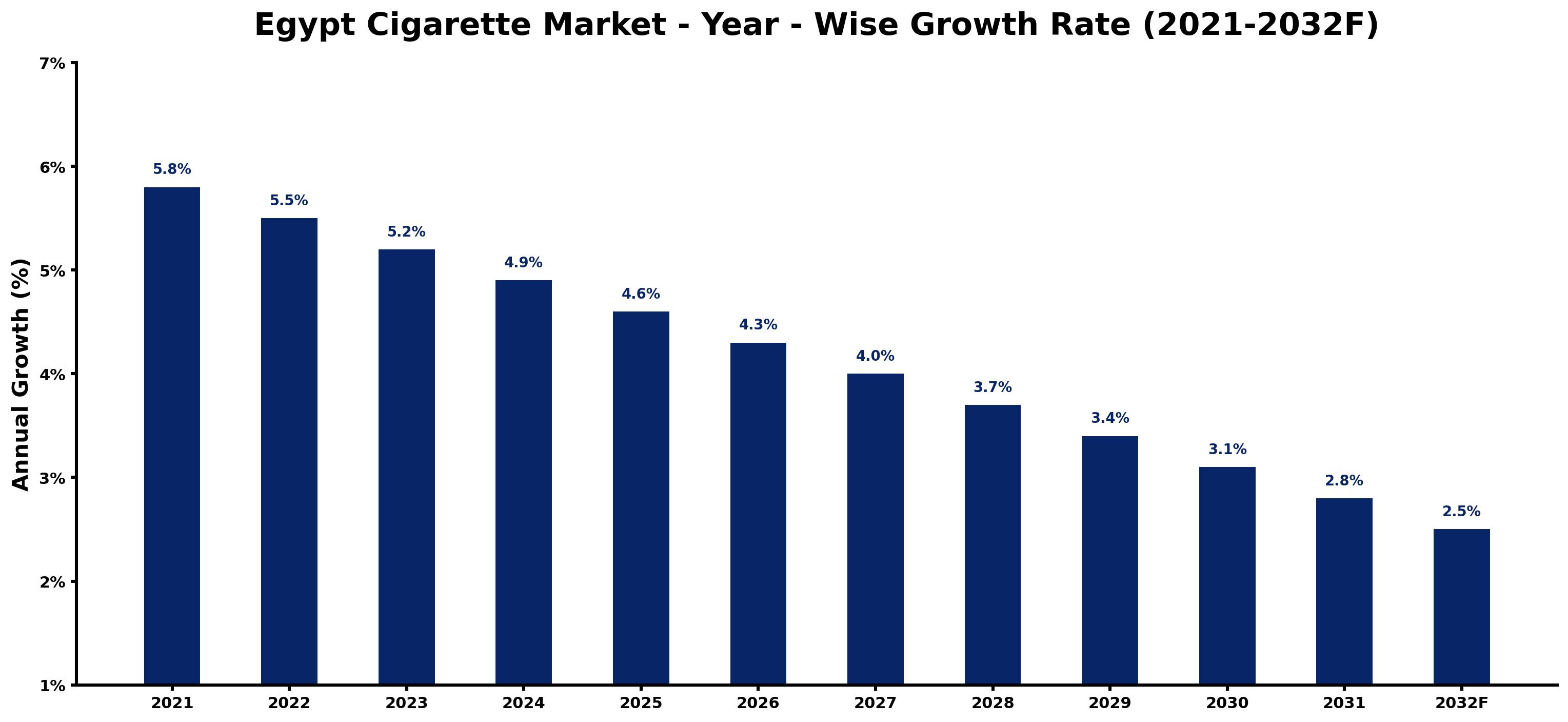
The table below presents the year‑wise growth rates along with the key drivers influencing the market
| Year | Growth Rate | Major Drivers |
| 2021 | 5.8% | Expansion of commercial construction activities |
| 2022 | 5.5% | Expansion of commercial construction activities |
| 2023 | 5.2% | Expansion of commercial construction activities |
| 2024 | 4.9% | Expansion of commercial construction activities |
| 2025 | 4.6% | Increasing industrial automation investments |
| 2026 | 4.3% | Environmental regulations reducing traditional demand |
| 2027 | 4.0% | Technology transition toward sustainable alternatives |
| 2028 | 3.7% | Increasing shift toward cleaner alternatives |
| 2029 | 3.4% | Growing adoption of energy efficient systems |
| 2030 | 3.1% | Growing adoption of energy efficient systems |
| 2031 | 2.8% | Declining investments in legacy infrastructure |
| 2032 | 2.5% | Increasing shift toward cleaner alternatives |
Note - Market size estimations and growth projections presented in this report are based on 6Wresearch's advanced forecasting approach, validated with industry datasets as of June 2026.
Egypt Cigarette Market Synopsis
The Egyptian cigarette market is marked by high consumption rates, influenced by both cultural factors and the relative affordability of tobacco products. With the dominance of well-established international brands and local competitors, the market landscape is vibrant, yet increasingly influenced by health awareness.
As health campaigns gain traction and governmental regulations tighten, consumers are showing a discernible shift in preferences. This dynamic environment presents both a challenge and an opportunity for stakeholders to innovate and adapt their product offerings to cater to a more health-conscious public.
Egypt Cigarette Market Key Takeaways
- The Egypt cigarette market continues to be substantial, with considerable growth projected over the next several years.
- Health awareness and government regulations are increasingly shaping consumer behavior and market dynamics.
- Flavored and menthol cigarettes are becoming popular among younger consumers, prompting product innovation.
- Alternative tobacco products, including e-cigarettes, are gaining traction, challenging traditional cigarette sales.
- The market remains relatively underdeveloped compared to Western counterparts, presenting ample expansion opportunities.
Evaluation of Restraints in Egypt Cigarette Market
The Egyptian cigarette market faces numerous restraints, primarily from the government's intensified regulatory framework aimed at public health improvement. Increasing taxes on tobacco products have led to a surge in prices, discouraging consumption among budget-conscious consumers. Furthermore, the rise in alternative products, such as e-cigarettes, is carving into the market share traditionally held by conventional cigarettes. This shift towards reduced-risk products poses a significant challenge for traditional manufacturers as they navigate these evolving consumer preferences alongside the ongoing battle against counterfeit cigarettes, which further complicates brand loyalty and market integrity.
Egypt Cigarette Market Trends
The Egypt cigarette market is currently characterized by several notable trends. There is a marked increase in consumer interest in alternative smoking products, especially among younger demographics who are more health-conscious. Concurrently, regulatory bodies are enforcing stricter laws regarding tobacco advertising and packaging, affecting traditional marketing strategies. The ongoing demand for premium and flavored cigarettes is fostering innovation among manufacturers, leading to diversification of product lines that appeal to contemporary tastes. This evolution represents a significant shift as the market adapts to the changing landscape of consumer preferences.
Egypt Cigarette Market Opportunities
Despite the challenges, the Egypt cigarette market offers intriguing investment opportunities, particularly for those willing to embrace innovation and adapt to emerging consumer trends. With a large, predominantly young consumer base and increasing disposable incomes, there is strong potential for companies to introduce new and differentiated products. Furthermore, capitalizing on the shift towards reduced-risk products could present lucrative avenues for growth. Firms that effectively align their strategies with the evolving regulatory landscape and consumer preferences will find ample opportunities to establish a competitive edge in this complex market.
Government Initiatives in the Egypt Cigarette Market
The Egyptian government has initiated several critical policies aimed at curbing smoking rates and enhancing public health. Key initiatives include significant tax increases on tobacco products designed to deter consumption, as well as comprehensive bans on smoking in public spaces to protect non-smokers from secondhand smoke exposure. Additionally, stringent health warnings on cigarette packaging are mandated to inform consumers of the health risks associated with smoking. These policies are part of a broader strategy to address the public health crisis posed by tobacco use while promoting smoking cessation programs across the nation.
Future Insights of the Egypt Cigarette Market
Looking towards the future, the Egypt cigarette market is expected to navigate a challenging environment driven by regulatory changes and shifting consumer preferences. The emphasis on public health and reduced smoking prevalence will likely continue to shape market dynamics, leading to decreased overall consumption in the long term. However, by focusing on innovation and aligning product offerings with the health-conscious trend, manufacturers can find pathways to maintain competitiveness. The anticipated growth in alternative tobacco products may also open new channels of revenue, indicating a gradual transformation of the market landscape through 2032.
Egypt Cigarette Market Latest Developments (May 2025 - June 2026)
Recent industry developments reflect a proactive shift towards compliance with emerging regulations and changing consumer needs. Many manufacturers are investing in research and development to diversify their product ranges, particularly in alternative smoking options. Furthermore, there is a growing trend of partnerships and collaborations aimed at enhancing product delivery and marketing strategies, especially to target younger consumers. These strategic moves underscore the industry's responsiveness to both the regulatory environment and evolving market demands.
Egypt Cigarette Market - Key Attractiveness of the Report
- 10 Years of Market Numbers
- Historical Data Starting from 2022 to 2025
- Base Year: 2025
- Forecast Data until 2032
- Key Performance Indicators Impacting the Market
- Major Upcoming Developments and Projects
Key Highlights of the Report:
- Egypt Cigarette? Market Outlook
- Market Size of Egypt Cigarette? Market, 2025
- Forecast of Egypt Cigarette? Market, 2032
- Historical Data and Forecast of Egypt Cigarette? Revenues & Volume for the Period 2022-2032F
- Egypt Cigarette? Market Trend Evolution
- Egypt Cigarette? Market Drivers and Challenges
- Egypt Cigarette? Price Trends
- Egypt Cigarette? Porter's Five Forces
- Egypt Cigarette? Industry Life Cycle
- Historical Data and Forecast of Egypt Cigarette? Market Revenues & Volume By Type for the Period 2022-2032F
- Historical Data and Forecast of Egypt Cigarette? Market Revenues & Volume By Light for the Period 2022-2032F
- Historical Data and Forecast of Egypt Cigarette? Market Revenues & Volume By Medium for the Period 2022-2032F
- Historical Data and Forecast of Egypt Cigarette? Market Revenues & Volume By Others for the Period 2022-2032F
- Historical Data and Forecast of Egypt Cigarette? Market Revenues & Volume By Distribution Channel for the Period 2022-2032F
- Historical Data and Forecast of Egypt Cigarette? Market Revenues & Volume By Tobacco Shops for the Period 2022-2032F
- Historical Data and Forecast of Egypt Cigarette? Market Revenues & Volume By Supermarket and Hypermarkets for the Period 2022-2032F
- Historical Data and Forecast of Egypt Cigarette? Market Revenues & Volume By Convenience Stores for the Period 2022-2032F
- Historical Data and Forecast of Egypt Cigarette? Market Revenues & Volume By Online Stores for the Period 2022-2032F
- Historical Data and Forecast of Egypt Cigarette? Market Revenues & Volume By Others for the Period 2022-2032F
- Egypt Cigarette? Import Export Trade Statistics
- Market Opportunity Assessment By Type
- Market Opportunity Assessment By Distribution Channel
- Egypt Cigarette? Top Companies Market Share
- Egypt Cigarette? Competitive Benchmarking By Technical and Operational Parameters
- Egypt Cigarette? Company Profiles
- Egypt Cigarette? Key Strategic Recommendations






































