United Arab Emirates (UAE) Cigarette Market Size, Share & Growth Rate
The United Arab Emirates (UAE) Cigarette Market was estimated at USD 249 Million in 2025 and is projected to reach USD 308 Million by 2032, growing at a CAGR of 3.1% from 2026 to 2032. This growth trajectory can be attributed to a combination of a robust expatriate community with diverse smoking habits, alongside a continual influx of tourists who sustain demand. The tobacco industry's adaptive marketing strategies and product offerings also play a crucial role in maintaining consumer interest.
United Arab Emirates (UAE) Cigarette Market Year-wise Growth Rate and Key Drivers
This graph highlights how the United Arab Emirates (UAE) Cigarette Market has steadily grown over the years, supported by major growth factors.
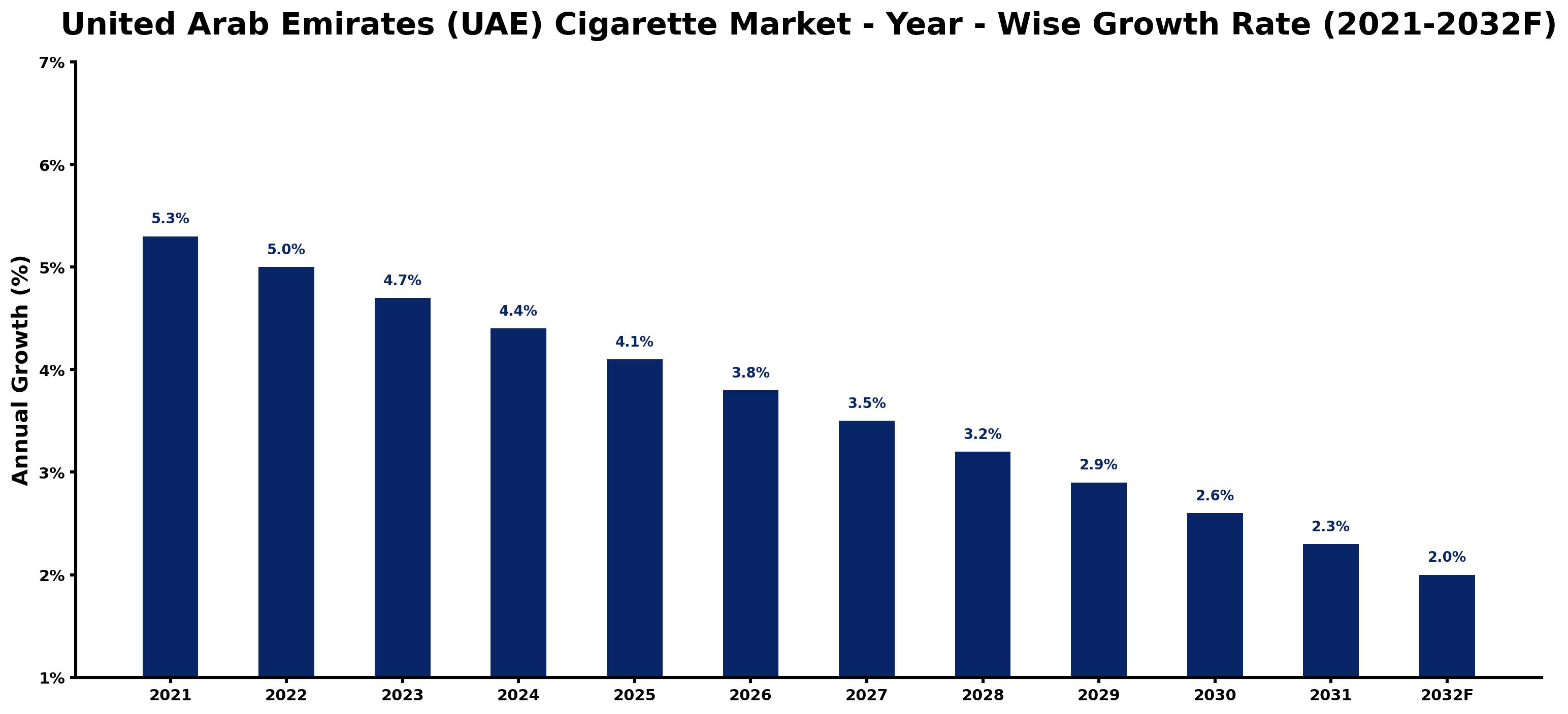
The table below presents the year‑wise growth rates along with the key drivers influencing the market
| Year | Growth Rate | Major Drivers |
| 2021 | 5.3% | Rapid growth in telecom and data center sectors |
| 2022 | 5.0% | Growing renewable energy integration projects |
| 2023 | 4.7% | Increasing smart city development projects |
| 2024 | 4.4% | Expansion of commercial construction activities |
| 2025 | 4.1% | Expansion of manufacturing activities |
| 2026 | 3.8% | Increasing shift toward cleaner alternatives |
| 2027 | 3.5% | Growing adoption of energy efficient systems |
| 2028 | 3.2% | Technology transition toward sustainable alternatives |
| 2029 | 2.9% | Increasing shift toward cleaner alternatives |
| 2030 | 2.6% | Declining investments in legacy infrastructure |
| 2031 | 2.3% | Declining investments in legacy infrastructure |
| 2032 | 2.0% | Environmental regulations reducing traditional demand |
Note - Market size estimations and growth projections presented in this report are based on 6Wresearch's advanced forecasting approach, validated with industry datasets as of June 2026.
United Arab Emirates (UAE) Cigarette Market Synopsis
The UAE cigarette market remains one of the most significant segments of the broader tobacco industry, driven by a unique blend of local and international preferences. Notably, the strong presence of expatriates enriches the market, introducing various smoking cultures and habits that continually influence purchasing patterns.
Furthermore, the market is bolstered by the tourism sector, where visitors often partake in local smoking habits. Despite ongoing regulatory efforts to reduce smoking rates, the combined effects of cultural diversity and tourism-related demand continue to support the growth of cigarette sales across the Emirates.
United Arab Emirates (UAE) Cigarette Market Key Takeaways
- The market is projected to experience steady growth, reaching USD 308 Million by 2032.
- A strong expatriate population significantly influences smoking preferences and consumption patterns.
- Tourism plays a pivotal role in maintaining cigarette sales, especially in urban centers.
- Regulatory measures aimed at reducing smoking have yet to fully dampen market demand.
- The tobacco industry continues to adapt with innovative marketing strategies and product lines.
Evaluation of Restraints in United Arab Emirates (UAE) Cigarette Market
The cigarette market in the UAE is facing substantial restraints, particularly stemming from rigorous public health initiatives. The government has placed increased taxes on tobacco products, which not only raises costs for consumers but also pushes many towards smoking cessation. Additional public smoking bans and comprehensive health warnings on packaging further contribute to a challenging environment for cigarette sales. These measures, while vital for public health, inevitably create headwinds for market growth.
United Arab Emirates (UAE) Cigarette Market Trends
Emerging trends in the UAE cigarette market reflect an evolving consumer landscape. There is a noticeable shift towards premium cigarette brands as consumers show a willingness to invest in higher-quality products. Furthermore, the introduction of alternative tobacco products, such as heated tobacco and electronic cigarettes, is gaining traction among younger demographics, signaling a potential shift in consumption patterns. Sustainability and health consciousness are increasingly shaping product development and marketing strategies within the industry.
United Arab Emirates (UAE) Cigarette Market Opportunities
Growth opportunities within the UAE cigarette market are manifold. The increasing demand for premium and specialty cigarette brands is inviting investments in product innovation and marketing. Moreover, as the regulatory landscape evolves, companies that adapt quickly to new compliance standards can gain a competitive advantage. There is also potential for market expansion through strategic partnerships with tourism entities, ensuring that transient populations have consistent access to a wide variety of products.
Government Initiatives in the United Arab Emirates (UAE) Cigarette Market
The UAE government has enacted numerous initiatives aimed at curbing smoking prevalence among its population. Key policies include increased taxation on tobacco products, comprehensive smoking bans in public areas, and mandatory health warnings on cigarette packages. Furthermore, ongoing public health campaigns are designed to raise awareness about the dangers of smoking, thereby fostering a healthier environment. These initiatives reflect the government's commitment to reducing tobacco consumption while balancing the economic contributions of the tobacco industry.
Future Insights of the United Arab Emirates (UAE) Cigarette Market
Looking ahead, the UAE cigarette market is likely to navigate a complex interplay of regulatory pressures and evolving consumer preferences. As the demand for premium products increases, brands that successfully innovate will thrive. The anticipated growth of alternative tobacco products could further shift the market dynamics, inviting both new players and established companies to explore these segments. A continued focus on sustainability and health consciousness among consumers will shape strategies going forward, necessitating a proactive approach to product development and marketing.
United Arab Emirates (UAE) Cigarette Market Latest Developments (May 2025 - June 2026)
Recent developments in the UAE cigarette market indicate a strategic shift towards health-oriented product offerings, with companies increasingly investing in research to meet emerging consumer preferences. Regulatory discussions are also underway, focusing on potential changes in taxation and public health initiatives. Innovations in product packaging and the introduction of digital marketing campaigns signify a robust response to the changing landscape, highlighting the industry's resilience in adapting to both challenges and opportunities.
United Arab Emirates (UAE) Cigarette Market - Key Attractiveness of the Report
- 10 Years of Market Numbers
- Historical Data Starting from 2022 to 2025
- Base Year: 2025
- Forecast Data until 2032
- Key Performance Indicators Impacting the Market
- Major Upcoming Developments and Projects
Key Highlights of the Report:
- United Arab Emirates (UAE) Cigarette? Market Outlook
- Market Size of United Arab Emirates (UAE) Cigarette? Market, 2025
- Forecast of United Arab Emirates (UAE) Cigarette? Market, 2032
- Historical Data and Forecast of United Arab Emirates (UAE) Cigarette? Revenues & Volume for the Period 2022-2032F
- United Arab Emirates (UAE) Cigarette? Market Trend Evolution
- United Arab Emirates (UAE) Cigarette? Market Drivers and Challenges
- United Arab Emirates (UAE) Cigarette? Price Trends
- United Arab Emirates (UAE) Cigarette? Porter's Five Forces
- United Arab Emirates (UAE) Cigarette? Industry Life Cycle
- Historical Data and Forecast of United Arab Emirates (UAE) Cigarette? Market Revenues & Volume By Type for the Period 2022-2032F
- Historical Data and Forecast of United Arab Emirates (UAE) Cigarette? Market Revenues & Volume By Light for the Period 2022-2032F
- Historical Data and Forecast of United Arab Emirates (UAE) Cigarette? Market Revenues & Volume By Medium for the Period 2022-2032F
- Historical Data and Forecast of United Arab Emirates (UAE) Cigarette? Market Revenues & Volume By Others for the Period 2022-2032F
- Historical Data and Forecast of United Arab Emirates (UAE) Cigarette? Market Revenues & Volume By Distribution Channel for the Period 2022-2032F
- Historical Data and Forecast of United Arab Emirates (UAE) Cigarette? Market Revenues & Volume By Tobacco Shops for the Period 2022-2032F
- Historical Data and Forecast of United Arab Emirates (UAE) Cigarette? Market Revenues & Volume By Supermarket and Hypermarkets for the Period 2022-2032F
- Historical Data and Forecast of United Arab Emirates (UAE) Cigarette? Market Revenues & Volume By Convenience Stores for the Period 2022-2032F
- Historical Data and Forecast of United Arab Emirates (UAE) Cigarette? Market Revenues & Volume By Online Stores for the Period 2022-2032F
- Historical Data and Forecast of United Arab Emirates (UAE) Cigarette? Market Revenues & Volume By Others for the Period 2022-2032F
- United Arab Emirates (UAE) Cigarette? Import Export Trade Statistics
- Market Opportunity Assessment By Type
- Market Opportunity Assessment By Distribution Channel
- United Arab Emirates (UAE) Cigarette? Top Companies Market Share
- United Arab Emirates (UAE) Cigarette? Competitive Benchmarking By Technical and Operational Parameters
- United Arab Emirates (UAE) Cigarette? Company Profiles
- United Arab Emirates (UAE) Cigarette? Key Strategic Recommendations






































