Egypt Facade Market Size, Share & Growth Rate
The Egypt Facade Market was estimated at USD 473 Million in 2025 and is projected to reach USD 667 Million by 2032, growing at a CAGR of 5.0% from 2026 to 2032. This growth trajectory is significantly influenced by the increasing urbanization and construction activities in residential, commercial, and industrial sectors. Additionally, the rising demand for energy-efficient and aesthetically appealing building facades is pushing stakeholders to adopt innovative facade solutions, thereby reshaping the market landscape.
Egypt Facade Market Year-wise Growth Rate and Key Drivers
This graph highlights how the Egypt Facade Market has steadily grown over the years, supported by major growth factors.
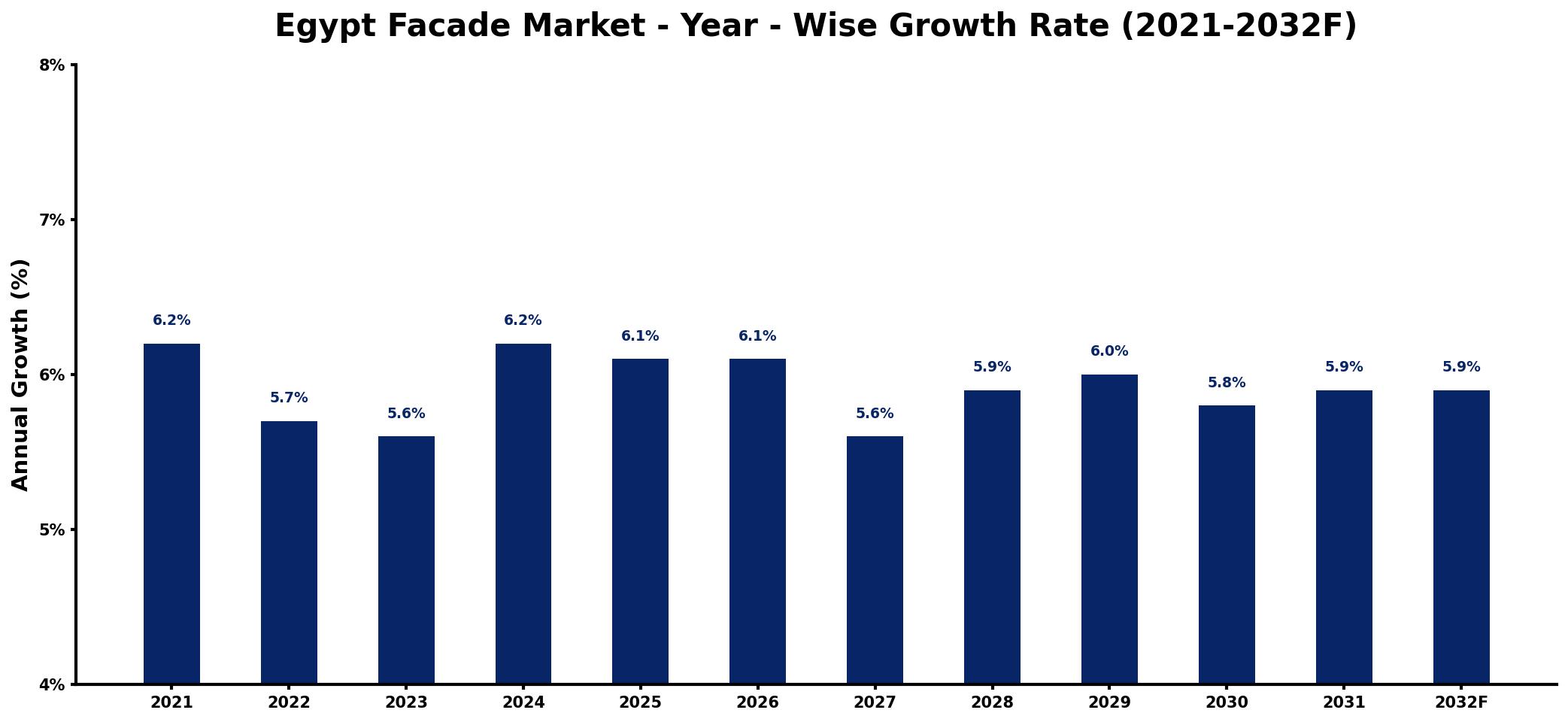
The table below presents the year‑wise growth rates along with the key drivers influencing the market
| Year | Growth Rate | Major Drivers |
| 2021 | 6.2% | Rising construction project investments |
| 2022 | 5.7% | Increased urbanization and infrastructure |
| 2023 | 5.6% | Growing demand for aesthetic designs |
| 2024 | 6.2% | Expansion of commercial real estate |
| 2025 | 6.1% | Boost in sustainable building practices |
| 2026 | 6.1% | Technological advancements in materials |
| 2027 | 5.6% | Surge in renovation and refurbishment |
| 2028 | 5.9% | Growth in tourism and hospitality |
| 2029 | 6.0% | Increased focus on energy efficiency |
| 2030 | 5.8% | Rising consumer preference for customization |
| 2031 | 5.9% | increased capital investment inflows |
| 2032 | 5.9% | Growing investment in smart buildings |
Note: Market size estimations and growth projections presented in this report are based on 6Wresearch's proprietary forecasting methodology, utilizing the latest available industry data, government publications, and primary research inputs.
Egypt Facade Market Synopsis
The most significant force shaping the Egypt Facade Market today is the escalating demand for sustainable building solutions. As both developers and architects prioritize energy efficiency and environmental responsibility, the adoption of modern materials such as insulated glass and high-performance coatings is surging, driving the overall market forward.
In parallel, the growth of construction activities across Egypt is accelerating the deployment of advanced facade technologies. The emergence of innovative designs, such as green walls and digital facades, reflects a shift towards a more integrated approach that merges aesthetics with functionality, thus catering to the evolving preferences of stakeholders in the construction industry.
Egypt Facade Market Key Takeaways
- The market is experiencing robust growth fueled by urbanization and increased construction projects.
- Sustainability and energy efficiency are now core considerations in facade design and material selection.
- Digital technologies are becoming essential tools for modern facade design and project execution.
- The competitive landscape includes both local and international players, enhancing product diversity.
- Investment opportunities abound in the manufacturing and supply of advanced facade materials and solutions.
Evaluation of Restraints in Egypt Facade Market
Despite its potential, the Egypt Facade Market is confronted by several restraints that could hinder growth. A major challenge is the inconsistent regulatory environment, which complicates project planning and execution. Additionally, the limited availability of skilled labor in the facade industry affects the quality and timelines of projects. Fluctuating raw material costs, particularly for imported items, also pose risks to project budgets and profitability. Addressing these issues will require collaboration among industry stakeholders to establish clear standards and improve workforce training.
Egypt Facade Market Trends
Current trends in the Egypt Facade Market showcase an increasing emphasis on energy-efficient and eco-friendly materials. Innovations such as solar shading systems and high-performance insulation are gaining traction among developers. Moreover, the integration of green elements, like vertical gardens, is becoming popular as a means to enhance aesthetic appeal while contributing to environmental sustainability. The market is also seeing a rise in digital tools, including Building Information Modeling (BIM) software, that facilitate improved design processes and project management.
Egypt Facade Market Opportunities
The Egypt Facade Market presents a multitude of growth and investment opportunities, particularly as the country focuses on infrastructure development and urbanization. Key areas for investment include the production and supply of innovative facade materials, such as aluminum and composite panels, and specialized services related to facade design and installation. The ongoing push towards green building practices further enhances the appeal for stakeholders interested in eco-friendly facade solutions.
Government Initiatives in the Egypt Facade Market
The Egyptian government is actively engaged in initiatives aimed at regulating the facade market to ensure building safety and aesthetic standards. Policies like the Construction Law No. 119 of 2008 necessitate that developers obtain permits for facade projects, specifying technical guidelines for construction. Furthermore, the Facade Improvement Program incentivizes property owners to enhance building aesthetics through financial support. These efforts are designed to bolster urban development and promote a visually appealing environment across the country.
Future Insights of the Egypt Facade Market
Looking ahead to 2026-2032, the Egypt Facade Market is poised for continued growth, driven by rapid urbanization and escalating construction activity. The government's focus on promoting sustainable infrastructure and the increasing demand for energy-efficient solutions will further propel this market segment. Advances in smart facade technologies are anticipated to play a crucial role in shaping the future landscape, ensuring that the market evolves in line with international trends and local needs.
Egypt Facade Market Latest Developments (2025 - 2026)
Recent developments in the Egypt Facade Market indicate a strong shift towards sustainability and digital transformation. Industry players are increasingly investing in research and development to innovate more eco-friendly materials and facade systems. There is also a noticeable trend towards collaborating with technology providers to integrate digital design tools in facade construction, enhancing overall project efficiency and design capabilities.
Egypt Facade Market - Key Attractiveness of the Report
- 10 Years of Market Numbers
- Historical Data Starting from 2022 to 2025
- Base Year: 2025
- Forecast Data until 2032
- Key Performance Indicators Impacting the Market
- Major Upcoming Developments and Projects
Key Highlights of the Report:
- Egypt Facade Market Outlook
- Market Size of Egypt Facade Market, 2025
- Forecast of Egypt Facade Market, 2032
- Historical Data and Forecast of Egypt Facade Revenues & Volume for the Period 2022-2032F
- Egypt Facade Market Trend Evolution
- Egypt Facade Market Drivers and Challenges
- Egypt Facade Price Trends
- Egypt Facade Porter's Five Forces
- Egypt Facade Industry Life Cycle
- Historical Data and Forecast of Egypt Facade Market Revenues & Volume By Product for the Period 2022-2032F
- Historical Data and Forecast of Egypt Facade Market Revenues & Volume By Ventilated Facades for the Period 2022-2032F
- Historical Data and Forecast of Egypt Facade Market Revenues & Volume By Non-ventilated Facades for the Period 2022-2032F
- Historical Data and Forecast of Egypt Facade Market Revenues & Volume By Others for the Period 2022-2032F
- Historical Data and Forecast of Egypt Facade Market Revenues & Volume By End-use for the Period 2022-2032F
- Historical Data and Forecast of Egypt Facade Market Revenues & Volume By Commercial for the Period 2022-2032F
- Historical Data and Forecast of Egypt Facade Market Revenues & Volume By Residential for the Period 2022-2032F
- Historical Data and Forecast of Egypt Facade Market Revenues & Volume By Industrial for the Period 2022-2032F
- Egypt Facade Import Export Trade Statistics
- Market Opportunity Assessment By Product
- Market Opportunity Assessment By End-use
- Egypt Facade Top Companies Market Share
- Egypt Facade Competitive Benchmarking By Technical and Operational Parameters
- Egypt Facade Company Profiles
- Egypt Facade Key Strategic Recommendations






































