Global Facade Market Highlights
| Market Size (2025) | USD 85 Billion |
| Forecast Size (2032) | USD 140 Billion |
| CAGR | 5.30% |
| Base Year | 2025 |
| Forecast Period | 2026-2032 |
| Largest Region | Asia-Pacific |
| Fastest Growing Region | Middle East |
| Largest Segment | Ventilated Facades |
| Fastest Growing Segment | Non-ventilated Facades |
| Leading Companies | Saint-Gobain, Kingspan Group, Alumil, Schüco International, and CRH plc |
Global Facade Market Size & Growth Rate (2026-2032)
The Global Facade Market was estimated at USD 85 Billion in 2025 and is projected to reach USD 140 Billion by 2032, growing at a CAGR of 5.30% from 2026 to 2032.
Global Facade Market Synopsis
The Global Facade Market is currently undergoing a transformation driven by increasing construction activities, particularly in urban centers. A notable shift towards energy-efficient solutions is reshaping design strategies, aligning with stringent regulatory frameworks focusing on sustainability and environmental impact.
In parallel, the emergence of advanced facade materials, including high-performance glass and smart technologies, positions the market at the nexus of architectural innovation. Such transformations not only enhance aesthetic appeal but also boost energy efficiency, catering to the evolving demands of modern architecture.
Global Facade Market Year-wise Growth Rate and Key Drivers
This graph illustrates the annual growth rates of the Global Facade Market from 2022 to 2032, highlighting a steady upward trajectory and projected expansion over the forecast period.
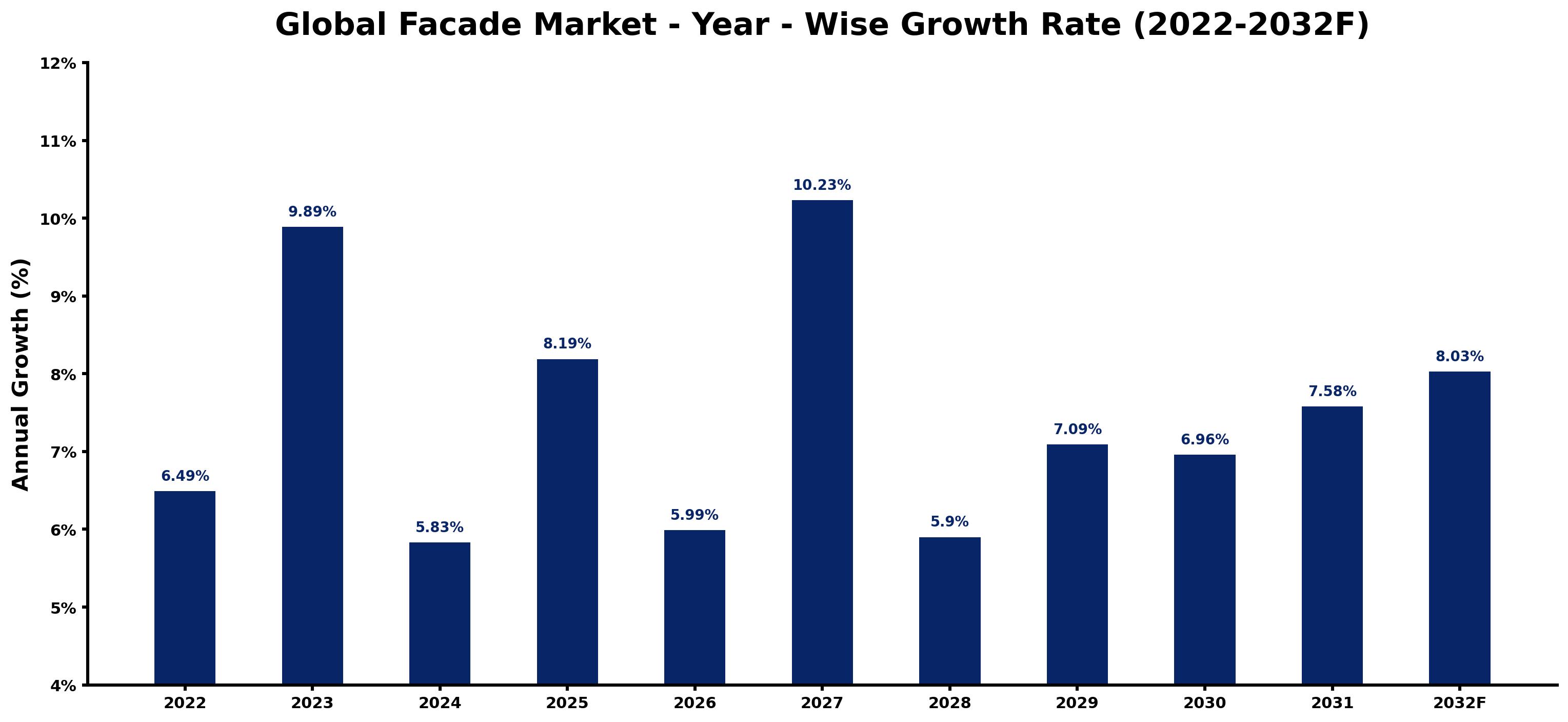
The table below presents the year‑wise growth rates along with the key drivers influencing the market
| Year | Growth Rate (%) | Major Drivers |
| 2022 | 6.49 | Increasing costs of raw materials led to higher facade construction expenses. |
| 2023 | 9.89 | Regional contractors expanded operations, elevating construction of new facade projects. |
| 2024 | 5.83 | Manufacturers prioritized sustainability initiatives, influencing facade design practices significantly. |
| 2025 | 8.19 | Building codes related to energy efficiency prompted updates in the facade technology. |
| 2026 | 5.99 | Commercial developers increasingly sought energy-efficient facades to meet consumer preferences. |
| 2027 | 10.23 | As urbanization accelerates, demand for innovative facade solutions intensifies significantly. |
| 2028 | 5.9 | In Europe, workforce skill advancements are improving facade construction methodologies. |
| 2029 | 7.09 | Strategic mergers and acquisitions among facade suppliers are enhancing competitive capabilities. |
| 2030 | 6.96 | A competitive shift towards eco-friendly materials reshapes facade offerings in the industry. |
| 2031 | 7.58 | Integrating advanced material handling systems streamlines facade production processes effectively. |
| 2032 | 8.03 | A transition to smart facade technologies enhances energy efficiency and sustainability outcomes. |
Note - Market size estimations and growth projections presented in this report are based on 6Wresearch's proprietary research methodology, combining internal industry data, secondary research, and primary validation, updated periodically to reflect current market conditions. As markets evolve rapidly, figures for certain industries may vary slightly and are intended as informed estimates rather than absolute figures. For the most current market sizing, we recommend validating figures with a 6Wresearch analyst.
Global Facade Market Key Takeaways
Below are some of the specific key takeaways from the market, including:
- Asia-Pacific commanded approximately ~50% share in the global facade market in 2025, emphasizing its dominance in urban construction.
- Non-ventilated Facades are projected to grow at a CAGR of 6.2% from 2026 to 2032, reflecting their increasing preference for aesthetic flexibility.
- The renovation segment is estimated to contribute over USD 1 trillion by 2028, highlighting the potential for facade upgrades in existing buildings.
- Leading players such as Saint-Gobain reported revenues exceeding USD 45 billion in 2025, underscoring strong market competitiveness.
Evaluation of Restraints in Global Facade Market
One of the foremost challenges in the Global Facade Market is the cost escalation of raw materials, exacerbated by fluctuations in supply chains. In 2021, the cost of aluminum rose by approximately 40%, directly impacting manufacturing costs. For example, manufacturers must navigate rising expenses to maintain profitability while complying with sustainability standards, such as the LEED certification, which increasingly focus on environmental impact and energy efficiency.
Global Facade Market Trends
Several core trends are shaping the operational dynamics of the Global Facade Market. First, the adoption of smart facades is gaining traction. For instance, in 2023, the implementation of smart glass technologies by markets like the commercial sector increased energy efficiency by up to 30% during peak hours. Emerging technologies, such as building-integrated photovoltaics, are becoming prevalent as building designs evolve.
Additionally, the push for sustainability is leading to an uptick in façade materials sourced from recycled content by manufacturers like Kingspan Group, which reported a 25% use of recycled materials in recent projects. This trend facilitates compliance with green building certifications while augmenting market demand for innovative solutions. Moreover, there is a significant move toward prefabricated facade systems that reduce construction time and lower labor costs, further enhancing operational efficiency.
Global Facade Market Opportunities
The future presents distinct revenue opportunities within the Global Facade Market, especially in the arena of renewable energy integration. For example, projects like the Solar Building in New York demonstrate how photovoltaic-integrated facades not only serve aesthetic functions but also generate energy, creating dual-value propositions for developers.
Further, retrofitting opportunities for aging commercial buildings could see a market influx of over USD 600 billion by 2030, further buoyed by government incentives aimed at energy efficiency. Many building owners are beginning to recognize the financial viability of upgrades that enhance building performance and reduce operating costs, creating an attractive landscape for innovative facade technologies.
Global Facade Market by Product
In the Global Facade Market, Ventilated Facades hold the largest share, accounting for approximately ~47% share in 2025, driven by their effective thermal performance and aesthetic versatility. Conversely, Non-ventilated Facades emerge as the fastest-growing segment, with a projected CAGR of 6.5% from 2026 to 2032. This growth is attributed to their ability to meet diverse architectural preferences while also addressing energy efficiency, marking them as a preferred choice in both new construction and renovation projects.
Global Facade Market by End-use
In the Global Facade Market, the Commercial sector leads with approximately ~58% share in 2025, reflecting strong demand driven by new office buildings and commercial spaces. The Industrial segment, on the other hand, is expected to exhibit the fastest growth, with a CAGR of 6.0% from 2026 to 2032, spurred by increased investment in manufacturing facilities that prioritize high-performance facades to enhance operational efficiency and reduce energy costs.
Global Facade Market by Region
Asia-Pacific is the largest region in the Global Facade Market, commanding around ~50% share in 2025, largely due to rapid urbanization and infrastructure development. In contrast, the Middle East is projected to be the fastest-growing region, with a CAGR of 7.0% from 2026 to 2032, fueled by ambitious building projects and significant investments in smart city initiatives aimed at modernizing urban landscapes.
Government Initiatives in the Global Facade Market
The regulatory landscape is actively shaping the Global Facade Market, with governments worldwide implementing various initiatives to promote energy efficiency and sustainable building practices. These policies not only influence market dynamics but also encourage innovation within the sector.
- Department of Energy, U.S. - Energy Policy Act of 2020, enacted on December 27, 2020, aims to enhance energy efficiency in buildings, impacting facade designs.
- European Commission - Green Deal for Europe, launched in January 2020, promotes the use of sustainable materials in construction, benefiting companies focusing on energy-efficient facades.
- Ministry of Housing and Urban Affairs, India - Energy Conservation Building Code (ECBC) 2017, aims to improve energy efficiency in new buildings, influencing facade materials.
- National Development and Reform Commission, China - 14th Five-Year Plan for Economic and Social Development (2021-2025), prioritizes sustainable urban development and energy efficiency, notably affecting facade development standards.
Future Insights of the Global Facade Market
As the Global Facade Market evolves, a notable trend will be the integration of smart technologies into facade designs. A prime example is the Solar Building project in New York, where photovoltaic-integrated facades not only enhance the architectural aesthetic but also produce energy. This dual functionality will likely become central to the product offerings of major players. Investments in advanced materials and energy-efficient solutions will drive significant shifts in competitive behavior, urging manufacturers to innovate continuously, thus positioning them for success in a market poised for structural transformation through 2032.
Global Facade Market Latest Developments
Recent advancements by key players illustrate their commitment to meeting contemporary challenges in the Global Facade Market. The following developments highlight strategic shifts within the industry:
- In early 2023, Kingspan Group announced plans for a major expansion of its manufacturing facilities in Europe, aimed at increasing production capacity for insulated facade systems, enhancing operational efficiency.
- In mid-2023, Schüco International launched a new range of modular facade systems designed for rapid assembly, significantly reducing installation time and labor costs, which could lead to broader market adoption.
- As of late 2023, CRH plc invested in innovative research collaborations focusing on sustainable materials, which enables the company to leverage evolving regulatory frameworks and increase its competitive edge.
- In early 2024, Saint-Gobain unveiled a line of smart glass products that adapt to changing light conditions, enhancing energy efficiency and supporting global sustainability goals through improved building management systems.
Global Facade Market Key Players and Industry Positioning
The competitive structure of the Global Facade Market is moderately consolidated, with several leading companies significantly influencing market trends. These players leverage their extensive experience, technological advantages, and robust supply chains to enhance their market positions while also adapting to emerging consumer demands for sustainability and efficiency.
| Leading Company | Core Strength | Strategic Focus |
|---|---|---|
| Saint-Gobain | Strong R&D capabilities in sustainable building materials. | Focus on energy-efficient and smart facade solutions. |
| Kingspan Group | Expertise in insulation technology and modular systems. | Expansion in eco-friendly building materials. |
| Alumil | Leading manufacturer of aluminum systems for facades. | Emphasis on custom and high-performance facade designs. |
| Schüco International | Specializes in innovative facade technologies. | Investment in smart facade automation and efficiency. |
| CRH plc | Global leader in construction materials industry. | Focus on expanding sustainable practices across product lines. |
With the competitive landscape shaped by these significant players, continued innovation, and strategic collaborations are expected to emerge, paving the way for enhanced market resilience and growth.
Key Attractiveness of the Report
- 10 Years of Market Numbers
- Historical Data Starting from 2022 to 2025
- Base Year: 2025
- Forecast Data until 2032
- Key Performance Indicators Impacting the Market
- Major Upcoming Developments and Projects
Key Highlights of the Report:
- Global Facade Market Outlook
- Market Size of Global Facade Market, 2025
- Forecast of Global Facade Market, 2032
- Historical Data and Forecast of Global Facade Revenues & Volume for the Period 2022-2032
- Global Facade Market Trend Evolution
- Global Facade Market Drivers and Challenges
- Global Facade Price Trends
- Global Facade Porter's Five Forces
- Global Facade Industry Life Cycle
- Historical Data and Forecast of Global Facade Market Revenues & Volume
- Historical Data and Forecast of Global Facade Market Revenues & Volume By Product for the Period 2022-2032
- Historical Data and Forecast of Global Facade Market Revenues & Volume By Ventilated Facades for the Period 2022-2032
- Historical Data and Forecast of Global Facade Market Revenues & Volume By Non-ventilated Facades for the Period 2022-2032
- Historical Data and Forecast of Global Facade Market Revenues & Volume By Others for the Period 2022-2032
- Historical Data and Forecast of Global Facade Market Revenues & Volume By End-use for the Period 2022-2032
- Historical Data and Forecast of Global Facade Market Revenues & Volume By Commercial for the Period 2022-2032
- Historical Data and Forecast of Global Facade Market Revenues & Volume By Residential for the Period 2022-2032
- Historical Data and Forecast of Global Facade Market Revenues & Volume By Industrial for the Period 2022-2032
- Historical Data and Forecast of North America Facade Market Revenues & Volume By Product for the Period 2022-2032
- Historical Data and Forecast of North America Facade Market Revenues & Volume By Ventilated Facades for the Period 2022-2032
- Historical Data and Forecast of North America Facade Market Revenues & Volume By Non-ventilated Facades for the Period 2022-2032
- Historical Data and Forecast of North America Facade Market Revenues & Volume By Others for the Period 2022-2032
- Historical Data and Forecast of North America Facade Market Revenues & Volume By End-use for the Period 2022-2032
- Historical Data and Forecast of North America Facade Market Revenues & Volume By Commercial for the Period 2022-2032
- Historical Data and Forecast of North America Facade Market Revenues & Volume By Residential for the Period 2022-2032
- Historical Data and Forecast of North America Facade Market Revenues & Volume By Industrial for the Period 2022-2032
- Historical Data and Forecast of United States of America Facade Market Revenues & Volume for the Period 2022-2032
- Historical Data and Forecast of Canada Facade Market Revenues & Volume for the Period 2022-2032
- Historical Data and Forecast of Rest of North America Facade Market Revenues & Volume for the Period 2022-2032
- Historical Data and Forecast of Latin America (LATAM) Facade Market Revenues & Volume By Product for the Period 2022-2032
- Historical Data and Forecast of Latin America (LATAM) Facade Market Revenues & Volume By Ventilated Facades for the Period 2022-2032
- Historical Data and Forecast of Latin America (LATAM) Facade Market Revenues & Volume By Non-ventilated Facades for the Period 2022-2032
- Historical Data and Forecast of Latin America (LATAM) Facade Market Revenues & Volume By Others for the Period 2022-2032
- Historical Data and Forecast of Latin America (LATAM) Facade Market Revenues & Volume By End-use for the Period 2022-2032
- Historical Data and Forecast of Latin America (LATAM) Facade Market Revenues & Volume By Commercial for the Period 2022-2032
- Historical Data and Forecast of Latin America (LATAM) Facade Market Revenues & Volume By Residential for the Period 2022-2032
- Historical Data and Forecast of Latin America (LATAM) Facade Market Revenues & Volume By Industrial for the Period 2022-2032
- Historical Data and Forecast of Brazil Facade Market Revenues & Volume for the Period 2022-2032
- Historical Data and Forecast of Mexico Facade Market Revenues & Volume for the Period 2022-2032
- Historical Data and Forecast of Argentina Facade Market Revenues & Volume for the Period 2022-2032
- Historical Data and Forecast of Rest of LATAM Facade Market Revenues & Volume for the Period 2022-2032
- Historical Data and Forecast of Asia Facade Market Revenues & Volume By Product for the Period 2022-2032
- Historical Data and Forecast of Asia Facade Market Revenues & Volume By Ventilated Facades for the Period 2022-2032
- Historical Data and Forecast of Asia Facade Market Revenues & Volume By Non-ventilated Facades for the Period 2022-2032
- Historical Data and Forecast of Asia Facade Market Revenues & Volume By Others for the Period 2022-2032
- Historical Data and Forecast of Asia Facade Market Revenues & Volume By End-use for the Period 2022-2032
- Historical Data and Forecast of Asia Facade Market Revenues & Volume By Commercial for the Period 2022-2032
- Historical Data and Forecast of Asia Facade Market Revenues & Volume By Residential for the Period 2022-2032
- Historical Data and Forecast of Asia Facade Market Revenues & Volume By Industrial for the Period 2022-2032
- Historical Data and Forecast of China Facade Market Revenues & Volume for the Period 2022-2032
- Historical Data and Forecast of India Facade Market Revenues & Volume for the Period 2022-2032
- Historical Data and Forecast of Japan Facade Market Revenues & Volume for the Period 2022-2032
- Historical Data and Forecast of Rest of Asia Facade Market Revenues & Volume for the Period 2022-2032
- Historical Data and Forecast of Africa Facade Market Revenues & Volume By Product for the Period 2022-2032
- Historical Data and Forecast of Africa Facade Market Revenues & Volume By Ventilated Facades for the Period 2022-2032
- Historical Data and Forecast of Africa Facade Market Revenues & Volume By Non-ventilated Facades for the Period 2022-2032
- Historical Data and Forecast of Africa Facade Market Revenues & Volume By Others for the Period 2022-2032
- Historical Data and Forecast of Africa Facade Market Revenues & Volume By End-use for the Period 2022-2032
- Historical Data and Forecast of Africa Facade Market Revenues & Volume By Commercial for the Period 2022-2032
- Historical Data and Forecast of Africa Facade Market Revenues & Volume By Residential for the Period 2022-2032
- Historical Data and Forecast of Africa Facade Market Revenues & Volume By Industrial for the Period 2022-2032
- Historical Data and Forecast of South Africa Facade Market Revenues & Volume for the Period 2022-2032
- Historical Data and Forecast of Nigeria Facade Market Revenues & Volume for the Period 2022-2032
- Historical Data and Forecast of Egypt Facade Market Revenues & Volume for the Period 2022-2032
- Historical Data and Forecast of Rest of Africa Facade Market Revenues & Volume for the Period 2022-2032
- Historical Data and Forecast of Europe Facade Market Revenues & Volume By Product for the Period 2022-2032
- Historical Data and Forecast of Europe Facade Market Revenues & Volume By Ventilated Facades for the Period 2022-2032
- Historical Data and Forecast of Europe Facade Market Revenues & Volume By Non-ventilated Facades for the Period 2022-2032
- Historical Data and Forecast of Europe Facade Market Revenues & Volume By Others for the Period 2022-2032
- Historical Data and Forecast of Europe Facade Market Revenues & Volume By End-use for the Period 2022-2032
- Historical Data and Forecast of Europe Facade Market Revenues & Volume By Commercial for the Period 2022-2032
- Historical Data and Forecast of Europe Facade Market Revenues & Volume By Residential for the Period 2022-2032
- Historical Data and Forecast of Europe Facade Market Revenues & Volume By Industrial for the Period 2022-2032
- Historical Data and Forecast of United Kingdom Facade Market Revenues & Volume for the Period 2022-2032
- Historical Data and Forecast of France Facade Market Revenues & Volume for the Period 2022-2032
- Historical Data and Forecast of Germany Facade Market Revenues & Volume for the Period 2022-2032
- Historical Data and Forecast of Rest of Europe Facade Market Revenues & Volume for the Period 2022-2032
- Historical Data and Forecast of Middle East Facade Market Revenues & Volume By Product for the Period 2022-2032
- Historical Data and Forecast of Middle East Facade Market Revenues & Volume By Ventilated Facades for the Period 2022-2032
- Historical Data and Forecast of Middle East Facade Market Revenues & Volume By Non-ventilated Facades for the Period 2022-2032
- Historical Data and Forecast of Middle East Facade Market Revenues & Volume By Others for the Period 2022-2032
- Historical Data and Forecast of Middle East Facade Market Revenues & Volume By End-use for the Period 2022-2032
- Historical Data and Forecast of Middle East Facade Market Revenues & Volume By Commercial for the Period 2022-2032
- Historical Data and Forecast of Middle East Facade Market Revenues & Volume By Residential for the Period 2022-2032
- Historical Data and Forecast of Middle East Facade Market Revenues & Volume By Industrial for the Period 2022-2032
- Historical Data and Forecast of Saudi Arabia Facade Market Revenues & Volume for the Period 2022-2032
- Historical Data and Forecast of UAE Facade Market Revenues & Volume for the Period 2022-2032
- Historical Data and Forecast of Turkey Facade Market Revenues & Volume for the Period 2022-2032
- Historical Data and Forecast of Rest of Middle East Facade Market Revenues & Volume for the Period 2022-2032
- Global Facade Market - Key Performance Indicators
- Global Facade Market - Import Export Trade Statistics
- Global Facade Market - Opportunity Assessment By Countries
- Global Facade Market - Opportunity Assessment By Product
- Global Facade Market - Opportunity Assessment By End-use
- Global Facade Market - Top Companies Market Share
- Global Facade Market - Top Companies Profiles
- Global Facade Market - Comparison of Players in Technical and Operating Parameters
- Global Facade Market - Strategic Recommendations
Markets Covered
The Global Facade Market report provides a detailed analysis of the following market segments:
By Regions and Countries:
- North America
- Europe
- LATAM
- Middle East
- Asia
- Africa
By Product:
- Ventilated Facades
- Non-ventilated Facades
- Others
By End-use:
- Commercial
- Residential
- Industrial






































