Egypt Fruit Pulp Market Size, Share & Growth Rate
The Egypt Fruit Pulp Market was estimated at USD 449 Million in 2025 and is projected to reach USD 596 Million by 2032, growing at a CAGR of 4.1% from 2026 to 2032. This upward trajectory is primarily driven by the increasing consumer inclination toward natural and minimally processed ingredients. With a growing health-conscious population, the demand for fruit-based products like juices and desserts is set to rise, making the market a focal point for food and beverage manufacturers in Egypt.
Egypt Fruit Pulp Market Year-wise Growth Rate and Key Drivers
This graph highlights how the Egypt Fruit Pulp Market has steadily grown over the years, supported by major growth factors.
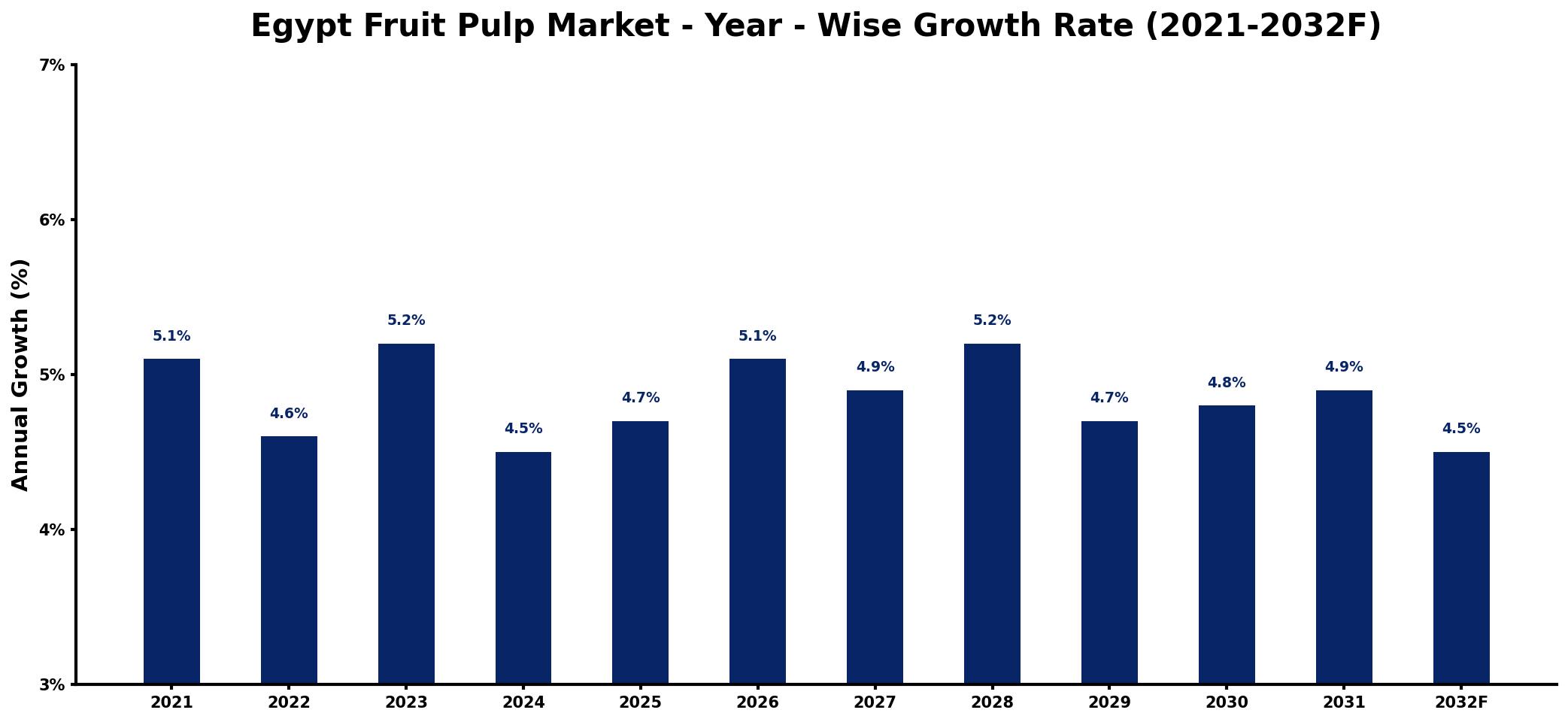
The table below presents the year‑wise growth rates along with the key drivers influencing the market
| Year | Growth Rate | Major Drivers |
| 2021 | 5.1% | Rising health consciousness among consumers |
| 2022 | 4.6% | Increased investment in processing facilities |
| 2023 | 5.2% | Growing popularity of natural ingredients |
| 2024 | 4.5% | Expansion of distribution networks |
| 2025 | 4.7% | Higher demand for organic options |
| 2026 | 5.1% | Emergence of new beverage trends |
| 2027 | 4.9% | Strengthening export opportunities globally |
| 2028 | 5.2% | Surge in online sales channels |
| 2029 | 4.7% | Adoption of sustainable packaging solutions |
| 2030 | 4.8% | Innovations in product formulations |
| 2031 | 4.9% | Increased collaboration with retailers |
| 2032 | 4.5% | Diversification of product offerings |
Note: Market size estimations and growth projections presented in this report are based on 6Wresearch's proprietary forecasting methodology, utilizing the latest available industry data, government publications, and primary research inputs.
Egypt Fruit Pulp Market Synopsis
Recent momentum in the Egypt Fruit Pulp Market highlights a positive trend fueled by the agricultural strengths of the country and the shifting consumer preferences toward healthier options. As food and beverage producers increasingly seek natural ingredients, the market is poised for expansion.
Looking forward, however, the market also faces hurdles, such as fluctuating production costs and competition from imports. This duality of momentum and challenges will shape the strategic decisions of stakeholders in the coming years, making ongoing market analysis crucial.
Egypt Fruit Pulp Market Key Takeaways
- The market's estimated growth is supported by a strong agricultural base in Egypt.
- Rising health trends among consumers are driving demand for natural fruit pulp ingredients.
- High production costs and competition from imports are significant challenges to local producers.
- Regulatory policies promote food safety and quality, impacting market dynamics.
- Consumer awareness of fruit pulp applications needs enhancement for sustained growth.
Evaluation of Restraints in Egypt Fruit Pulp Market
Despite its promising growth potential, the Egypt Fruit Pulp Market grapples with notable constraints. High production costs pose a significant barrier for local producers, making it difficult to compete against imported alternatives that often offer lower price points. Additionally, fluctuations in the availability and pricing of raw fruit can lead to inconsistencies in pulp production, affecting overall supply. Consumer awareness about the diverse applications of fruit pulp remains limited, which can restrict broader market acceptance. Regulatory challenges regarding food safety and quality standards add another layer of complexity, making it essential for producers to navigate these hurdles effectively to capitalize on growth opportunities.
Egypt Fruit Pulp Market Trends
The Egypt Fruit Pulp Market is experiencing several noteworthy trends that are reshaping its landscape. The increased adoption of clean label products is driving demand for fruit pulp, as manufacturers strive to meet consumer expectations for transparency and natural ingredients. Additionally, advancements in processing technologies are enhancing the quality and yield of fruit pulp, which is critical for meeting the growing demand in various applications, from beverages to confectionery items. Furthermore, there is a noticeable shift towards sustainable practices, with producers exploring eco-friendly methods of cultivation and processing to appeal to environmentally conscious consumers.
Egypt Fruit Pulp Market Opportunities
Genuine growth opportunities abound in the Egypt Fruit Pulp Market, particularly as demand for innovative product formulations rises. The increasing popularity of plant-based diets is creating a fertile ground for the development of new fruit-based offerings, particularly in the health food sector. Moreover, untapped export markets present significant potential for local producers to diversify their customer base and expand their reach. By investing in consumer education and marketing strategies, companies can elevate the profile of fruit pulp applications, driving broader acceptance and usage across various food and beverage segments.
Government Initiatives in the Egypt Fruit Pulp Market
The Egyptian government plays a pivotal role in fostering the fruit pulp market through various policies aimed at ensuring food safety and quality. Export incentives are designed to bolster local production and encourage international trade, while import tariffs on certain fruits protect domestic producers from foreign competition. Additionally, comprehensive processing standards are in place to maintain high product quality, which not only benefits domestic consumers but also positions Egyptian fruit pulp favorably in global markets.
Future Insights of the Egypt Fruit Pulp Market
Looking ahead to 2026-2032, the Egypt Fruit Pulp Market is set to evolve significantly. As health trends continue to dominate consumer preferences, the demand for natural and high-quality fruit pulp will grow. Innovations in food processing technology will likely enhance production efficiencies, addressing some current challenges while unlocking new possibilities for product development. With strategic government support and an emphasis on sustainability, the market is well-positioned to capitalize on emerging trends and expand its global presence.
Egypt Fruit Pulp Market Latest Developments (2025 - 2026)
Recent developments within the Egypt Fruit Pulp Market indicate a burgeoning interest in sustainable production methods, with several stakeholders prioritizing eco-friendly practices. This shift is partly a response to consumer demand for more responsible sourcing. Additionally, collaborations between local producers and international buyers are on the rise, seeking to enhance market reach and diversify product offerings. Innovations in processing techniques are also being implemented, aimed at improving product quality and operational efficiencies.
Egypt Fruit Pulp Market - Key Attractiveness of the Report
- 10 Years of Market Numbers
- Historical Data Starting from 2022 to 2025
- Base Year: 2025
- Forecast Data until 2032
- Key Performance Indicators Impacting the Market
- Major Upcoming Developments and Projects
Key Highlights of the Report:
- Egypt Fruit Pulp Market Outlook
- Market Size of Egypt Fruit Pulp Market, 2025
- Forecast of Egypt Fruit Pulp Market, 2032
- Historical Data and Forecast of Egypt Fruit Pulp Revenues & Volume for the Period 2022-2032F
- Egypt Fruit Pulp Market Trend Evolution
- Egypt Fruit Pulp Market Drivers and Challenges
- Egypt Fruit Pulp Price Trends
- Egypt Fruit Pulp Porter's Five Forces
- Egypt Fruit Pulp Industry Life Cycle
- Historical Data and Forecast of Egypt Fruit Pulp Market Revenues & Volume By Fruit Type for the Period 2022-2032F
- Historical Data and Forecast of Egypt Fruit Pulp Market Revenues & Volume By Mango for the Period 2022-2032F
- Historical Data and Forecast of Egypt Fruit Pulp Market Revenues & Volume By Strawberry for the Period 2022-2032F
- Historical Data and Forecast of Egypt Fruit Pulp Market Revenues & Volume By Apple for the Period 2022-2032F
- Historical Data and Forecast of Egypt Fruit Pulp Market Revenues & Volume By Guava for the Period 2022-2032F
- Historical Data and Forecast of Egypt Fruit Pulp Market Revenues & Volume By Berries for the Period 2022-2032F
- Historical Data and Forecast of Egypt Fruit Pulp Market Revenues & Volume By Citrus Fruits for the Period 2022-2032F
- Historical Data and Forecast of Egypt Fruit Pulp Market Revenues & Volume By Others for the Period 2022-2032F
- Historical Data and Forecast of Egypt Fruit Pulp Market Revenues & Volume By Form for the Period 2022-2032F
- Historical Data and Forecast of Egypt Fruit Pulp Market Revenues & Volume By Liquid for the Period 2022-2032F
- Historical Data and Forecast of Egypt Fruit Pulp Market Revenues & Volume By Powder for the Period 2022-2032F
- Historical Data and Forecast of Egypt Fruit Pulp Market Revenues & Volume By Application for the Period 2022-2032F
- Historical Data and Forecast of Egypt Fruit Pulp Market Revenues & Volume By Food and Beverages for the Period 2022-2032F
- Historical Data and Forecast of Egypt Fruit Pulp Market Revenues & Volume By Distribution for the Period 2022-2032F
- Historical Data and Forecast of Egypt Fruit Pulp Market Revenues & Volume By E-Commerce for the Period 2022-2032F
- Historical Data and Forecast of Egypt Fruit Pulp Market Revenues & Volume By Convenience Stores for the Period 2022-2032F
- Historical Data and Forecast of Egypt Fruit Pulp Market Revenues & Volume By Supermarkets/Hypermarkets for the Period 2022-2032F
- Historical Data and Forecast of Egypt Fruit Pulp Market Revenues & Volume By Specialty Stores for the Period 2022-2032F
- Historical Data and Forecast of Egypt Fruit Pulp Market Revenues & Volume By Others for the Period 2022-2032F
- Egypt Fruit Pulp Import Export Trade Statistics
- Market Opportunity Assessment By Fruit Type
- Market Opportunity Assessment By Form
- Market Opportunity Assessment By Application
- Market Opportunity Assessment By Distribution
- Egypt Fruit Pulp Top Companies Market Share
- Egypt Fruit Pulp Competitive Benchmarking By Technical and Operational Parameters
- Egypt Fruit Pulp Company Profiles
- Egypt Fruit Pulp Key Strategic Recommendations






































