Egypt Herbal Cosmetics Market Size, Share & Growth Rate
The Egypt Herbal Cosmetics Market was estimated at USD 193 Million in 2025 and is projected to reach USD 258 Million by 2032, growing at a CAGR of 4.2% from 2026 to 2032. This upward trajectory is largely fueled by an increasing consumer shift towards natural and organic beauty solutions. As awareness regarding the harmful effects of synthetic ingredients escalates, Egyptian consumers are favoring herbal products known for their gentleness on the skin and environmental friendliness.
Egypt Herbal Cosmetics Market Year-wise Growth Rate and Key Drivers
This graph highlights how the Egypt Herbal Cosmetics Market has steadily grown over the years, supported by major growth factors.
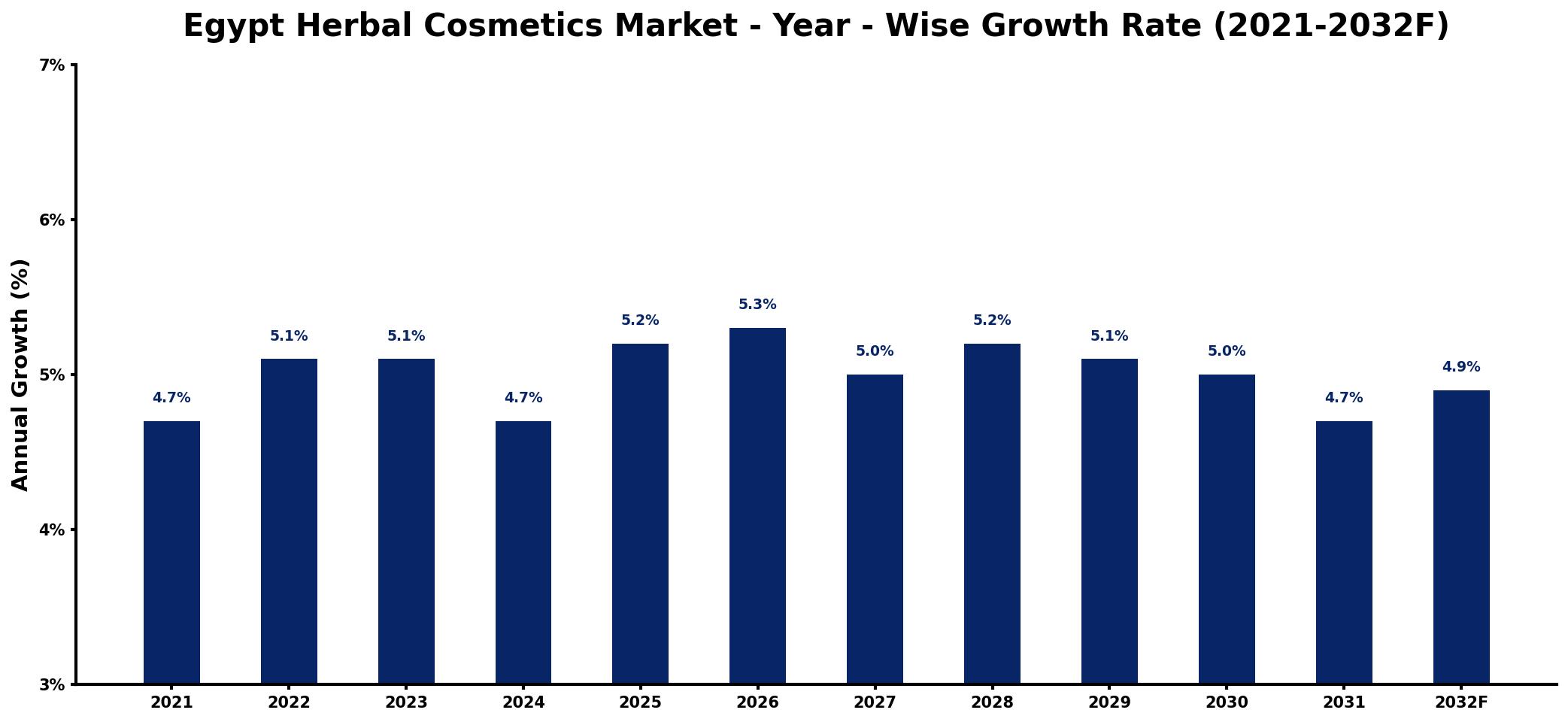
The table below presents the year‑wise growth rates along with the key drivers influencing the market
| Year | Growth Rate | Major Drivers |
| 2021 | 4.7% | Rising consumer health consciousness |
| 2022 | 5.1% | Growing demand for natural ingredients |
| 2023 | 5.1% | Increase in online retail presence |
| 2024 | 4.7% | Expansion of local production facilities |
| 2025 | 5.2% | Increased investment in R&D |
| 2026 | 5.3% | Surge in eco-friendly packaging |
| 2027 | 5.0% | Higher consumer awareness campaigns |
| 2028 | 5.2% | Strengthened distribution network strategies |
| 2029 | 5.1% | Emergence of influencer marketing trends |
| 2030 | 5.0% | Growth in sustainable sourcing practices |
| 2031 | 4.7% | Development of niche market segments |
| 2032 | 4.9% | Adoption of personalized product offerings |
Note: Market size estimations and growth projections presented in this report are based on 6Wresearch's proprietary forecasting methodology, utilizing the latest available industry data, government publications, and primary research inputs.
Egypt Herbal Cosmetics Market Synopsis
In Egypt, the demand for herbal cosmetics is surging, reflecting a growing preference for beauty products that leverage the therapeutic benefits of traditional ingredients. Skincare, haircare, and body care segments are particularly thriving as consumers seek products free from harmful additives.
This market is characterized by the incorporation of local herbal staples such as aloe vera, hibiscus, and chamomile. The increasing focus on sustainability and cruelty-free practices further cements the appeal of herbal cosmetics among a diverse consumer base, from eco-conscious young adults to skincare aficionados.
Egypt Herbal Cosmetics Market Key Takeaways
- The market is driven by a notable consumer trend favoring natural and organic ingredients.
- Traditional Egyptian herbs are becoming increasingly popular among both brands and consumers.
- Product innovation is essential for capturing the attention of the growing segment of herbal beauty enthusiasts.
- Investors are finding ample opportunities for growth in manufacturing and distribution.
- Government policies are supporting the regulation and quality assurance of herbal cosmetic products.
Evaluation of Restraints in Egypt Herbal Cosmetics Market
Despite the promising growth in the Egypt Herbal Cosmetics Market, there are notable challenges that hinder its progress. Regulatory hurdles, particularly regarding ingredient sourcing and strict labeling requirements, can create bottlenecks for product launches. Furthermore, competition from well-established mainstream beauty brands complicates market penetration for herbal cosmetics. Consumer skepticism about the effectiveness of herbal products compared to conventional options also poses a barrier. Ensuring product authenticity and safety is paramount, and the current lack of standardized certifications can exacerbate these concerns. Overcoming these challenges will necessitate enhanced educational initiatives to build consumer trust and investment in quality control measures.
Egypt Herbal Cosmetics Market Trends
The landscape of the Egypt Herbal Cosmetics Market is shaped by current trends that emphasize natural wellness and sustainability. Increasing consumer awareness about the benefits of herbal ingredients is transforming product formulations across various beauty categories. Furthermore, brands are leaning towards innovative packaging that highlights eco-friendliness, which resonates with environmentally aware consumers. The trend of personalized skincare is also gaining traction, as companies seek to tailor products using local herbs to better meet the unique needs of Egyptian consumers. Additionally, the rising interest in beauty routines that integrate traditional Egyptian herbal remedies signals a potential growth area.
Egypt Herbal Cosmetics Market Opportunities
The Egypt Herbal Cosmetics Market presents substantial investment opportunities driven by the increasing consumer demand for organic and sustainable products. Entrepreneurs and established brands can capitalize on this trend by exploring avenues in the manufacturing and distribution of herbal formulations that cater to local preferences. There is also potential in R&D for unique formulations that leverage the rich heritage of Egyptian herbal remedies. Additionally, partnerships with local suppliers of herbal ingredients can enhance product authenticity and appeal. Ultimately, the focus on natural solutions provides fertile ground for business growth and innovation in this market.
Government Initiatives in the Egypt Herbal Cosmetics Market
The Egyptian government is actively fostering the growth of the herbal cosmetics industry through a range of policies aimed at ensuring product safety and quality. Regulations require that all herbal cosmetic products be registered with the Ministry of Health, emphasizing compliance with stringent safety standards. Moreover, the government encourages the use of locally sourced ingredients, thus supporting domestic producers while promoting sustainable practices. This regulatory framework is designed to enhance consumer trust and boost the competitiveness of Egyptian herbal products in both domestic and international markets.
Future Insights of the Egypt Herbal Cosmetics Market
Looking ahead, the Egypt Herbal Cosmetics Market is poised for significant expansion from 2026 to 2032. The increasing consumer inclination towards organic and cruelty-free products is anticipated to fuel market growth. In particular, the youthful demographic in Egypt, with its strong focus on beauty and self-care, is likely to be a key driver. Brands that prioritize innovation and consumer education about the advantages of herbal cosmetics will be well-positioned to capture market share. As awareness surrounding sustainable practices continues to rise, companies that align with these values will find fertile ground for growth.
Egypt Herbal Cosmetics Market Latest Developments (2025 - 2026)
Recently, the Egypt Herbal Cosmetics Market has seen a surge in new product launches focusing on traditional herbal ingredients. Companies are increasingly showcasing the benefits of locally sourced materials in their branding and marketing strategies. There has also been a notable uptick in collaborations among herbal brands to promote education and awareness about natural beauty solutions. As consumer preferences continue to shift towards herbal alternatives, the market is responding with diverse offerings that cater to this demand.
Egypt Herbal Cosmetics Market - Key Attractiveness of the Report
- 10 Years of Market Numbers
- Historical Data Starting from 2022 to 2025
- Base Year: 2025
- Forecast Data until 2032
- Key Performance Indicators Impacting the Market
- Major Upcoming Developments and Projects
Key Highlights of the Report:
- Egypt Herbal Cosmetics Market Outlook
- Market Size of Egypt Herbal Cosmetics Market, 2025
- Forecast of Egypt Herbal Cosmetics Market, 2032
- Historical Data and Forecast of Egypt Herbal Cosmetics Revenues & Volume for the Period 2022-2032F
- Egypt Herbal Cosmetics Market Trend Evolution
- Egypt Herbal Cosmetics Market Drivers and Challenges
- Egypt Herbal Cosmetics Price Trends
- Egypt Herbal Cosmetics Porter's Five Forces
- Egypt Herbal Cosmetics Industry Life Cycle
- Historical Data and Forecast of Egypt Herbal Cosmetics Market Revenues & Volume By Physical State for the Period 2022-2032F
- Historical Data and Forecast of Egypt Herbal Cosmetics Market Revenues & Volume By Solid for the Period 2022-2032F
- Historical Data and Forecast of Egypt Herbal Cosmetics Market Revenues & Volume By Semi-solid for the Period 2022-2032F
- Historical Data and Forecast of Egypt Herbal Cosmetics Market Revenues & Volume By Liquid for the Period 2022-2032F
- Historical Data and Forecast of Egypt Herbal Cosmetics Market Revenues & Volume By Product for the Period 2022-2032F
- Historical Data and Forecast of Egypt Herbal Cosmetics Market Revenues & Volume By Skin Care Product for the Period 2022-2032F
- Historical Data and Forecast of Egypt Herbal Cosmetics Market Revenues & Volume By Hair Care Product for the Period 2022-2032F
- Historical Data and Forecast of Egypt Herbal Cosmetics Market Revenues & Volume By Baby Care Product for the Period 2022-2032F
- Historical Data and Forecast of Egypt Herbal Cosmetics Market Revenues & Volume By Oral Care Product for the Period 2022-2032F
- Historical Data and Forecast of Egypt Herbal Cosmetics Market Revenues & Volume By Make-up Product for the Period 2022-2032F
- Historical Data and Forecast of Egypt Herbal Cosmetics Market Revenues & Volume By Distribution Channel for the Period 2022-2032F
- Historical Data and Forecast of Egypt Herbal Cosmetics Market Revenues & Volume By Supermarket for the Period 2022-2032F
- Historical Data and Forecast of Egypt Herbal Cosmetics Market Revenues & Volume By Pharmacy for the Period 2022-2032F
- Historical Data and Forecast of Egypt Herbal Cosmetics Market Revenues & Volume By Departmental Store for the Period 2022-2032F
- Historical Data and Forecast of Egypt Herbal Cosmetics Market Revenues & Volume By Beauty Spa/Salon for the Period 2022-2032F
- Historical Data and Forecast of Egypt Herbal Cosmetics Market Revenues & Volume By Internet Retailing for the Period 2022-2032F
- Historical Data and Forecast of Egypt Herbal Cosmetics Market Revenues & Volume By Specialty Store for the Period 2022-2032F
- Egypt Herbal Cosmetics Import Export Trade Statistics
- Market Opportunity Assessment By Physical State
- Market Opportunity Assessment By Product
- Market Opportunity Assessment By Distribution Channel
- Egypt Herbal Cosmetics Top Companies Market Share
- Egypt Herbal Cosmetics Competitive Benchmarking By Technical and Operational Parameters
- Egypt Herbal Cosmetics Company Profiles
- Egypt Herbal Cosmetics Key Strategic Recommendations






































